
Game Theory (Stanford Encyclopedia of Philosophy)
Game theory in the form known to economists, social scientists, and
biologists, was given its first general mathematical formulation by
John von Neumann and Oskar Morgenstern
().
For reasons to be discussed later, limitations in their formal
framework initially made the theory applicable only under special and
limited conditions. This situation has dramatically changed, in ways
we will examine as we go along, over the past seven decades, as the
framework has been deepened and generalized. Refinements are still
being made, and we will review a few outstanding problems that lie
along the advancing front edge of these developments towards the end
of the article. However, since at least the late 1970s it has been
possible to say with confidence that game theory is the most important
and useful tool in the analyst’s kit whenever she confronts
situations in which what counts as one agent’s best action (for
her) depends on expectations about what one or more other agents will
do, and what counts as their best actions (for them) similarly depend
on expectations about her.
Despite the fact that game theory has been rendered mathematically and
logically systematic only since 1944, game-theoretic insights can be
found among commentators going back to ancient times. For example, in
two of Plato’s texts, the Laches and the
Symposium, Socrates recalls an episode from the Battle of
Delium that some commentators have interpreted (probably
anachronistically) as involving the following situation. Consider a
soldier at the front, waiting with his comrades to repulse an enemy
attack. It may occur to him that if the defense is likely to be
successful, then it isn’t very probable that his own personal
contribution will be essential. But if he stays, he runs the risk of
being killed or wounded—apparently for no point. On the other
hand, if the enemy is going to win the battle, then his chances of
death or injury are higher still, and now quite clearly to no point,
since the line will be overwhelmed anyway. Based on this reasoning, it
would appear that the soldier is better off running away regardless of
who is going to win the battle. But if all of the soldiers reason this
way—as they all apparently should, since they’re
all in identical situations—then this will certainly bring
about the outcome in which the battle is lost. Of course, this
point, since it has occurred to us as analysts, can occur to the
soldiers too. Does this give them a reason for staying at their posts?
Just the contrary: the greater the soldiers’ fear that the
battle will be lost, the greater their incentive to get themselves out
of harm’s way. And the greater the soldiers’ belief that
the battle will be won, without the need of any particular
individual’s contributions, the less reason they have to stay
and fight. If each soldier anticipates this sort of reasoning
on the part of the others, all will quickly reason themselves into a
panic, and their horrified commander will have a rout on his hands
before the enemy has even engaged.
Long before game theory had come along to show analysts how to think
about this sort of problem systematically, it had occurred to some
actual military leaders and influenced their strategies. Thus the
Spanish conqueror Cortez, when landing in Mexico with a small force
who had good reason to fear their capacity to repel attack from the
far more numerous Aztecs, removed the risk that his troops might think
their way into a retreat by burning the ships on which they had
landed. With retreat having thus been rendered physically impossible,
the Spanish soldiers had no better course of action than to stand and
fight—and, furthermore, to fight with as much determination as
they could muster. Better still, from Cortez’s point of view,
his action had a discouraging effect on the motivation of the Aztecs.
He took care to burn his ships very visibly, so that the Aztecs would
be sure to see what he had done. They then reasoned as follows: Any
commander who could be so confident as to willfully destroy his own
option to be prudent if the battle went badly for him must have good
reasons for such extreme optimism. It cannot be wise to attack an
opponent who has a good reason (whatever, exactly, it might be) for
being sure that he can’t lose. The Aztecs therefore retreated
into the surrounding hills, and Cortez had the easiest possible
victory.
These two situations, at Delium and as manipulated by Cortez, have a
common and interesting underlying logic. Notice that the soldiers are
not motivated to retreat just, or even mainly, by their
rational assessment of the dangers of battle and by their
self-interest. Rather, they discover a sound reason to run away by
realizing that what it makes sense for them to do depends on what it
will make sense for others to do, and that all of the others can
notice this too. Even a quite brave soldier may prefer to run rather
than heroically, but pointlessly, die trying to stem the oncoming tide
all by himself. Thus we could imagine, without contradiction, a
circumstance in which an army, all of whose members are brave, flees
at top speed before the enemy makes a move. If the soldiers really
are brave, then this surely isn’t the outcome any of
them wanted; each would have preferred that all stand and fight. What
we have here, then, is a case in which the interaction of
many individually rational decision-making processes—one process
per soldier—produces an outcome intended by no one. (Many armies
try to avoid this problem just as Cortez did. Since they can’t
usually make retreat physically impossible, they make it
economically irrational: for most of history, it was standard
military practice to execute deserters. In that context standing and
fighting is each soldier’s individually rational course of
action after all, because the expected cost of running is at least as
high as the cost of staying.)
Another classic source that invites this sequence of reasoning is
found in Shakespeare’s Henry V. During the Battle of
Agincourt Henry decided to slaughter his French prisoners, in full
view of the enemy and to the surprise of his subordinates, who
describe the action as being out of moral character. The reasons Henry
gives allude to non-strategic considerations: he is afraid that the
prisoners may free themselves and threaten his position. However, a
game theorist might have furnished him with supplementary strategic
(and similarly prudential, though perhaps not moral) justification.
His own troops observe that the prisoners have been killed, and
observe that the enemy has observed this. Therefore, they know what
fate will await them at the enemy’s hand if they don’t
win. Metaphorically, but very effectively, their boats have been
burnt. The slaughter of the prisoners plausibly sent a signal to the
soldiers of both sides, thereby changing their incentives in ways that
favoured English prospects for victory.
These examples might seem to be relevant only for those who find
themselves in situations of cut-throat competition. Perhaps, one might
think, it is important for generals, politicians, mafiosi, sports
coaches and others whose jobs involve strategic manipulation of
others, but the philosopher should only deplore its amorality. Such a
conclusion would be highly premature, however. The study of the
logic that governs the interrelationships amongst incentives,
strategic interactions and outcomes has been fundamental in modern
political philosophy, since centuries before anyone had an explicit
name for this sort of logic. Philosophers share with social scientists
the need to be able to represent and systematically model not only
what they think people normatively ought to do, but what they
often actually do in interactive situations.
Hobbes’s Leviathan is often regarded as the founding
work in modern political philosophy, the text that began the
continuing round of analyses of the function and justification of the
state and its restrictions on individual liberties. The core of
Hobbes’s reasoning can be given straightforwardly as follows.
The best situation for all people is one in which each is free to do
as she pleases. (One may or may not agree with this as a matter of
psychology or ideology, but it is Hobbes’s assumption.) Often,
such free people will wish to cooperate with one another in order to
carry out projects that would be impossible for an individual acting
alone. But if there are any immoral or amoral agents around, they will
notice that their interests might at least sometimes be best served by
getting the benefits from cooperation and not returning them. Suppose,
for example, that you agree to help me build my house in return for my
promise to help you build yours. After my house is finished, I can
make your labour free to me simply by reneging on my promise. I then
realize, however, that if this leaves you with no house, you will have
an incentive to take mine. This will put me in constant fear of you,
and force me to spend valuable time and resources guarding myself
against you. I can best minimize these costs by striking first and
killing you at the first opportunity. Of course, you can anticipate
all of this reasoning by me, and so have good reason to try to beat me
to the punch. Since I can anticipate this reasoning by
you, my original fear of you was not paranoid; nor was yours
of me. In fact, neither of us actually needs to be immoral to get this
chain of mutual reasoning going; we need only think that there is some
possibility that the other might try to cheat on bargains.
Once a small wedge of doubt enters any one mind, the incentive induced
by fear of the consequences of being preempted—hit
before hitting first—quickly becomes overwhelming on both sides.
If either of us has any resources of our own that the other might
want, this murderous logic can take hold long before we are so silly
as to imagine that we could ever actually get as far as making deals
to help one another build houses in the first place. Left to their own
devices, agents who are at least sometimes narrowly self-interested
can repeatedly fail to derive the benefits of cooperation, and instead
be trapped in a state of ‘war of all against all’, in
Hobbes’s words. In these circumstances, human life, as he
vividly and famously put it, will be “solitary, poor, nasty,
brutish and short.”
Hobbes’s proposed solution to this problem was tyranny. The
people can hire an agent—a government—whose job is to
punish anyone who breaks any promise. So long as the threatened
punishment is sufficiently dire then the cost of reneging on promises
will exceed the cost of keeping them. The logic here is identical to
that used by an army when it threatens to shoot deserters. If all
people know that these incentives hold for most others, then
cooperation will not only be possible, but can be the expected norm,
so that the war of all against all becomes a general peace.
Hobbes pushes the logic of this argument to a very strong conclusion,
arguing that it implies not only a government with the right and the
power to enforce cooperation, but an ‘undivided’
government in which the arbitrary will of a single ruler must impose
absolute obligation on all. Few contemporary political theorists think
that the particular steps by which Hobbes reasons his way to this
conclusion are both sound and valid. Working through these issues
here, however, would carry us away from our topic into details of
contractarian political philosophy. What is important in the present
context is that these details, as they are in fact pursued in
contemporary debates, involve sophisticated interpretation of the
issues using the resources of modern game theory (see, for example,
).
Furthermore, Hobbes’s most basic point, that the fundamental
justification for the coercive authority and practices of governments
is peoples’ own need to protect themselves from what game
theorists call ‘social dilemmas’, is accepted by many, if
not most, political theorists. Notice that Hobbes has not
argued that tyranny is a desirable thing in itself. The structure of
his argument is that the logic of strategic interaction leaves only
two general political outcomes possible: tyranny and anarchy. Sensible
agents then choose tyranny as the lesser of two evils.
The reasoning of the Athenian soldiers, of Cortez, and of
Hobbes’s political agents has a common logic, one derived from
their situations. In each case, the aspect of the environment that is
most important to the agents’ achievement of their preferred
outcomes is the set of expectations and possible reactions to their
strategies by other agents. The distinction between acting
parametrically on a passive world and acting
non-parametrically on a world that tries to act in
anticipation of these actions is fundamental. If you want to kick a
rock down a hill, you need only concern yourself with the rock’s
mass relative to the force of your blow, the extent to which it is
bonded with its supporting surface, the slope of the ground on the
other side of the rock, and the expected impact of the collision on
your foot. The values of all of these variables are independent of
your plans and intentions, since the rock has no interests of its own
and takes no actions to attempt to assist or thwart you. By contrast,
if you wish to kick a person down the hill, then unless that person is
unconscious, bound or otherwise incapacitated, you will likely not
succeed unless you can disguise your plans until it’s too late
for him to take either evasive or forestalling action. Furthermore,
his probable responses should be expected to visit costs upon you,
which you would be wise to consider. Finally, the relative
probabilities of his responses will depend on his expectations about
your probable responses to his responses. (Consider the difference it
will make to both of your reasoning if one or both of you are armed,
or one of you is bigger than the other, or one of you is the
other’s boss.) The logical issues associated with the second
sort of situation (kicking the person as opposed to the rock) are
typically much more complicated, as a simple hypothetical example will
illustrate.
Suppose first that you wish to cross a river that is spanned by three
bridges. (Assume that swimming, wading or boating across are
impossible.) The first bridge is known to be safe and free of
obstacles; if you try to cross there, you will succeed. The second
bridge lies beneath a cliff from which large rocks sometimes fall. The
third is inhabited by deadly cobras. Now suppose you wish to
rank-order the three bridges with respect to their preferability as
crossing-points. Unless you get positive enjoyment from risking your
life—which, without violating any economist’s conception
of rationality, you might well (a complication we’ll take up
later in this article)—then your decision problem here is
straightforward. The first bridge is obviously best, since it is
safest. To rank-order the other two bridges, you require information
about their relative levels of danger. If you can study the frequency
of rock-falls and the movements of the cobras for awhile, you might be
able to calculate that the probability of your being crushed by a rock
at the second bridge is 10% and of being struck by a cobra at the
third bridge is 20%. Your reasoning here is strictly parametric
because neither the rocks nor the cobras are trying to influence your
actions, by, for example, concealing their typical patterns of
behaviour because they know you are studying them. It is obvious what
you should do here: cross at the safe bridge. Now let us complicate
the situation a bit. Suppose that the bridge with the rocks is
immediately before you, while the safe bridge is a day’s
difficult hike upstream. Your decision-making situation here is
slightly more complicated, but it is still strictly parametric. You
have to decide whether the cost of the long hike is worth exchanging
for the penalty of a 10% chance of being hit by a rock. However, this
is all you must decide, and your probability of a successful crossing
is entirely up to you; the environment is not interested in your
plans.
However, if we now complicate the situation by adding a non-parametric
element, it becomes more challenging. Suppose that you are a fugitive
of some sort, and waiting on the other side of the river with a gun is
your pursuer. She will catch and shoot you, let us suppose, only if
she waits at the bridge you try to cross; otherwise, you will escape.
As you reason through your choice of bridge, it occurs to you that she
is over there trying to anticipate your reasoning. It will seem that,
surely, choosing the safe bridge straight away would be a mistake,
since that is just where she will expect you, and your chances of
death rise to certainty. So perhaps you should risk the rocks, since
these odds are much better. But wait … if you can reach this
conclusion, your pursuer, who is just as well-informed as you are, can
anticipate that you will reach it, and will be waiting for you if you
evade the rocks. So perhaps you must take your chances with the
cobras; that is what she must least expect. But, then, no … if
she expects that you will expect that she will least expect this, then
she will most expect it. This dilemma, you realize with dread, is
general: you must do what your pursuer least expects; but whatever you
most expect her to least expect is automatically what she will most
expect. You appear to be trapped in indecision. But what should
console you somewhat here is that, on the other side of the river,
your pursuer is trapped in exactly the same quandary, unable to decide
which bridge to wait at because as soon as she imagines committing to
one, she will notice that if she can find a best reason to pick a
bridge, you can anticipate that same reason and then avoid her.
We know from experience that, in situations such as this, people do
not usually stand and dither in circles forever. As we’ll see
later, there is a unique best solution available to each
player. However, until the 1940s neither philosophers nor economists
knew how to find it mathematically. As a result, economists were
forced to treat non-parametric influences as if they were
complications on parametric ones. This is likely to strike the reader
as odd, since, as our example of the bridge-crossing problem was meant
to show, non-parametric features are often fundamental features of
decision-making problems. Part of the explanation for game
theory’s relatively late entry into the field lies in the
problems with which economists had historically been concerned.
Classical economists, such as Adam Smith and David Ricardo, were
mainly interested in the question of how agents in very large
markets—whole nations—could interact so as to bring about
maximum monetary wealth for themselves. Smith’s basic insight,
that efficiency is best maximized by agents first differentiating
their potential contributions and then freely seeking mutually
advantageous bargains, was mathematically verified in the twentieth
century. However, the demonstration of this fact applies only in
conditions of ‘perfect competition,’ that is, when
individuals or firms face no costs of entry or exit into markets, when
there are no economies of scale, and when no agents’ actions
have unintended side-effects on other agents’ well-being.
Economists always recognized that this set of assumptions is purely an
idealization for purposes of analysis, not a possible state of affairs
anyone could try (or should want to try) to institutionally establish.
But until the mathematics of game theory matured near the end of the
1970s, economists had to hope that the more closely a market
approximates perfect competition, the more efficient it will
be. No such hope, however, can be mathematically or logically
justified in general; indeed, as a strict generalization the
assumption was shown to be false as far back as the 1950s.
This article is not about the foundations of economics, but it is
important for understanding the origins and scope of game theory to
know that perfectly competitive markets have built into them a feature
that renders them susceptible to parametric analysis. Because agents
face no entry costs to markets, they will open shop in any given
market until competition drives all profits to zero. This implies that
if production costs are fixed and demand is exogenous, then agents
have no options about how much to produce if they are trying to
maximize the differences between their costs and their revenues. These
production levels can be determined separately for each agent, so none
need pay attention to what the others are doing; each agent treats her
counterparts as passive features of the environment. The other kind of
situation to which classical economic analysis can be applied without
recourse to game theory is that of a monopoly facing many customers.
Here, as long as no customer has a share of demand large enough to
exert strategic leverage, non-parametric considerations drop out and
the firm’s task is only to identify the combination of price and
production quantity at which it maximizes profit. However, both
perfect and monopolistic competition are very special and unusual
market arrangements. Prior to the advent of game theory, therefore,
economists were severely limited in the class of circumstances to
which they could straightforwardly apply their models.
Philosophers share with economists a professional interest in the
conditions and techniques for the maximization of welfare. In
addition, philosophers have a special concern with the logical
justification of actions, and often actions are justified by reference
to their expected outcomes. (One tradition in moral philosophy,
utilitarianism, is based on the idea that all morally significant
actions are best justified in this way.) Without game theory, both of
these problems resist analysis wherever non-parametric aspects are
relevant. We will demonstrate this shortly by reference to the most
famous (though not the most typical) game, the so-called
Prisoner’s Dilemma, and to other, more typical, games.
In doing this, we will need to introduce, define and illustrate the
basic elements and techniques of game theory.
An economic agent is, by definition, an entity with
preferences. Game theorists, like economists and philosophers
who study practical choice, describe these by means of an abstract
concept called utility. This refers to some ranking, on some
specified scale, of the subjective welfare or change in subjective
welfare that an agent derives from an event. By ‘welfare’
we refer to some normative index of relative alignment between states
of the world and agents’ valuations of the states in question,
justified by reference to some background framework. For example, we
might evaluate the relative welfare of countries (which we might model
as agents for some purposes) by reference to their per capita incomes,
and we might evaluate the relative welfare of an animal, in the
context of predicting and explaining its behavioral dispositions, by
reference to its expected evolutionary fitness. In the case of people,
it is most typical in economics and applications of game theory to
evaluate their relative welfare by reference to their own implicit or
explicit judgments of it. This is why we referred above to
subjective welfare. Consider a person who adores the taste of
pickles but dislikes onions. She might be said to associate higher
utility with states of the world in which, all else being equal, she
consumes more pickles and fewer onions than with states in which she
consumes more onions and fewer pickles. Examples of this kind suggest
that ‘utility’ denotes a measure of subjective
psychological fulfillment, and this is indeed how the concept
was originally interpreted by economists and philosophers influenced
by the utilitarianism of Jeremy Bentham. However, economists in the
early 20th century recognized increasingly clearly that their main
interest was in the market property of decreasing marginal demand,
regardless of whether that was produced by satiated individual
consumers or by some other factors. In the 1930s this motivation of
economists fit comfortably with the dominance of behaviourism and
radical empiricism in psychology and in the philosophy of science
respectively. Behaviourists and radical empiricists objected to the
theoretical use of such unobservable entities as ‘psychological
fulfillment quotients.’ The intellectual climate was thus
receptive to the efforts of the economist Paul Samuelson
()
to redefine utility in such a way that it becomes a purely technical
concept rather than one rooted in speculative psychology. Since
Samuelson’s redefinition became standard in the 1950s, when we
say that an agent acts so as to maximize her utility, we mean by
‘utility’ simply whatever it is that the agent’s
behavior suggests her to consistently act so as to make more probable.
If this looks circular to you, it should: theorists who follow
Samuelson intend the statement ‘agents act so as to
maximize their utility’ as a tautology, where an
‘(economic) agent’ is any entity that can be accurately
described as acting to maximize a utility function, an
‘action’ is any utility-maximizing selection from a set of
possible alternatives, and a‘utility function’ is what an
economic agent maximizes. Like other tautologies occurring in the
foundations of scientific theories, this interlocking (recursive)
system of definitions is useful not in itself, but because it helps to
fix our contexts of inquiry.
Though the behaviourism of the 1930s has since been displaced by
widespread interest in cognitive processes, many theorists continue to
follow Samuelson’s way of understanding utility because they
think it important that game theory apply to any kind of
agent—a person, a bear, a bee, a firm or a country—and not
just to agents with human minds. When such theorists say that agents
act so as to maximize their utility, they want this to be part of the
definition of what it is to be an agent, not an empirical
claim about possible inner states and motivations. Samuelson’s
conception of utility, defined by way of Revealed Preference
Theory (RPT) introduced in his classic paper
()
satisfies this demand.
Economists and others who interpret game theory in terms of RPT should
not think of game theory as an empirical account of the motivations of
some flesh-and-blood actors (such as actual people). Rather, they
should regard game theory as part of the body of mathematics that is
used to model those entities who consistently select elements from
mutually exclusive action sets, resulting in patterns of choices,
which, allowing for some stochasticity and noise, can be statistically
modeled as maximization of utility functions. On this interpretation,
game theory could not be refuted by any empirical observations, since
it is not an empirical theory in the first place. Of course,
observation and experience could lead someone favoring this
interpretation to conclude that game theory is of little help
in describing actual human behavior.
Some other theorists understand the point of game theory differently.
They view game theory as providing an explanatory account of actual
human strategic reasoning processes. For this idea to be applicable,
we must suppose that agents at least sometimes do what they do in
non-parametric settings because game-theoretic logic
recommends certain actions as the ‘rational’ ones. Such an
understanding of game theory incorporates a normative aspect,
since ‘rationality’ is taken to denote a property that an
agent should at least generally want to have. These two very general
ways of thinking about the possible uses of game theory are compatible
with the tautological interpretation of utility maximization. The
philosophical difference is not idle from the perspective of the
working game theorist, however. As we will see in a later section,
those who hope to use game theory to explain strategic
reasoning, as opposed to merely strategic behavior,
face some special philosophical and practical problems.
Since game theory is a technology for formal modeling, we must have a
device for thinking of utility maximization in mathematical terms.
Such a device is called a utility function. We will introduce
the general idea of a utility function through the special case of an
ordinal utility function. (Later, we will encounter utility
functions that incorporate more information.) The utility-map for an
agent is called a ‘function’ because it maps ordered
preferences onto the real numbers. Suppose that agent \(x\)
prefers bundle \(a\) to bundle \(b\) and bundle \(b\) to bundle \(c\).
We then map these onto a list of numbers, where the function maps the
highest-ranked bundle onto the largest number in the list, the
second-highest-ranked bundle onto the next-largest number in the list,
and so on, thus:
\[\begin{align}
\text{bundle } a &\gg 3 \\
\text{bundle } b &\gg 2 \\
\text{bundle } c &\gg 1
\end{align}\]
The only property mapped by this function is order. The
magnitudes of the numbers are irrelevant; that is, it must not be
inferred that \(x\) gets 3 times as much utility from bundle \(a\) as
she gets from bundle \(c\). Thus we could represent exactly the
same utility function as that above by
\[\begin{align}
\text{bundle } a &\gg 7,326 \\
\text{bundle } b &\gg 12.6 \\
\text{bundle } c &\gg -1,000,000
\end{align}\]
The numbers featuring in an ordinal utility function are thus not
measuring any quantity of anything. A utility-function in
which magnitudes do matter is called ‘cardinal’.
Whenever someone refers to a utility function without specifying which
kind is meant, you should assume that it’s ordinal. These are
the sorts we’ll need for the first set of games we’ll
examine. Later, when we come to seeing how to solve games that involve
(ex ante) uncertainty—our river-crossing game from Part
1 above, for example—we’ll need to build cardinal utility
functions. The technique for doing this was given by
,
and was an essential aspect of their invention of game theory. For
the moment, however, we will need only ordinal functions.
All situations in which at least one agent can only act to maximize
her utility through anticipating (either consciously, or just
implicitly in his behavior) the responses to her actions by one or
more other agents is called a game. Agents involved in games
are referred to as players. If all agents have optimal
actions regardless of what the others do, as in purely parametric
situations or conditions of monopoly or perfect competition (see
above) we can model this without appeal to game theory; otherwise, we
need it.
Game theorists assume that players have sets of capacities that are
typically referred to in the literature of economics as comprising
‘rationality’. Usually this is formulated by simple
statements such as ‘it is assumed that players are
rational’. In literature critical of economics in general, or of
the importation of game theory into humanistic disciplines, this kind
of rhetoric has increasingly become a magnet for attack. There is a
dense and intricate web of connections associated with
‘rationality’ in the Western cultural tradition, and
historically the word was often used to normatively marginalize
characteristics as normal and important as emotion, femininity and
empathy. Game theorists’ use of the concept need not, and
generally does not, implicate such ideology. For present purposes we
will use ‘economic rationality’ as a strictly technical,
not normative, term to refer to a narrow and specific set of
restrictions on preferences that are shared by von Neumann and
Morgenstern’s original version of game theory, and RPT.
Economists use a second, equally important (to them) concept of
rationality when they are modeling markets, which they call
‘rational expectations’. In this phrase,
‘rationality’ refers not to restrictions on preferences
but to non-restrictions on information processing: rational
expectations are idealized beliefs that reflect statistically
accurately weighted use of all information available to an agent. The
reader should note that these two uses of one word within the same
discipline are technically unconnected. Furthermore, original RPT has
been specified over the years by several different sets of axioms for
different modeling purposes. Once we decide to treat rationality as a
technical concept, each time we adjust the axioms we effectively
modify the concept. Consequently, in any discussion involving
economists and philosophers together, we can find ourselves in a
situation where different participants use the same word to refer to
something different. For readers new to economics, game theory,
decision theory and the philosophy of action, this situation naturally
presents a challenge.
In this article, ‘economic rationality’ will be used in
the technical sense shared within game theory, microeconomics and
formal decision theory, as follows. An economically rational player is
one who can (i) assess outcomes, in the sense of rank-ordering them
with respect to their contributions to her welfare; (ii) calculate
paths to outcomes, in the sense of recognizing which sequences of
actions are probabilistically associated with which outcomes; and
(iii) select actions from sets of alternatives (which we’ll
describe as ‘choosing’ actions) that yield her
most-preferred outcomes, given the actions of the other players. We
might summarize the intuition behind all this as follows: an entity is
usefully modeled as an economically rational agent to the extent that
it has alternatives, and chooses from amongst these in a way that is
motivated, at least more often than not, by what seems best for its
purposes. For readers who are antecedently familiar with the work of
the philosopher Daniel Dennett, we could equate the idea of an
economically rational agent with the kind of entity Dennett
characterizes as intentional, and then say that we can
usefully predict an economically rational agent’s behavior from
‘the intentional stance’. As will be discussed later, the
intentional stance can be made precise for application to
quantitatively specified choices by drawing, sometimes with special
modifications, on the subjective rationality axioms of
().
Economic rationality might in some cases be satisfied by internal
computations performed by an agent, and she might or might not be
aware of computing or having computed its conditions and implications.
In other cases, economic rationality might simply be embodied in
behavioral dispositions built by natural, cultural or market
selection. In particular, in calling an action ‘chosen’ we
imply no necessary deliberation, conscious or otherwise. We mean
merely that the action was taken when an alternative action was
available, in some sense of ‘available’ normally
established by the context of the particular analysis.
(‘Available’, as used by game theorists and economists,
should never be read as if it meant merely
‘metaphysically’ or ‘logically’ available; it
is almost always pragmatic, contextual and revisable by more refined
modeling.)
Each player in a game faces a choice among two or more possible
strategies. A strategy is a predetermined ‘program of
play’ that tells her what actions to take in response to
every possible strategy other players might use. The
significance of the italicized phrase here will become clear when we
take up some sample games below.
A crucial aspect of the specification of a game involves the
information that players have when they choose strategies. The
simplest games (from the perspective of logical structure) are those
in which agents have perfect information, meaning that at
every point where each agent’s strategy tells her to take an
action, she knows everything that has happened in the game up to that
point. A board-game of sequential moves in which both players watch
all the action (and know the rules in common), such as chess, is an
instance of such a game. By contrast, the example of the
bridge-crossing game from Section 1 above illustrates a game of
imperfect information, since the fugitive must choose a
bridge to cross without knowing the bridge at which the pursuer has
chosen to wait, and the pursuer similarly makes her decision in
ignorance of the choices of her quarry. Since game theory is about
economically rational action given the strategically significant
actions of others, it should not surprise you to be told that what
agents in games believe, or fail to believe, about each others’
actions makes a considerable difference to the logic of our analyses,
as we will see.
The difference between games of perfect and of imperfect information
is related to (though certainly not identical with!) a distinction
between ways of representing games that is based on order
of play. Let us begin by distinguishing between sequential-move
and simultaneous-move games in terms of information. It is natural, as
a first approximation, to think of sequential-move games as being ones
in which players choose their strategies one after the other, and of
simultaneous-move games as ones in which players choose their
strategies at the same time. This isn’t quite right, however,
because what is of strategic importance is not the temporal
order of events per se, but whether and when players know
about other players’ actions relative to having to choose
their own. For example, if two competing businesses are both planning
marketing campaigns, one might commit to its strategy months before
the other does; but if neither knows what the other has committed to
or will commit to when they make their decisions, this is a
simultaneous-move game. Chess, by contrast, is normally played as a
sequential-move game: you see what your opponent has done before
choosing your own next action. (Chess can be turned into a
simultaneous-move game if the players each call moves on a common
board while isolated from one another; but this is a very different
game from conventional chess.)
It was said above that the distinction between sequential-move and
simultaneous-move games is not identical to the distinction between
perfect-information and imperfect-information games. Explaining why
this is so is a good way of establishing full understanding of both
sets of concepts. As simultaneous-move games were characterized in the
previous paragraph, it must be true that all simultaneous-move games
are games of imperfect information. However, some games may contain
mixes of sequential and simultaneous moves. For example, two firms
might commit to their marketing strategies independently and in
secrecy from one another, but thereafter engage in pricing competition
in full view of one another. If the optimal marketing strategies were
partially or wholly dependent on what was expected to happen in the
subsequent pricing game, then the two stages would need to be analyzed
as a single game, in which a stage of sequential play followed a stage
of simultaneous play. Whole games that involve mixed stages of this
sort are games of imperfect information, however temporally staged
they might be. Games of perfect information (as the name implies)
denote cases where no moves are simultaneous (and where no
player ever forgets what has gone before).
As previously noted, games of perfect information are the (logically)
simplest sorts of games. This is so because in such games (as long as
the games are finite, that is, terminate after a known number of
actions) players and analysts can use a straightforward procedure for
predicting outcomes. A player in such a game chooses her first action
by considering each series of responses and counter-responses that
will result from each action open to her. She then asks herself which
of the available final outcomes brings her the highest utility, and
chooses the action that starts the chain leading to this outcome. This
process is called backward induction (because the reasoning
works backwards from eventual outcomes to present choice
problems).
There will be much more to be said about backward induction and its
properties in a later section (when we come to discuss equilibrium and
equilibrium selection). For now, it has been described just so we can
use it to introduce one of the two types of mathematical objects used
to represent games: game trees. A game tree is an example of
what mathematicians call a directed graph. That is, it is a
set of connected nodes in which the overall graph has a direction. We
can draw trees from the top of the page to the bottom, or from left to
right. In the first case, nodes at the top of the page are interpreted
as coming earlier in the sequence of actions. In the case of a tree
drawn from left to right, leftward nodes are prior in the sequence to
rightward ones. An unlabelled tree has a structure of the following
sort:
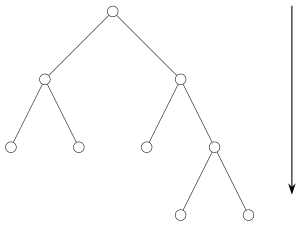
Figure 1
The point of representing games using trees can best be grasped by
visualizing the use of them in supporting backward-induction
reasoning. Just imagine the player (or analyst) beginning at the end
of the tree, where outcomes are displayed, and then working backwards
from these, looking for sets of strategies that describe paths leading
to them. Since a player’s utility function indicates which
outcomes she prefers to which, we also know which paths she will
prefer. Of course, not all paths will be possible because the other
player has a role in selecting paths too, and won’t take actions
that lead to less preferred outcomes for her. We will present some
examples of this interactive path selection, and detailed techniques
for reasoning through these examples, after we have described a
situation we can use a tree to model.
Trees are used to represent sequential games, because they
show the order in which actions are taken by the players. However,
games are sometimes represented on matrices rather than
trees. This is the second type of mathematical object used to
represent games. Matrices, unlike trees, simply show the outcomes,
represented in terms of the players’ utility functions, for
every possible combination of strategies the players might use. For
example, it makes sense to display the river-crossing game from
on a matrix, since in that game both the fugitive and the hunter have
just one move each, and each chooses their move in ignorance of what
the other has decided to do. Here, then, is part of the
matrix:
0,1
1,0
1,0
?
0,1
?
?
?
0,1
Figure 2
The fugitive’s three possible strategies—cross at the safe
bridge, risk the rocks, or risk the cobras—form the rows of the
matrix. Similarly, the hunter’s three possible
strategies—waiting at the safe bridge, waiting at the rocky
bridge and waiting at the cobra bridge—form the columns of the
matrix. Each cell of the matrix shows—or, rather would
show if our matrix was complete—an outcome defined in
terms of the players’ payoffs. A player’s payoff
is simply the number assigned by her ordinal utility function to the
state of affairs corresponding to the outcome in question. For each
outcome, Row’s payoff is always listed first, followed by
Column’s. Thus, for example, the upper left-hand corner above
shows that when the fugitive crosses at the safe bridge and the hunter
is waiting there, the fugitive gets a payoff of 0 and the hunter gets
a payoff of 1. We interpret these by reference to the two
players’ utility functions, which in this game are very simple.
If the fugitive gets safely across the river he receives a payoff of
1; if he doesn’t he gets 0. If the fugitive doesn’t make
it, either because he’s shot by the hunter or hit by a rock or
bitten by a cobra, then the hunter gets a payoff of 1 and the fugitive
gets a payoff of 0.
We’ll briefly explain the parts of the matrix that have been
filled in, and then say why we can’t yet complete the rest.
Whenever the hunter waits at the bridge chosen by the fugitive, the
fugitive is shot. These outcomes all deliver the payoff vector (0, 1).
You can find them descending diagonally across the matrix above from
the upper left-hand corner. Whenever the fugitive chooses the safe
bridge but the hunter waits at another, the fugitive gets safely
across, yielding the payoff vector (1, 0). These two outcomes are
shown in the second two cells of the top row. All of the other cells
are marked, for now, with question marks. Why? The problem
here is that if the fugitive crosses at either the rocky bridge or the
cobra bridge, he introduces parametric factors into the game. In these
cases, he takes on some risk of getting killed, and so producing the
payoff vector (0, 1), that is independent of anything the hunter does.
We don’t yet have enough concepts introduced to be able to show
how to represent these outcomes in terms of utility
functions—but by the time we’re finished we will, and this
will provide the key to solving our puzzle from
.
Matrix games are referred to as ‘normal-form’ or
‘strategic-form’ games, and games as trees are referred to
as ‘extensive-form’ games. The two sorts of games are not
equivalent, because extensive-form games contain
information—about sequences of play and players’ levels of
information about the game structure—that strategic-form games
do not. In general, a strategic-form game could represent any one of
several extensive-form games, so a strategic-form game is best thought
of as being a set of extensive-form games. When order of play
is irrelevant to a game’s outcome, then you should study its
strategic form, since it’s the whole set you want to know about.
Where order of play is relevant, the extensive form
must be specified or your conclusions will be unreliable.
The distinctions described above are difficult to fully grasp if all
one has to go on are abstract descriptions. They’re best
illustrated by means of an example. For this purpose, we’ll use
the most famous of all games: the Prisoner’s Dilemma. It in fact
gives the logic of the problem faced by Cortez’s and Henry
V’s soldiers (see
),
and by Hobbes’s agents before they empower the tyrant. However,
for reasons which will become clear a bit later, you should not take
the PD as a typical game; it isn’t. We use it as an
extended example here only because it’s particularly helpful for
illustrating the relationship between strategic-form and
extensive-form games (and later, for illustrating the relationships
between one-shot and repeated games; see
below).
The name of the Prisoner’s Dilemma game is derived from the
following situation typically used to exemplify it. Suppose that the
police have arrested two people whom they know have committed an armed
robbery together. Unfortunately, they lack enough admissible evidence
to get a jury to convict. They do, however, have enough
evidence to send each prisoner away for two years for theft of the
getaway car. The chief inspector now makes the following offer to each
prisoner: If you will confess to the robbery, implicating your
partner, and she does not also confess, then you’ll go free and
she’ll get ten years. If you both confess, you’ll each get
5 years. If neither of you confess, then you’ll each get two
years for the auto theft.
Our first step in modeling the two prisoners’ situation as a
game is to represent it in terms of utility functions. Following the
usual convention, let us name the prisoners ‘Player I’ and
‘Player II’. Both Player I’s and Player II’s
ordinal utility functions are identical:
\[\begin{align}
\text{Go free } &\gg 4 \\
2 \text{ years } &\gg 3 \\
5 \text{ years } &\gg 2 \\
10 \text{ years } &\gg 0
\end{align}\]
The numbers in the function above are now used to express each
player’s payoffs in the various outcomes possible in
the situation. We can represent the problem faced by both of them on a
single matrix that captures the way in which their separate choices
interact; this is the strategic form of their game:
2,2
4,0
0,4
3,3
Figure 3
Each cell of the matrix gives the payoffs to both players for each
combination of actions. Player I’s payoff appears as the first
number of each pair, Player II’s as the second. So, if both
players confess then they each get a payoff of 2 (5 years in prison
each). This appears in the upper-left cell. If neither of them
confess, they each get a payoff of 3 (2 years in prison each). This
appears as the lower-right cell. If Player I confesses and Player II
doesn’t then Player I gets a payoff of 4 (going free) and Player
II gets a payoff of 0 (ten years in prison). This appears in the
upper-right cell. The reverse situation, in which Player II confesses
and Player I refuses, appears in the lower-left cell.
Each player evaluates his or her two possible actions here by
comparing their personal payoffs in each column, since this shows you
which of their actions is preferable, just to themselves, for each
possible action by their partner. So, observe: If Player II confesses
then Player I gets a payoff of 2 by confessing and a payoff of 0 by
refusing. If Player II refuses, then Player I gets a payoff of 4 by
confessing and a payoff of 3 by refusing. Therefore, Player I is
better off confessing regardless of what Player II does. Player II,
meanwhile, evaluates her actions by comparing her payoffs down each
row, and she comes to exactly the same conclusion that Player I does.
Wherever one action for a player is superior to her other actions for
each possible action by the opponent, we say that the first action
strictly dominates the second one. In the PD, then,
confessing strictly dominates refusing for both players. Both players
know this about each other, thus entirely eliminating any temptation
to depart from the strictly dominated path. Thus both players will
confess, and both will go to prison for 5 years.
The players, and analysts, can predict this outcome using a mechanical
procedure, known as iterated elimination of strictly dominated
strategies. Player 1 can see by examining the matrix that his payoffs
in each cell of the top row are higher than his payoffs in each
corresponding cell of the bottom row. Therefore, it can never be
utility-maximizing for him to play his bottom-row strategy, viz.,
refusing to confess, regardless of what Player II does. Since
Player I’s bottom-row strategy will never be played, we can
simply delete the bottom row from the matrix. Now it is
obvious that Player II will not refuse to confess, since her payoff
from confessing in the two cells that remain is higher than her payoff
from refusing. So, once again, we can delete the one-cell column on
the right from the game. We now have only one cell remaining, that
corresponding to the outcome brought about by mutual confession. Since
the reasoning that led us to delete all other possible outcomes
depended at each step only on the premise that both players are
economically rational—that is, will choose strategies that lead
to higher payoffs over strategies that lead to lower ones—there
are strong grounds for viewing joint confession as the
solution to the game, the outcome on which its play
must converge to the extent that economic rationality
correctly models the behavior of the players. You should note that the
order in which strictly dominated rows and columns are deleted
doesn’t matter. Had we begun by deleting the right-hand column
and then deleted the bottom row, we would have arrived at the same
solution.
It’s been said a couple of times that the PD is not a typical
game in many respects. One of these respects is that all its rows and
columns are either strictly dominated or strictly dominant. In any
strategic-form game where this is true, iterated elimination of
strictly dominated strategies is guaranteed to yield a unique
solution. Later, however, we will see that for many games this
condition does not apply, and then our analytic task is less
straightforward.
The reader will probably have noticed something disturbing about the
outcome of the PD. Had both players refused to confess, they’d
have arrived at the lower-right outcome in which they each go to
prison for only 2 years, thereby both earning higher utility
than either receives when both confess. This is the most important
fact about the PD, and its significance for game theory is quite
general. We’ll therefore return to it below when we discuss
equilibrium concepts in game theory. For now, however, let us stay
with our use of this particular game to illustrate the difference
between strategic and extensive forms.
When people introduce the PD into popular discussions, one will often
hear them say that the police inspector must lock his prisoners into
separate rooms so that they can’t communicate with one another.
The reasoning behind this idea seems obvious: if the players could
communicate, they’d surely see that they’re each better
off if both refuse, and could make an agreement to do so, no? This,
one presumes, would remove each player’s conviction that he or
she must confess because they’ll otherwise be sold up the river
by their partner. In fact, however, this intuition is misleading and
its conclusion is false.
When we represent the PD as a strategic-form game, we implicitly
assume that the prisoners can’t attempt collusive agreement
since they choose their actions simultaneously. In this case,
agreement before the fact can’t help. If Player I is convinced
that his partner will stick to the bargain then he can seize the
opportunity to go scot-free by confessing. Of course, he realizes that
the same temptation will occur to Player II; but in that case he again
wants to make sure he confesses, as this is his only means of avoiding
his worst outcome. The prisoners’ agreement comes to naught
because they have no way of enforcing it; their promises to each other
constitute what game theorists call ‘cheap talk’.
But now suppose that the prisoners do not move
simultaneously. That is, suppose that Player II can choose
after observing Player I’s action. This is the sort of
situation that people who think non-communication important must have
in mind. Now Player II will be able to see that Player I has remained
steadfast when it comes to her choice, and she need not be concerned
about being suckered. However, this doesn’t change anything, a
point that is best made by re-representing the game in extensive form.
This gives us our opportunity to introduce game-trees and the method
of analysis appropriate to them.
First, however, here are definitions of some concepts that will be
helpful in analyzing game-trees:
Node: a point at which a player chooses an action.
Initial node: the point at which the first action in the game
occurs.Terminal node: any node which, if reached, ends the game.
Each terminal node corresponds to an outcome.Subgame: any connected set of nodes and branches descending
uniquely from one node.Payoff: an ordinal utility number assigned to a player at an
outcome.Outcome: an assignment of a set of payoffs, one to each
player in the game.Strategy: a program instructing a player which action to take
at every node in the tree where she could possibly be called on to
make a choice.
These quick definitions may not mean very much to you until you follow
them being put to use in our analyses of trees below. It will probably
be best if you scroll back and forth between them and the examples as
we work through them. By the time you understand each example,
you’ll find the concepts and their definitions natural and
intuitive.
To make this exercise maximally instructive, let’s suppose that
Players I and II have studied the matrix above and, seeing that
they’re both better off in the outcome represented by the
lower-right cell, have formed an agreement to cooperate. Player I is
to commit to refusal first, after which Player II will reciprocate
when the police ask for her choice. We will refer to a strategy of
keeping the agreement as ‘cooperation’, and will denote it
in the tree below with ‘C’. We will refer to a strategy of
breaking the agreement as ‘defection’, and will denote it
on the tree below with ‘D’. Each node is numbered 1, 2, 3,
… , from top to bottom, for ease of reference in discussion.
Here, then, is the tree:
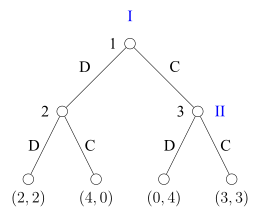
Figure 4
Look first at each of the terminal nodes (those along the bottom).
These represent possible outcomes. Each is identified with an
assignment of payoffs, just as in the strategic-form game, with Player
I’s payoff appearing first in each set and Player II’s
appearing second. Each of the structures descending from the nodes 1,
2 and 3 respectively is a subgame. We begin our backward-induction
analysis—using a technique called Zermelo’s
algorithm—with the sub-games that arise last in the
sequence of play. If the subgame descending from node 3 is played,
then Player II will face a choice between a payoff of 4 and a payoff
of 3. (Consult the second number, representing her payoff, in each set
at a terminal node descending from node 3.) II earns her higher payoff
by playing D. We may therefore replace the entire subgame with an
assignment of the payoff (0,4) directly to node 3, since this is the
outcome that will be realized if the game reaches that node. Now
consider the subgame descending from node 2. Here, II faces a choice
between a payoff of 2 and one of 0. She obtains her higher payoff, 2,
by playing D. We may therefore assign the payoff (2,2) directly to
node 2. Now we move to the subgame descending from node 1. (This
subgame is, of course, identical to the whole game; all games are
subgames of themselves.) Player I now faces a choice between outcomes
(2,2) and (0,4). Consulting the first numbers in each of these sets,
he sees that he gets his higher payoff—2—by playing D. D
is, of course, the option of confessing. So Player I confesses, and
then Player II also confesses, yielding the same outcome as in the
strategic-form representation.
What has happened here intuitively is that Player I realizes that if
he plays C (refuse to confess) at node 1, then Player II will be able
to maximize her utility by suckering him and playing D. (On the tree,
this happens at node 3.) This leaves Player I with a payoff of 0 (ten
years in prison), which he can avoid only by playing D to begin with.
He therefore defects from the agreement.
We have thus seen that in the case of the Prisoner’s Dilemma,
the simultaneous and sequential versions yield the same outcome. This
will often not be true of other games, however. Furthermore, only
finite extensive-form (sequential) games of perfect information can be
solved using Zermelo’s algorithm.
As noted earlier in this section, sometimes we must represent
simultaneous moves within games that are otherwise
sequential. (In all such cases the game as a whole will be one of
imperfect information, so we won’t be able to solve it using
Zermelo’s algorithm.) We represent such games using the device
of information sets. Consider the following tree:
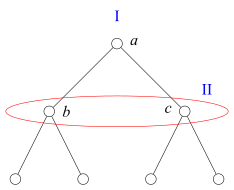
Figure 5
The oval drawn around nodes \(b\) and \(c\) indicates that they lie
within a common information set. This means that at these nodes
players cannot infer back up the path from whence they came; Player II
does not know, in choosing her strategy, whether she is at \(b\) or
\(c\). (For this reason, what properly bear numbers in extensive-form
games are information sets, conceived as ‘action points’,
rather than nodes themselves; this is why the nodes inside the oval
are labelled with letters rather than numbers.) Put another way,
Player II, when choosing, does not know what Player I has done at node
\(a\). But you will recall from earlier in this section that this is
just what defines two moves as simultaneous. We can thus see that the
method of representing games as trees is entirely general. If no node
after the initial node is alone in an information set on its tree, so
that the game has only one subgame (itself), then the whole game is
one of simultaneous play. If at least one node shares its information
set with another, while others are alone, the game involves both
simultaneous and sequential play, and so is still a game of imperfect
information. Only if all information sets are inhabited by just one
node do we have a game of perfect information.
In the Prisoner’s Dilemma, the outcome we’ve represented
as (2,2), indicating mutual defection, was said to be the
‘solution’ to the game. Following the general practice in
economics, game theorists refer to the solutions of games as
equilibria. Philosophically minded readers will want to pose
a conceptual question right here: What is ‘equilibrated’
about some game outcomes such that we are motivated to call them
‘solutions’? When we say that a physical system is in
equilibrium, we mean that it is in a stable state, one in
which all the causal forces internal to the system balance each other
out and so leave it ‘at rest’ until and unless it is
perturbed by the intervention of some exogenous (that is,
‘external’) force. This is what economists have
traditionally meant in talking about ‘equilibria’; they
read economic systems as being networks of mutually constraining
(often causal) relations, just like physical systems, and the
equilibria of such systems are then their endogenously stable states.
(Note that, in both physical and economic systems, endogenously stable
states might never be directly observed because the systems in
question are never isolated from exogenous influences that move and
destabilize them. In both classical mechanics and in economics,
equilibrium concepts are tools for analysis, not predictions
of what we expect to observe.) As we will see in later sections, it is
possible to maintain this understanding of equilibria in the case of
game theory. However, as we noted in Section 2.1, some people
interpret game theory as being an explanatory theory of strategic
reasoning. For them, a solution to a game must be an outcome that a
rational agent would predict using the mechanisms of rational
computation alone. Such theorists face some puzzles about
solution concepts that are less important to the theorist who
isn’t trying to use game theory to under-write a general
analysis of rationality. The interest of philosophers in game theory
is more often motivated by this ambition than is that of the economist
or other scientist.
It’s useful to start the discussion here from the case of the
Prisoner’s Dilemma because it’s unusually simple from the
perspective of the puzzles about solution concepts. What we referred
to as its ‘solution’ is the unique Nash
equilibrium of the game. (The ‘Nash’ here refers to
John Nash, the Nobel Laureate mathematician who in
did most to extend and generalize von Neumann &
Morgenstern’s pioneering work.) Nash equilibrium (henceforth
‘NE’) applies (or fails to apply, as the case may be) to
whole sets of strategies, one for each player in a game. A
set of strategies is a NE just in case no player could improve her
payoff, given the strategies of all other players in the game, by
changing her strategy. Notice how closely this idea is related to the
idea of strict dominance: no strategy could be a NE strategy if it is
strictly dominated. Therefore, if iterative elimination of strictly
dominated strategies takes us to a unique outcome, we know that the
vector of strategies that leads to it is the game’s unique NE.
Now, almost all theorists agree that avoidance of strictly dominated
strategies is a minimum requirement of economic rationality.
A player who knowingly chooses a strictly dominated strategy directly
violates clause (iii) of the definition of economic agency as given in
.
This implies that if a game has an outcome that is a unique
NE, as in the case of joint confession in the PD, that must be its
unique solution. This is one of the most important respects in which
the PD is an ‘easy’ (and atypical) game.
We can specify one class of games in which NE is always not only
necessary but sufficient as a solution concept. These are
finite perfect-information games that are also zero-sum. A
zero-sum game (in the case of a game involving just two players) is
one in which one player can only be made better off by making the
other player worse off. (Tic-tac-toe is a simple example of such a
game: any move that brings one player closer to winning brings her
opponent closer to losing, and vice-versa.) We can determine whether a
game is zero-sum by examining players’ utility functions: in
zero-sum games these will be mirror-images of each other, with one
player’s highly ranked outcomes being low-ranked for the other
and vice-versa. In such a game, if I am playing a strategy such that,
given your strategy, I can’t do any better, and if you are
also playing such a strategy, then, since any change of
strategy by me would have to make you worse off and vice-versa, it
follows that our game can have no solution compatible with our mutual
economic rationality other than its unique NE. We can put this another
way: in a zero-sum game, my playing a strategy that maximizes my
minimum payoff if you play the best you can, and your simultaneously
doing the same thing, is just equivalent to our both playing
our best strategies, so this pair of so-called ‘maximin’
procedures is guaranteed to find the unique solution to the game,
which is its unique NE. (In tic-tac-toe, this is a draw. You
can’t do any better than drawing, and neither can I, if both of
us are trying to win and trying not to lose.)
However, most games do not have this property. It won’t be
possible, in this one article, to enumerate all of the ways
in which games can be problematic from the perspective of their
possible solutions. (For one thing, it is highly unlikely that
theorists have yet discovered all of the possible problems.) However,
we can try to generalize the issues a bit.
First, there is the problem that in most non-zero-sum games, there is
more than one NE, but not all NE look equally plausible as the
solutions upon which strategically alert players would hit. Consider
the strategic-form game below (taken from
(and which we’ll encounter again later under the name
‘Hi-lo’):
10,10
0,0
0,0
1,1
Figure 6
This game has two NE: \(s_1\)-\(t_1\) and \(s_2\)-\(t_2\). (Note that
no rows or columns are strictly dominated here. But if Player I is
playing \(s_1\) then Player II can do no better than \(t_1,\) and
vice-versa; and similarly for the \(s_2\)-\(t_2\) pair.) If NE is our
only solution concept, then we shall be forced to say that either of
these outcomes is equally persuasive as a solution. However, if game
theory is regarded as an explanatory and/or normative theory of
strategic reasoning, this seems to be leaving something out: surely
sensible players with perfect information would converge on
\(s_1\)-\(t_1\)? (Note that this is not like the situation in
the PD, where the socially superior situation is unachievable because
it is not a NE. In the case of the game above, both players have every
reason to try to converge on the NE in which they are better off.)
This illustrates the fact that NE is a relatively (logically)
weak solution concept, often failing to predict intuitively
sensible solutions because, if applied alone, it refuses to allow
players to use principles of equilibrium selection that, if not
demanded by economic rationality—or a more ambitious
philosopher’s concept of rationality—at least seem both
sensible and computationally accessible. Consider another example from
,
p. 397:
10,0
5,2
10,1
2,0
Figure 7
Here, no strategy strictly dominates another. However, Player
I’s top row, \(s_1,\) weakly dominates \(s_2,\) since I
does at least as well using \(s_1\) as \(s_2\) for any reply
by Player II, and on one reply by II (\(t_2\)), I does better. So
should not the players (and the analyst) delete the weakly dominated
row \(s_2\)? When they do so, column \(t_1\) is then strictly
dominated, and the NE \(s_1\)-\(t_2\) is selected as the unique
solution. However, as Kreps goes on to show using this example, the
idea that weakly dominated strategies should be deleted just like
strict ones has odd consequences.
we change the payoffs of the game just a bit, as follows:
10,10
5,2
10,11
2,0
Figure 8
\(s_2\) is still weakly dominated as before; but of our two NE,
\(s_2\)-\(t_1\) is now the most attractive for both players; so why
should the analyst eliminate its possibility? (Note that this game,
again, does not replicate the logic of the PD. There, it
makes sense to eliminate the most attractive outcome, joint refusal to
confess, because both players have incentives to unilaterally deviate
from it, so it is not an NE. This is not true of \(s_2\)-\(t_1\) in
the present game. You should be starting to clearly see why we called
the PD game ‘atypical’.) The argument for
eliminating weakly dominated strategies is that Player 1 may be
nervous, fearing that Player II is not completely sure to be
economically rational (or that Player II fears that Player I
isn’t completely reliably economically rational, or that Player
II fears that Player I fears that Player II isn’t completely
reliably economically rational, and so on ad infinitum) and so might
play \(t_2\) with some positive probability. If the possibility of
departures from reliable economic rationality is taken seriously, then
we have an argument for eliminating weakly dominated strategies:
Player I thereby insures herself against her worst outcome,
\(s_2\)-\(t_2\). Of course, she pays a cost for this insurance,
reducing her expected payoff from 10 to 5. On the other hand, we might
imagine that the players could communicate before playing the game and
agree to coordinate on \(s_2\)-\(t_1\), thereby removing
some, most or all of the uncertainty that encourages elimination of
the weakly dominated row \(s_1\), and eliminating \(s_1\)-\(t_2\) as a
viable solution instead!
Any proposed principle for solving games that may have the effect of
eliminating one or more NE from consideration as solutions is referred
to as a refinement of NE. In the case just discussed,
elimination of weakly dominated strategies is one possible refinement,
since it refines away the NE \(s_2\)-\(t_1\), and correlation is
another, since it refines away the other NE, \(s_1\)-\(t_2\), instead.
So which refinement is more appropriate as a solution concept? People
who think of game theory as an explanatory and/or normative theory of
strategic rationality have generated a substantial literature in which
the merits and drawbacks of a large number of refinements are debated.
In principle, there seems to be no limit on the number of refinements
that could be considered, since there may also be no limits on the set
of philosophical intuitions about what principles a rational agent
might or might not see fit to follow or to fear or hope that other
players are following.
We now digress briefly to make a point about terminology. Theorists
who adopt the revealed preference interpretation of the utility
functions in game theory are sometimes referred to in the philosophy
of economics literature as ‘behaviorists’. This reflects
the fact the revealed preference approaches equate choices with
economically consistent actions, rather than being intended to refer
to mental constructs. Historically, there was a relationship of
comfortable alignment, though not direct theoretical co-construction,
between revealed preference in economics and the methodological and
ontological behaviorism that dominated scientific psychology during
the middle decades of the twentieth century. However, this usage is
increasingly likely to cause confusion due to the more recent rise of
behavioral game theory
(.
This program of research aims to directly incorporate into
game-theoretic models generalizations, derived mainly from experiments
with people, about ways in which people differ from purer economic
agents in the inferences they draw from information
(‘framing’). Applications also typically incorporate
special assumptions about utility functions, also derived from
experiments. For example, players may be taken to be willing to make
trade-offs between the magnitudes of their own payoffs and
inequalities in the distribution of payoffs among the players. We will
turn to some discussion of behavioral game theory in
,
and
.
For the moment, note that this use of game theory crucially rests on
assumptions about psychological representations of value thought to be
common among people. Thus it would be misleading to refer to
behavioral game theory as ‘behaviorist’. But then it just
would invite confusion to continue referring to conventional economic
game theory that relies on revealed preference as
‘behaviorist’ game theory. We will therefore refer to it
as ‘non-psychological’ game theory. We mean by this the
kind of game theory used by most economists who are not
revisionist behavioral economists. (We use the qualifier
‘revisionist’ to reflect the further complication that
increasingly many economists who apply revealed preference concepts
conduct experiments, and some of them call themselves
‘behavioral economists’! For a proposed new set of
conventions to reduce this labeling chaos, see
,
pp. 200–201.) These ‘establishment’ economists
treat game theory as the abstract mathematics of strategic
interaction, rather than as an attempt to directly characterize
special psychological dispositions that might be typical in
humans.
Non-psychological game theorists tend to take a dim view of much of
the refinement program. This is for the obvious reason that it relies
on intuitions about which kinds of inferences people should
find sensible. Like most scientists, non-psychological game theorists
are suspicious of the force and basis of philosophical assumptions as
guides to empirical and mathematical modeling.
Behavioral game theory, by contrast, can be understood as a refinement
of game theory, though not necessarily of its solution concepts, in a
different sense. It restricts the theory’s underlying axioms for
application to a special class of agents, individual, psychologically
typical humans. It motivates this restriction by reference to
inferences, along with preferences, that people do find
natural, regardless of whether these seem rational,
which they frequently do not. Non-psychological and behavioral game
theory have in common that neither is intended to be
normative—though both are often used to try to describe
norms that prevail in groups of players, as well to explain
why norms might persist in groups of players even when they appear to
be less than fully rational to philosophical intuitions. Both see the
job of applied game theory as being to predict outcomes of
empirical games given some distribution of strategic
dispositions, and some distribution of expectations about the
strategic dispositions of others, that are shaped by dynamics in
players’ environments, including institutional pressures and
structures and evolutionary selection. Let us therefore group
non-psychological and behavioral game theorists together, just for
purposes of contrast with normative game theorists, as
descriptive game theorists.
Descriptive game theorists are often inclined to doubt that the goal
of seeking a general theory of rationality makes sense as a
project. Institutions and evolutionary processes build many
environments, and what counts as rational procedure in one environment
may not be favoured in another. On the other hand, an entity that does
not at least stochastically (i.e., perhaps noisily but statistically
more often than not) satisfy the minimal restrictions of economic
rationality cannot, except by accident, be accurately characterized as
aiming to maximize a utility function. To such entities game theory
has no application in the first place.
This does not imply that non-psychological game theorists abjure all
principled ways of restricting sets of NE to subsets based on their
relative probabilities of arising. In particular, non-psychological
game theorists tend to be sympathetic to approaches that shift
emphasis from rationality onto considerations of the informational
dynamics of games. We should perhaps not be surprised that NE analysis
alone often fails to tell us much of applied, empirical interest about
strategic-form games (e.g., Figure 6 above), in which informational
structure is suppressed. Equilibrium selection issues are often more
fruitfully addressed in the context of extensive-form games.
In order to deepen our understanding of extensive-form games, we need
an example with more interesting structure than the PD offers.
Consider the game described by this tree:
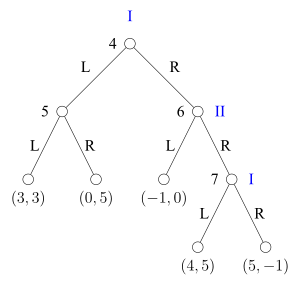
Figure 9
This game is not intended to fit any preconceived situation; it is
simply a mathematical object in search of an application. (L and R
here just denote ‘left’ and ‘right’
respectively.)
Now consider the strategic form of this game:
3,3
3,3
0,5
0,5
3,3
3,3
0,5
0,5
−1,0
4,5
−1,0
4,5
−1,0
5,−1
−1,0
5,−1
Figure 10
If you are confused by this, remember that a strategy must tell a
player what to do at every information set where that player
has an action. Since each player chooses between two actions at each
of two information sets here, each player has four strategies in
total. The first letter in each strategy designation tells each player
what to do if he or she reaches their first information set, the
second what to do if their second information set is reached. I.e., LR
for Player II tells II to play L if information set 5 is reached and R
if information set 6 is reached.
If you examine the matrix in Figure 10, you will discover that (LL,
RL) is among the NE. This is a bit puzzling, since if Player I reaches
her second information set (7) in the extensive-form game, she would
hardly wish to play L there; she earns a higher payoff by playing R at
node 7. Mere NE analysis doesn’t notice this because NE is
insensitive to what happens off the path of play. Player I,
in choosing L at node 4, ensures that node 7 will not be reached; this
is what is meant by saying that it is ‘off the path of
play’. In analyzing extensive-form games, however, we
should care what happens off the path of play, because
consideration of this is crucial to what happens on the path.
For example, it is the fact that Player I would play R if
node 7 were reached that would cause Player II to play L if
node 6 were reached, and this is why Player I won’t choose R at
node 4. We are throwing away information relevant to game solutions if
we ignore off-path outcomes, as mere NE analysis does. Notice that
this reason for doubting that NE is a wholly satisfactory equilibrium
concept in itself has nothing to do with intuitions about rationality,
as in the case of the refinement concepts discussed in Section
2.5.
Now apply Zermelo’s algorithm to the extensive form of our
current example. Begin, again, with the last subgame, that descending
from node 7. This is Player I’s move, and she would choose R
because she prefers her payoff of 5 to the payoff of 4 she gets by
playing L. Therefore, we assign the payoff \((5, -1)\) to node 7. Thus
at node 6 II faces a choice between \((-1, 0)\) and \((5, -1)\). He
chooses L. At node 5 II chooses R. At node 4 I is thus choosing
between (0, 5) and \((-1, 0)\), and so plays L. Note that, as in the
PD, an outcome appears at a terminal node—(4, 5) from node
7—that is Pareto superior to the NE. Again, however, the
dynamics of the game prevent it from being reached.
The fact that Zermelo’s algorithm picks out the strategy vector
(LR, RL) as the unique solution to the game shows that it’s
yielding something other than just an NE. In fact, it is generating
the game’s subgame perfect equilibrium (SPE). It gives
an outcome that yields a NE not just in the whole game but in
every subgame as well. This is a persuasive solution concept because,
again unlike the refinements of Section 2.5, it does not demand
‘extra’ rationality of agents in the sense of expecting
them to have and use philosophical intuitions about ‘what makes
sense’. It does, however, assume that players not only know
everything strategically relevant to their situation but also
use all of that information. In arguments about the
foundations of economics, this is often referred to as an aspect of
rationality, as in the phrase ‘rational expectations’.
But, as noted earlier, it is best to be careful not to confuse the
general normative idea of rationality with computational power and the
possession of budgets, in time and energy, to make the most of it.
An agent playing a subgame perfect strategy simply chooses, at every
node she reaches, the path that brings her the highest payoff in
the subgame emanating from that node. SPE predicts a game’s
outcome just in case, in solving the game, the players foresee that
they will all do that.
A main value of analyzing extensive-form games for SPE is that this
can help us to locate structural barriers to social optimization. In
our current example, Player I would be better off, and Player II no
worse off, at the left-hand node emanating from node 7 than at the SPE
outcome. But Player I’s economic rationality, and Player
II’s awareness of this, blocks the socially efficient outcome.
If our players wish to bring about the more socially efficient outcome
(4, 5) here, they must do so by redesigning their institutions so as
to change the structure of the game. The enterprise of changing
institutional and informational structures so as to make efficient
outcomes more likely in the games that agents (that is, people,
corporations, governments, etc.) actually play is known as
mechanism design, and is one of the leading areas of
application of game theory. The main techniques are reviewed in
,
the first author of which was awarded the Nobel Prize for his
pioneering work in the area.
Many readers, but especially philosophers, might wonder why, in the
case of the example taken up in the previous section, mechanism design
should be necessary unless players are morbidly selfish sociopaths.
Surely, the players might be able to just see that outcome
(4, 5) is socially and morally superior; and since the whole problem
also takes for granted that they can also see the path of actions that
leads to this efficient outcome, who is the game theorist to announce
that, unless their game is changed, it’s unattainable? This
objection, which applies the distinctive idea of rationality urged by
Immanuel Kant, indicates the leading way in which many philosophers
mean more by ‘rationality’ than descriptive game theorists
do. This theme is explored with great liveliness and polemical force
in Binmore
(,
).
This weighty philosophical controversy about rationality is sometimes
confused by misinterpretation of the meaning of ‘utility’
in non-psychological game theory. To root out this mistake, consider
the Prisoner’s Dilemma again. We have seen that in the unique NE
of the PD, both players get less utility than they could have through
mutual cooperation. This may strike you, even if you are not a Kantian
(as it has struck many commentators) as perverse. Surely, you may
think, it simply results from a combination of selfishness and
paranoia on the part of the players. To begin with they have no regard
for the social good, and then they shoot themselves in the feet by
being too untrustworthy to respect agreements.
This way of thinking is very common in popular discussions, and badly
mixed up. To dispel its influence, let us first introduce some
terminology for talking about outcomes. Welfare economists typically
measure social good in terms of Pareto efficiency. A
distribution of utility \(\beta\) is said to be Pareto
superior over another distribution \(\delta\) just in case from
state \(\delta\) there is a possible redistribution of utility to
\(\beta\) such that at least one player is better off in \(\beta\)
than in \(\delta\) and no player is worse off. Failure to move from a
Pareto-inferior to a Pareto-superior distribution is
inefficient because the existence of \(\beta\) as a
possibility, at least in principle, shows that in \(\delta\) some
utility is being wasted. Now, the outcome (3,3) that represents mutual
cooperation in our model of the PD is clearly Pareto superior to
mutual defection; at (3,3) both players are better off than
at (2,2). So it is true that PDs lead to inefficient outcomes. This
was true of our example in Section 2.6 as well.
However, inefficiency should not be associated with immorality. A
utility function for a player is supposed to represent everything
that player cares about, which may be anything at all. As we have
described the situation of our prisoners they do indeed care only
about their own relative prison sentences, but there is nothing
essential in this. What makes a game an instance of the PD is strictly
and only its payoff structure. Thus we could have two Mother Theresa
types here, both of whom care little for themselves and wish only to
feed starving children. But suppose the original Mother Theresa wishes
to feed the children of Calcutta while Mother Juanita wishes to feed
the children of Bogota. And suppose that the international aid agency
will maximize its donation if the two saints nominate the same city,
will give the second-highest amount if they nominate each
others’ cities, and the lowest amount if they each nominate
their own city. Our saints are in a PD here, though hardly selfish or
unconcerned with the social good.
To return to our prisoners, suppose that, contrary to our assumptions,
they do value each other’s well-being as well as their
own. In that case, this must be reflected in their utility functions,
and hence in their payoffs. If their payoff structures are changed so
that, for example, they would feel so badly about contributing to
inefficiency that they’d rather spend extra years in prison than
endure the shame, then they will no longer be in a PD. But all this
shows is that not every possible situation is a PD; it does
not show that selfishness is among the assumptions of game
theory. It is the logic of the prisoners’ situation,
not their psychology, that traps them in the inefficient outcome, and
if that really is their situation then they are stuck in it
(barring further complications to be discussed below). Agents who wish
to avoid inefficient outcomes are best advised to prevent certain
games from arising; the defender of the possibility of Kantian
rationality is really proposing that they try to dig themselves out of
such games by turning themselves into different agents.
In general, then, a game is partly defined by the payoffs
assigned to the players. In any application, such assignments should
be based on sound empirical evidence. If a proposed solution involves
tacitly changing these payoffs, then this ‘solution’ is in
fact a disguised way of changing the subject and evading the
implications of best modeling practice.
Our last point above opens the way to a philosophical puzzle, one of
several that still preoccupy those concerned with the logical
foundations of game theory. It can be raised with respect to any
number of examples, but we will borrow an elegant one from C.
Bicchieri
().
Consider the following game:
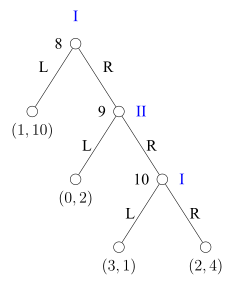
Figure 11
The NE outcome here is at the single leftmost node descending from
node 8. To see this, backward induct again. At node 10, I would play L
for a payoff of 3, giving II a payoff of 1. II can do better than this
by playing L at node 9, giving I a payoff of 0. I can do better than
this by playing L at node 8; so that is what I does, and the game
terminates without II getting to move. A puzzle is then raised by
Bicchieri (along with other authors, including
and
)
by way of the following reasoning. Player I plays L at node 8 because
she knows that Player II is economically rational, and so would, at
node 9, play L because Player II knows that Player I is economically
rational and so would, at node 10, play L. But now we have the
following paradox: Player I must suppose that Player II, at node 9,
would predict Player I’s economically rational play at node 10
despite having arrived at a node (9) that could only be reached if
Player I is not economically rational! If Player I is not economically
rational then Player II is not justified in predicting that Player I
will not play R at node 10, in which case it is not clear that Player
II shouldn’t play R at 9; and if Player II plays R at 9, then
Player I is guaranteed of a better payoff then she gets if she plays L
at node 8. Both players use backward induction to solve the game;
backward induction requires that Player I know that Player II knows
that Player I is economically rational; but Player II can solve the
game only by using a backward induction argument that takes as a
premise the failure of Player I to behave in accordance with economic
rationality. This is the paradox of backward induction.
A standard way around this paradox in the literature is to invoke the
so-called ‘trembling hand’ due to
.
The idea here is that a decision and its consequent act may
‘come apart’ with some nonzero probability, however small.
That is, a player might intend to take an action but then slip up in
the execution and send the game down some other path instead. If there
is even a remote possibility that a player may make a
mistake—that her ‘hand may tremble’—then no
contradiction is introduced by a player’s using a backward
induction argument that requires the hypothetical assumption that
another player has taken a path that an economically rational player
could not choose. In our example, Player II could reason about what to
do at node 9 conditional on the assumption that Player I chose L at
node 8 but then slipped.
points out that the apparent paradox does not arise merely from our
supposing that both players are economically rational. It rests
crucially on the additional premise that each player must know, and
reasons on the basis of knowing, that the other player is economically
rational. This is the premise with which each player’s
conjectures about what would happen off the equilibrium path of play
are inconsistent. A player has reason to consider out-of-equilibrium
possibilities if she either believes that her opponent is economically
rational but his hand may tremble or she attaches some
nonzero probability to the possibility that he is not economically
rational or she attaches some doubt to her conjecture about
his utility function. As Gintis also stresses, this issue with solving
extensive-form games for SEP by Zermelo’s algorithm
generalizes: a player has no reason to play even a Nash
equilibrium strategy unless she expects other players to also play
Nash equilibrium strategies. We will return to this issue in
below.
The paradox of backward induction, like the puzzles raised by
equilibrium refinement, is mainly a problem for those who view game
theory as contributing to a normative theory of rationality
(specifically, as contributing to that larger theory the theory of
strategic rationality). The non-psychological game theorist
can give a different sort of account of apparently
“irrational” play and the prudence it encourages. This
involves appeal to the empirical fact that actual agents, including
people, must learn the equilibrium strategies of games they
play, at least whenever the games are at all complicated. Research
shows that even a game as simple as the Prisoner’s Dilemma
requires learning by people
(,
,
,
p. 265). What it means to say that people must learn equilibrium
strategies is that we must be a bit more sophisticated than was
indicated earlier in constructing utility functions from behavior in
application of Revealed Preference Theory. Instead of constructing
utility functions on the basis of single episodes, we must do so on
the basis of observed runs of behavior once it has
stabilized, signifying maturity of learning for the subjects in
question and the game in question. Once again, the Prisoner’s
Dilemma makes a good example. People encounter few one-shot
Prisoner’s Dilemmas in everyday life, but they encounter many
repeated PD’s with non-strangers. As a result, when set
into what is intended to be a one-shot PD in the experimental
laboratory, people tend to initially play as if the game were a single
round of a repeated PD. The repeated PD has many Nash equilibria that
involve cooperation rather than defection. Thus experimental subjects
tend to cooperate at first in these circumstances, but learn after
some number of rounds to defect. The experimenter cannot infer that
she has successfully induced a one-shot PD with her experimental setup
until she sees this behavior stabilize.
If players of games realize that other players may need to learn game
structures and equilibria from experience, this gives them reason to
take account of what happens off the equilibrium paths of
extensive-form games. Of course, if a player fears that other players
have not learned equilibrium, this may well remove her incentive to
play an equilibrium strategy herself. This raises a set of deep
problems about social learning
().
How can ignorant players learn to play equilibria if sophisticated
players don’t show them, because the sophisticated are not
incentivized to play equilibrium strategies until the ignorant have
learned? The crucial answer in the case of applications of game theory
to interactions among people is that young people are
socialized by growing up in networks of
institutions, including cultural norms. Most complex
games that people play are already in progress among people who were
socialized before them—that is, have learned game structures and
equilibria
().
Novices must then only copy those whose play appears to be expected
and understood by others. Institutions and norms are rich with
reminders, including homilies and easily remembered rules of thumb, to
help people remember what they are doing
.
As noted in
above, when observed behavior does not stabilize around
equilibria in a game, and there is no evidence that learning is still
in process, the analyst should infer that she has incorrectly modeled
the situation she is studying. Chances are that she has either
mis-specified players’ utility functions, the strategies
available to the players, or the information that is available to
them. Given the complexity of many of the situations that social
scientists study, we should not be surprised that mis-specification of
models happens frequently. Applied game theorists must do lots of
learning, just like their subjects.
The paradox of backward induction is one of a family of paradoxes that
arise if one builds possession and use of literally complete
information into a concept of rationality. (Consider, by analogy, the
stock market paradox that arises if we suppose that economically
rational investment incorporates literally rational expectations:
assume that no individual investor can beat the market in the long run
because the market always knows everything the investor knows; then no
one has incentive to gather knowledge about asset values; then no one
will ever gather any such information and so from the assumption that
the market knows everything it follows that the market cannot know
anything!)As we will see in detail in various discussions below, most
applications of game theory explicitly incorporate uncertainty and
prospects for learning by players. The extensive-form games with SPE
that we looked at above are really conceptual tools to help us prepare
concepts for application to situations where complete and perfect
information is unusual. We cannot avoid the paradox if we think, as
some philosophers and normative game theorists do, that one of the
conceptual tools we want to use game theory to sharpen is a fully
general idea of rationality itself. But this is not a concern
entertained by economists and other scientists who put game theory to
use in empirical modeling. In real cases, unless players have
experienced play at equilibrium with one another in the past, even if
they are all economically rational and all believe this about one
another, we should predict that they will attach some positive
probability to the conjecture that understanding of game structures
among some players is imperfect. This then explains why people, even
if they are economically rational agents, may often, or even usually,
play as if they believe in trembling hands.
Learning of equilibria may take various forms for different agents and
for games of differing levels of complexity and risk. Incorporating it
into game-theoretic models of interactions thus introduces an
extensive new set of technicalities. For the most fully developed
general theory, the reader is referred to
;
the same authors provide a non-technical overview of the issues in
.
A first important distinction is between learning specific parameters
between rounds of a repeated game (see
)
with common players, and learning about general strategic
expectations across different games. The latter can include learning
about players if the learner is updating expectations based on her
models of types of players she recurrently encounters. Then
we can distinguish between passive learning, in which a
player merely updates her subjective priors based on her
observation of moves and outcomes, and strategic choices she infers
from these, and active learning, in which she probes—in
technical language screens—for information about other
players’ strategies by choosing strategies that test her
conjectures about what will occur off what she believes to be the
game’s equilibrium path. A major difficulty for both players and
modelers is that screening moves might be misinterpreted if players
are also incentivized to make moves to signal information to
one another (see
).
In other words: trying to learn about strategies can under some
circumstances interfere with players’ abilities to learn
equilibria. Finally, the discussion so far has assumed that all
possible learning in a game is about the structure of the game itself.
shows that if players are learning new information about causal
processes occurring outside a game while simultaneously trying to
update expectations about other players’ strategies, the modeler
can find herself reaching beyond the current limits of technical
knowledge.
It was said above that people might usually play as if they
believe in trembling hands. A very general reason for this is that
when people interact, the world does not furnish them with cue-cards
advising them about the structures of the games they’re playing.
They must make and test conjectures about this from their social
contexts. Sometimes, contexts are fixed by institutional rules. For
example, when a person walks into a retail shop and sees a price tag
on something she’d like to have, she knows without needing to
conjecture or learn anything that she’s involved in a simple
‘take it or leave it’ game. In other markets, she might
know she is expected to haggle, and know the rules for that too.
Given the unresolved complex relationship between learning theory and
game theory, the reasoning above might seem to imply that game theory
can never be applied to situations involving human players that are
novel for them. Fortunately, however, we face no such impasse. In a
pair of influential papers, McKelvey and Palfrey
(,
) developed the solution concept of quantal response
equilibrium (QRE). QRE is not a refinement of NE, in the sense of
being a philosophically motivated effort to strengthen NE by reference
to normative standards of rationality. It is, rather, a method for
calculating the equilibrium properties of choices made by players
whose conjectures about possible errors in the choices of other
players are uncertain. QRE is thus standard equipment in the toolkit
of experimental economists who seek to estimate the distribution of
utility functions in populations of real people placed in situations
modeled as games. QRE would not have been practically serviceable in
this way before the development of econometrics packages such as Stata
(TM) allowed computation of QRE given adequately powerful observation
records from interestingly complex games. QRE is rarely utilized by
behavioral economists, and is almost never used by psychologists, in
analyzing laboratory data. In consequence, many studies by researchers
of these types make dramatic rhetorical points by
‘discovering’ that real people often fail to converge on
NE in experimental games. But NE, though it is a minimalist solution
concept in one sense because it abstracts away from much informational
structure, is simultaneously a demanding empirical expectation if it
is imposed categorically (that is, if players are expected to play as
if they are all certain that all others are playing NE strategies).
Predicting play consistent with QRE is consistent with—indeed,
is motivated by—the view that NE captures the core general
concept of a strategic equilibrium. One way of framing the
philosophical relationship between NE and QRE is as follows. NE
defines a logical principle that is well adapted for
disciplining thought and for conceiving new strategies for generic
modeling of new classes of social phenomena. For purposes of
estimating real empirical data one needs to be able to define
equilibrium statistically. QRE represents one way of doing
this, consistently with the logic of NE. The idea is sufficiently rich
that its depths remain an open domain of investigation by game
theorists. The current state of understanding of QRE is
comprehensively reviewed in
The games we’ve modeled to this point have all involved players
choosing from amongst pure strategies, in which each seeks a
single optimal course of action at each node that constitutes a best
reply to the actions of others. Often, however, a player’s
utility is optimized through use of a mixed strategy, in
which she flips a weighted coin amongst several possible actions. (We
will see later that there is an alternative interpretation of mixing,
not involving randomization at a particular information set; but we
will start here from the coin-flipping interpretation and then build
on it in
.)
Mixing is called for whenever no pure strategy maximizes the
player’s utility against all opponent strategies. Our
river-crossing game from
exemplifies this. As we saw, the puzzle in that game consists in the
fact that if the fugitive’s reasoning selects a particular
bridge as optimal, his pursuer must be assumed to be able to duplicate
that reasoning. The fugitive can escape only if his pursuer cannot
reliably predict which bridge he’ll use. Symmetry of logical
reasoning power on the part of the two players ensures that the
fugitive can surprise the pursuer only if it is possible for him to
surprise himself.
Suppose that we ignore rocks and cobras for a moment, and imagine that
the bridges are equally safe. Suppose also that the fugitive has no
special knowledge about his pursuer that might lead him to venture a
specially conjectured probability distribution over the
pursuer’s available strategies. In this case, the
fugitive’s best course is to roll a three-sided die, in which
each side represents a different bridge (or, more conventionally, a
six-sided die in which each bridge is represented by two sides). He
must then pre-commit himself to using whichever bridge is selected by
this randomizing device. This fixes the odds of his survival
regardless of what the pursuer does; but since the pursuer has no
reason to prefer any available pure or mixed strategy, and since in
any case we are presuming her epistemic situation to be symmetrical to
that of the fugitive, we may suppose that she will roll a three-sided
die of her own. The fugitive now has a 2/3 probability of escaping and
the pursuer a 1/3 probability of catching him. Neither the fugitive
nor the pursuer can improve their chances given the other’s
randomizing mix, so the two randomizing strategies are in Nash
equilibrium. Note that if one player is randomizing then the
other does equally well on any mix of probabilities over
bridges, so there are infinitely many combinations of best replies.
However, each player should worry that anything other than a random
strategy might be coordinated with some factor the other player can
detect and exploit. Since any non-random strategy is exploitable by
another non-random strategy, in a zero-sum game such as our example,
only the vector of randomized strategies is a NE.
Now let us re-introduce the parametric factors, that is, the falling
rocks at bridge #2 and the cobras at bridge #3. Again, suppose that
the fugitive is sure to get safely across bridge #1, has a 90% chance
of crossing bridge #2, and an 80% chance of crossing bridge #3. We can
solve this new game if we make certain assumptions about the two
players’ utility functions. Suppose that Player 1, the fugitive,
cares only about living or dying (preferring life to death) while the
pursuer simply wishes to be able to report that the fugitive is dead,
preferring this to having to report that he got away. (In other words,
neither player cares about how the fugitive lives or dies.)
Suppose also for now that neither player gets any utility or
disutility from taking more or less risk. In this case, the fugitive
simply takes his original randomizing formula and weights it according
to the different levels of parametric danger at the three bridges.
Each bridge should be thought of as a lottery over the
fugitive’s possible outcomes, in which each lottery has a
different expected payoff in terms of the items in his
utility function.
Consider matters from the pursuer’s point of view. She will be
using her NE strategy when she chooses the mix of probabilities over
the three bridges that makes the fugitive indifferent among his
possible pure strategies. The bridge with rocks is 1.1 times more
dangerous for him than the safe bridge. Therefore, he will be
indifferent between the two when the pursuer is 1.1 times more likely
to be waiting at the safe bridge than the rocky bridge. The cobra
bridge is 1.2 times more dangerous for the fugitive than the safe
bridge. Therefore, he will be indifferent between these two bridges
when the pursuer’s probability of waiting at the safe bridge is
1.2 times higher than the probability that she is at the cobra bridge.
Suppose we use \(s_1\), \(s_2\) and \(s_3\) to represent the
fugitive’s parametric survival rates at each bridge. Then the
pursuer minimizes the net survival rate across any pair of bridges by
adjusting the probabilities p1 and p2 that she will wait at them so
that
\[
s_1 (1 – p_1) = s_2 (1 – p_2)
\]
Since \(p_1 + p_2 = 1\), we can rewrite this as
\[
s_1 \times p_2 = s_2 \times p_1
\]
so
\[
\frac{p_1}{s_1} = \frac{p_2}{s_2}.
\]
Thus the pursuer finds her NE strategy by solving the following
simultaneous equations:
\[\begin{align}
1(1-p_1) &= 0.9(1-p_2) \\
&=0.8(1-p_3)
\end{align}\]
\[
p_1 + p_2 + p_3 = 1
\]
Then
\[\begin{align}
p_1 &= \frac{49}{121} \\
p_2 &= \frac{41}{121} \\
p_3 &= \frac{31}{121}
\end{align}\]
Now let \(f_1\), \(f_2\), \(f_3\) represent the probabilities with
which the fugitive chooses each respective bridge. Then the fugitive
finds his NE strategy by solving
\[\begin{align}
s_1 \times f_1 &= s_2 \times f_2 \\
&= s_3 \times f_3
\end{align}\]
so
\[\begin{align}
1 \times f_1 &= 0.9 \times f_2 \\
&= 0.8 \times f_3
\end{align}\]
simultaneously with
\[
f_1 + f_2 + f_3 = 1
\]
Then
\[\begin{align}
f_1 &= \frac{36}{121} \\
f_2 &= \frac{40}{121} \\
f_3 &= \frac{45}{121}
\end{align}\]
These two sets of NE probabilities tell each player how to weight his
or her die before throwing it. Note the—perhaps
surprising—result that the fugitive, though by hypothesis he
gets no enjoyment from gambling, uses riskier bridges with higher
probability. This is the only way of making the pursuer
indifferent over which bridge she stakes out, which in turn is what
maximizes the fugitive’s probability of survival.
We were able to solve this game straightforwardly because we set the
utility functions in such a way as to make it zero-sum, or
strictly competitive. That is, every gain in expected utility
by one player represents a precisely symmetrical loss by the other.
However, this condition may often not hold. Suppose now that the
utility functions are more complicated. The pursuer most prefers an
outcome in which she shoots the fugitive and so claims credit for his
apprehension to one in which he dies of rockfall or snakebite; and she
prefers this second outcome to his escape. The fugitive prefers a
quick death by gunshot to the pain of being crushed or the terror of
an encounter with a cobra. Most of all, of course, he prefers to
escape. Suppose, plausibly, that the fugitive cares more
strongly about surviving than he does about getting killed
one way rather than another. We cannot solve this game, as before,
simply on the basis of knowing the players’ ordinal utility
functions, since the intensities of their respective
preferences will now be relevant to their strategies.
Prior to the work of
,
situations of this sort were inherently baffling to analysts. This is
because utility does not denote a hidden psychological variable such
as pleasure. As we discussed in
,
utility is merely a measure of relative behavioural dispositions
given certain consistency assumptions about relations between
preferences and choices. It therefore makes no sense to imagine
comparing our players’ cardinal—that is,
intensity-sensitive—preferences with one another’s, since
there is no independent, interpersonally constant yardstick we could
use. How, then, can we model games in which cardinal information is
relevant? After all, modeling games requires that all players’
utilities be taken simultaneously into account, as we’ve
seen.
A crucial aspect of
work was the solution to this problem. Here, we will provide a brief
outline of their ingenious technique for building cardinal utility
functions out of ordinal ones. It is emphasized that what follows is
merely an outline, so as to make cardinal utility
non-mysterious to you as a student who is interested in knowing about
the philosophical foundations of game theory, and about the range of
problems to which it can be applied. Providing a manual you could
follow in building your own cardinal utility functions would
require many pages. Such manuals are available in many textbooks.
Suppose that we now assign the following ordinal utility function to
the river-crossing fugitive:
\[\begin{align}
\text{Escape} &\gg 4 \\
\text{Death by shooting} &\gg 3 \\
\text{Death by rockfall} &\gg 2 \\
\text{Death by snakebite} &\gg 1
\end{align}\]
We are supposing that his preference for escape over any form
of death is stronger than his preferences between causes of death.
This should be reflected in his choice behaviour in the following way.
In a situation such as the river-crossing game, he should be willing
to run greater risks to increase the relative probability of escape
over shooting than he is to increase the relative probability of
shooting over snakebite. This bit of logic is the crucial insight
behind
solution to the cardinalization problem.
Suppose we asked the fugitive to pick, from the available set of
outcomes, a best one and a worst one.
‘Best’ and ‘worst’ are defined in terms of
expected payoffs as illustrated in our current zero-sum game example:
a player maximizes his expected payoff if, when choosing among
lotteries that contain only two possible prizes, he always chooses so
as to maximize the probability of the best outcome—call this
\(\mathbf{W}\)—and to minimize the probability of the worst
outcome—call this \(\mathbf{L}\). Now imagine expanding the set
of possible prizes so that it includes prizes that the agent values as
intermediate between \(\mathbf{W}\) and \(\mathbf{L}\). We find, for a
set of outcomes containing such prizes, a lottery over them such that
our agent is indifferent between that lottery and a lottery including
only \(\mathbf{W}\) and \(\mathbf{L}\). In our example, this is a
lottery that includes being shot and being crushed by rocks. Call this
lottery \(\mathbf{T}\) . We define a utility function \(q =
u(\mathbf{T})\) from outcomes to the real (as opposed to ordinal)
number line such that if \(q\) is the expected prize in
\(\mathbf{T}\), the agent is indifferent between winning
\(\mathbf{T}\) and winning a lottery \(\mathbf{T}^*\) in which
\(\mathbf{W}\) occurs with probability \(u(\mathbf{T})\) and
\(\mathbf{L}\) occurs with probability \(1-u(\mathbf{T})\). Assuming
that the agent’s behaviour respects the principle of
reduction of compound lotteries (ROCL)—that is, he does
not gain or lose utility from considering more complex lotteries
rather than simple ones—the set of mappings of outcomes in
\(\mathbf{T}\) to \(u\mathbf{T}^*\) gives a von Neumann-Morgenstern
utility function (vNMuf) with cardinal structure over all outcomes in
\(\mathbf{T}\).
What exactly have we done here? We’ve given our agent choices
over lotteries, instead of directly over resolved outcomes, and
observed how much extra risk of death he’s willing to run to
change the odds of getting one form of death relative to an
alternative form of death. Note that this cardinalizes the
agent’s preference structure only relative to agent-specific
reference points \(\mathbf{W}\) and \(\mathbf{L}\); the procedure
reveals nothing about comparative extra-ordinal preferences
between agents, which helps to make clear that constructing a
vNMuf does not introduce a potentially objective psychological
element. Furthermore, two agents in one game, or one agent under
different sorts of circumstances, may display varying attitudes to
risk. Perhaps in the river-crossing game the pursuer, whose life is
not at stake, will enjoy gambling with her glory while our fugitive is
cautious. In analyzing the river-crossing game, however, we
don’t have to be able to compare the pursuer’s
cardinal utilities with the fugitive’s. Both agents, after all,
can find their NE strategies if they can estimate the probabilities
each will assign to the actions of the other. This means that each
must know both vNMufs; but neither need try to comparatively value the
outcomes over which they’re choosing.
We can now fill in the rest of the matrix for the bridge-crossing game
that we started to draw in Section 2. If both players are risk-neutral
and their revealed preferences respect ROCL, then we have enough
information to be able to assign expected utilities, expressed by
multiplying the original payoffs by the relevant probabilities, as
outcomes in the matrix. Suppose that the hunter waits at the cobra
bridge with probability \(x\) and at the rocky bridge with probability
\(y\). Since her probabilities across the three bridges must sum to 1,
this implies that she must wait at the safe bridge with probability
\(1 – (x + y)\). Then, continuing to assign the fugitive a payoff of 0
if he dies and 1 if he escapes, and the hunter the reverse payoffs,
our complete matrix is as follows:
0,1
1,0
1,0
0.9,0.1
0,1
0.9,0.1
0.8,0.2
0.8,0.2
0,1
Figure 12
We can now read the following facts about the game directly from the
matrix. No pair of pure strategies is a pair of best replies to the
other. Therefore, the game’s only NE require at least one player
to use a mixed strategy.
In all of our examples and workings to this point, we have presupposed
that players’ beliefs about probabilities in lotteries match
objective probabilities. But in real interactive choice situations,
agents must often rely on their subjective estimations or perceptions
of probabilities. In one of the greatest contributions to
twentieth-century behavioral and social science,
showed how to incorporate subjective probabilities, and their
relationships to preferences over risk, within the framework of von
Neumann-Morgenstern expected utility theory. Indeed, Savage’s
achievement amounts to the formal completion of EUT. Then, just over a
decade later,
showed how to solve games involving maximizers of Savage expected
utility. This is often taken to have marked the true maturity of game
theory as a tool for application to behavioral and social science, and
was recognized as such when Harsanyi joined Nash and Selten as a
recipient of the first Nobel prize awarded to game theorists in
1994.
As we observed in considering the need for people playing games to
learn trembling hand equilibria and QRE, when we model the strategic
interactions of people we must allow for the fact that people are
typically uncertain about their models of one another. This
uncertainty is reflected in their choices of strategies. Furthermore,
some actions might be taken specifically for the sake of learning
about the accuracy of a player’s conjectures about other
players. Harsanyi’s extension of game theory incorporates these
crucial elements.
Consider the three-player imperfect-information game below known as
‘Selten’s horse’ (for its inventor, Nobel Laureate
Reinhard Selten, and because of the shape of its tree; taken from
,
p. 426):
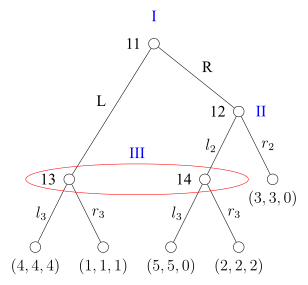
Figure 13
This game has four NE: \((\mathrm{L}, l_2, l_3),\) \((\mathrm{L}, r_2,
l_3),\) \((\mathrm{R}, r_2, l_3)\) and \((\mathrm{R}, r_2, r_3).\)
Consider the fourth of these NE. It arises because when Player I plays
R and Player II plays \(r_2\), Player III’s entire information
set is off the path of play, and it doesn’t matter to the
outcome what Player III does. But Player I would not play R if Player
III could tell the difference between being at node 13 and being at
node 14. The structure of the game incentivizes efforts by Player I to
supply Player III with information that would open up her closed
information set. Player III should believe this information because
the structure of the game shows that Player I has incentive to
communicate it truthfully. The game’s solution would then be the
SPE of the (now) perfect information game: \((\mathrm{L}, r_2, l_3).\)
Theorists who think of game theory as part of a normative theory of
general rationality, for example most philosophers, and refinement
program enthusiasts among economists, have pursued a strategy that
would identify this solution on general principles. Notice what Player
III in Selten’s Horse might wonder about as he selects his
strategy. “Given that I get a move, was my action node reached
from node 11 or from node 12?” What, in other words, are the
conditional probabilities that Player III is at node 13 or 14
given that he has a move? Now, if conditional probabilities are what
Player III wonders about, then what Players I and II might make
conjectures about when they select their strategies are
Player III’s beliefs about these conditional
probabilities. In that case, Player I must conjecture about Player
II’s beliefs about Player III’s beliefs, and Player
III’s beliefs about Player II’s beliefs and so on. The
relevant beliefs here are not merely strategic, as before, since they
are not just about what players will do given a set of
payoffs and game structures, but about what understanding of
conditional probability they should expect other players to operate
with.
What beliefs about conditional probability is it reasonable for
players to expect from each other? If we follow
we would suggest as a normative principle that they should reason and
expect others to reason in accordance with Bayes’s
rule. This tells them how to compute the probability of an event
\(F\) given information \(E\) (written ‘\(pr(F\mid
E)\)’):
\[
pr(F\mid E) = \frac{pr(E\mid F) \times pr(F)}{pr(E)}
\]
We will put Bayes’s Rule to work on an example immediately
below. But first some theoretical discussion of its general
significance in game theory is in order. In Section 2.8 we saw that a
range of complications are introduced into game theory when players
have scope for learning. This is an understatement: the
majority of the purely theoretical literature in game theory over the
past four decades has concerned the complications in question. This is
partly because the issues are deep and difficult, and partly because
most actual strategic situations to which game theory is most usefully
applied do in fact call upon players to learn. When people (or other
animals) get embroiled in strategic interactions, the world
doesn’t typically furnish unambiguous information about game
structures. In particular, it doesn’t, so to speak, stamp
players’ utility functions on their foreheads. When players are
unsure of the structure of the games they play, which depends on the
utility vectors of all players, we say that their information is
incomplete.
In addition, players might not know some parametric probability
distributions that are relevant to their strategy choices. In the
example of the river-crossing game just discussed, we supposed that
both players know ex ante (i.e., when they select their
strategies) the probabilities with which rocks fall and cobras strike.
In an actual situation of the kind imagined, this is unlikely. Both
players might study both risk bridges for awhile to gather information
about the probability distributions of the dangerous (to the fugitive)
events. But estimates may be biased unless samples are very large and
probabilities are stationary (e.g., rockfalls don’t become less
frequent as more exposed rocks fall). When players are uncertain about
parametric contingencies, we model this in an extensive-form game by
adding an additional player, usually called ‘Nature’, that
has no utility function, and hence no stake in the game’s
outcome, and that draws actions randomly relative to some specified
probability distribution. We can allow that strategic players (i.e.,
players other than Nature) might have to make choices without knowing
what Nature has drawn for them by putting Nature’s range of
moves within a single information set, just as we do for strategic
choices in an extensive-form game where some moves are simultaneous,
as in Figure 13 above. Then players’uncertainty about parametric
factors is modelled as imperfect information.
Finally, if strategic players’estimates of uncertain parameters
are independent, each player’s estimate is potentially
informative to the other player. In a repeated game, players can
acquire information about one anothers’estimates of the
parametric probabilities by observing one anothers’choices.
Suppose, for example, that in our river-crossing game there is a
succession of fugitives, and successful escapees send reports back to
those who follow them. Now imagine that the Pursuer is surprised to
find Fugitives choosing the rocky bridge much less often than she
expected. If she assumes that the Fugitives are economically rational,
then she should update her estimate of the probability of
rockfalls; evidently it was too low. Then, of course, she should
adjust her strategy accordingly. This information is available to both
the Pursuer and the Fugitives, so as updating is effected the
equilibria of the game change. In particular, because the
extent of prior uncertainty is reduced by updating, the range
of outcomes compatible with equilibrium shrinks, and so an equilibrium
is more likely to be found by real-life agents.
Because Bayes’s Rule is a principle to govern learning, it can
be relevant to games where at least some players have information that
is either imperfect or incomplete. Where only imperfect information is
concerned, a theory of subjective expected utility that follows or
modifies Savage’s axioms applies directly. This is the subject
of the remainder of this section. Incomplete information raises deeper
challenges, which we will consider in later sections. But our
repeated-game example above allows for a particularly interesting and
powerful application of Bayes’s Rule. If players know that other
players follow Bayes’s Rule in updating their beliefs,
and utility depends exclusively on information, then when
players received shared signals they can jointly solve their strategic
problems by identifying what Aumann
(,
) called ‘correlated equilibrium’.
For now, to illustrate use of Bayes’s Rule in the most
straightforward kind of case, imperfect information without Nature in
extensive-form games, we’ll start with Selten’s Horse
(i.e., Figure 13). If we assume that players’ beliefs are
consistent with Bayes’s Rule, then we may define a
sequential equilibrium as a solution to the game. A SE has
two parts: (1) a strategy profile § for each player, as before,
and (2) a system of beliefs \(\mu\) for each player. \(\mu\)
assigns to each information set \(h\) a probability distribution over
the nodes in \(h\), with the interpretation that these are the beliefs
of player \(i(h)\) about where in her information set she is, given
that information set \(h\) has been reached. Then a sequential
equilibrium is a profile of strategies § and a system of beliefs
\(\mu\) consistent with Bayes’s rule such that starting from
every information set \(h\) in the tree player \(i(h)\) plays
optimally from then on, given that what she believes to have
transpired previously is given by \(\mu(h)\) and what will transpire
at subsequent moves is given by §.
Consider again the NE that we previously identified for Selten’s
Horse, \((\mathrm{R}, r_2, r_3).\) Suppose that Player III assigns
pr(1) to her belief that if she gets a move she is at node 13. Then
Player I, given a consistent \(\mu(I),\) must believe that Player III
will play \(l_3\), in which case her only SE strategy is L. So
although \((\mathrm{R}, r_2, l_3)\) is a NE, it is not a SE.
The use of the consistency requirement in this example is somewhat
trivial, so consider now a second case (also taken from
,
p. 429):
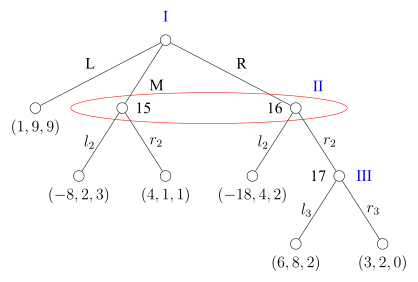
Figure 14
Suppose that Player I plays L, Player II plays \(l_2\) and Player III
plays \(l_3\). Suppose also that \(\mu\)(II) assigns \(pr(.3)\) to
node 16. In that case, \(l_2\) is not a SE strategy for Player II,
since \(l_2\) returns an expected payoff of \(.3(4) + .7(2) = 2.6,\)
while \(r_2\) brings an expected payoff of 3.1. Notice that if we
fiddle the strategy profile for player III while leaving everything
else fixed, \(l_2\) could become a SE strategy for Player II.
If §(III) yielded a play of \(l_3\) with \(pr(.5)\) and \(r_3\)
with \(pr(.5),\) then if Player II plays \(r_2\) his expected payoff
would now be 2.2, so \((\mathrm{L},l_2,l_3)\) would be a SE. Now
imagine setting \(\mu\)(III) back as it was, but change \(\mu\)(II) so
that Player II thinks the conditional probability of being at node 16
is greater than .5; in that case, \(l_2\) is again not a SE
strategy.
The idea of SE is hopefully now clear. We can apply it to the
river-crossing game in a way that avoids the necessity for the pursuer
to flip any coins if we modify the game a bit. Suppose now that the
pursuer can change bridges twice during the fugitive’s passage,
and will catch him just in case she meets him as he leaves the bridge.
Then the pursuer’s SE strategy is to divide her time at the
three bridges in accordance with the proportion given by the equation
in the third paragraph of Section 3 above.
It must be noted that since Bayes’s rule cannot be applied to
events with probability 0, its application to SE requires that players
assign non-zero probabilities to all actions available in extensive
form. This requirement is captured by supposing that all strategy
profiles be strictly mixed, that is, that every action at
every information set be taken with positive probability. You will see
that this is just equivalent to supposing that all hands sometimes
tremble, or alternatively that no expectations are quite certain. A SE
is said to be trembling-hand perfect if all strategies played
at equilibrium are best replies to strategies that are strictly mixed.
You should also not be surprised to be told that no weakly dominated
strategy can be trembling-hand perfect, since the possibility of
trembling hands gives players the most persuasive reason for avoiding
such strategies.
How can the non-psychological game theorist understand the concept of
an NE that is an equilibrium in both actions and beliefs? Decades of
experimental study have shown that when human subjects play games,
especially games that ideally call for use of Bayes’s rule in
making conjectures about other players’ beliefs, we should
expect significant heterogeneity in strategic responses.
Multiple kinds of informational channels typically link different
agents with the incentive structures in their environments. Some
agents may actually compute equilibria, with more or less error.
Others may settle within error ranges that stochastically drift around
equilibrium values through more or less myopic conditioned learning.
Still others may select response patterns by copying the behavior of
other agents, or by following rules of thumb that are embedded in
cultural and institutional structures and represent historical
collective learning. Note that the issue here is specific to game
theory, rather than merely being a reiteration of a more general
point, which would apply to any behavioral science, that people behave
noisily from the perspective of ideal theory. In a given game, whether
it would be rational for even a trained, self-aware, computationally
well resourced agent to play NE would depend on the frequency with
which he or she expected others to do likewise. If she expects some
other players to stray from NE play, this may give her a reason to
stray herself. Instead of predicting that human players will reveal
strict NE strategies, the experienced experimenter or modeler
anticipates that there will be a relationship between their play and
the expected costs of departures from NE. Consequently, maximum
likelihood estimation of observed actions typically identifies a QRE
as providing a better fit than any NE.
An analyst handling empirical data in this way should not be
interpreted as ‘testing the hypothesis’ that the agents
under analysis are ‘rational’. Rather, she conjectures
that they are agents, that is, that there is a systematic relationship
between changes in statistical patterns in their behavior and some
risk-weighted cardinal rankings of possible goal-states. If the agents
are people or institutionally structured groups of people that monitor
one another and are incentivized to attempt to act collectively, these
conjectures will often be regarded as reasonable by critics, or even
as pragmatically beyond question, even if always defeasible given the
non-zero possibility of bizarre unknown circumstances of the kind
philosophers sometimes consider (e.g., the apparent people are
pre-programmed unintelligent mechanical simulacra that would be
revealed as such if only the environment incentivized responses not
written into their programs). The analyst might assume that all of the
agents respond to incentive changes in accordance with Savage
expected-utility theory, particularly if the agents are firms that
have learned response contingencies under normatively demanding
conditions of market competition with many players. If the
analyst’s subjects are individual people, and especially if they
are in a non-standard environment relative to their cultural and
institutional experience, she might more wisely estimate a maximum
likelihood mixture model that allows that a range of different utility
structures govern different subsets of her choice data. The way to
think about this is as follows. Each utility model that applies to
some people in the sample describes a data-generating process (DGP).
These various DGPs interact in the game to produce outcomes. When the
data are used to estimate the mixture model, she learns which
proportions of the data are best estimated by which of her
hypothesised DGPs (provided she specified her models well enough given
her data to identify them). All this is to say that use of game theory
does not force a scientist to empirically apply a model that is likely
to be too precise and narrow in its specifications to plausibly fit
the messy complexities of real strategic interaction. A good applied
game theorist should also be a well-schooled econometrician.
One crucial caveat, to which we will return in
,
is that when we apply game theory to a situation in which agents have
opportunities to learn, because their information is imperfect or
incomplete, then we must decide whether it is or is not reasonable to
expect the agents to update their beliefs using Bayes’s Rule. If
we do not think we are empirically justified in such an
expectation, then we might expect agents to take actions that have no
strategic purpose other than to directly probe the parametric or
strategic environment. This presents all players with a special source
of additional uncertainty: was the function of another player’s
action’s to probe or to directly harvest utility? Handling
applications that must allow for this kind of uncertainty requires
considerable mathematical expertise, as reviewed in
and updated in
.
The consequent range of modelling discretion makes situations
involving non-Bayesian learning treacherous for the applied game
theorist to try to predict; often, the best she can expect to usefully
do is explain what happened after the fact. (It should be added that
such explanation is often essential for generalization to new cases,
and, at least as importantly, to intervening if participants or
regulators want to change outcomes.) The reader might suppose that
this must be the standard case: how likely can it be that people, most
of whom have never heard of Bayes’s Rule, let alone used it
calculate predictions, will both learn according to the rule and
anticipate that those with whom they interact will do so too? But
there is a response to this basis for scepticism. Most animals,
including people, have no explicit knowledge of why they behave as
they do. Where Bayesian learning specifically is concerned, there is
growing evidence from neuroscience that what distinguishes
neuro-cortical learning from learning in older brain regions is that
the former is fundamentally Bayesian
(;
). This makes explanatory sense: Bayesian learning is
situationally flexible learning, and supplying capacity for such
learning is almost certainly the function that caused neocortex to
grow over time in a number of socially intelligent animals, and to
acquire a significantly larger battery of cerebral cortical neurons in
the case of modern humans
().
It is a plausible conjecture that people are Bayesian learners
whether they know it or not.
The game theorist can directly exploit Bayesian learning at the
meta-level of her own modelling. Above it was suggested that applied
game theorists should estimate maximum-likelihood mixture models to
capture heterogeneous risk-preference structures in groups of people.
In the existing literature this is the current state of the art. But
it has a limitation: results are sensitive to the modeller’s
discretion concerning which models she includes in her mixtures, and
there is no settled typology of such models. The need for such
unprincipled discretion is potentially eliminated if the theorist
instead uses a Hierarchical Bayesian model (see
;
). Advice to take up this resource does not call upon the
game theorist to become an expert coder, as a routine for such models
is now included in the economist’s standard econometrics
package, Stata (TM). This promises a substantial potential improvement
in the power and accuracy of game-theoretic models of real strategic
interactions, and is an attractive target for future research.
So far we’ve restricted our attention to one-shot
games, that is, games in which players’ strategic concerns
extend no further than the terminal nodes of their single interaction.
However, games are often played with future games in mind,
and this can significantly alter their outcomes and equilibrium
strategies. Our topic in this section is repeated games, that
is, games in which sets of players expect to face each other in
similar situations on multiple occasions. We approach these first
through the limited context of repeated prisoner’s dilemmas.
We’ve seen that in the one-shot PD the only NE is mutual
defection. This may no longer hold, however, if the players expect to
meet each other again in future PDs. Imagine that four firms, all
making widgets, agree to maintain high prices by jointly restricting
supply. (That is, they form a cartel.) This will only work if each
firm maintains its agreed production quota. Typically, each firm can
maximize its profit by departing from its quota while the others
observe theirs, since it then sells more units at the higher market
price brought about by the almost-intact cartel. In the one-shot case,
all firms would share this incentive to defect and the cartel would
immediately collapse. However, the firms expect to face each other in
competition for a long period. In this case, each firm knows that if
it breaks the cartel agreement, the others can punish it by
underpricing it for a period long enough to more than eliminate its
short-term gain. Of course, the punishing firms will take short-term
losses too during their period of underpricing. But these losses may
be worth taking if they serve to reestablish the cartel and bring
about maximum long-term prices.
One simple, and famous (but not, contrary to widespread myth,
necessarily optimal) strategy for preserving cooperation in repeated
PDs is called Tit-for-tat. This strategy tells each player to
behave as follows:
- Always cooperate in the first round.
- Thereafter, take whatever action your opponent took in the
previous round.
A group of players all playing Tit-for-tat will never see any
defections. Since, in a population where others play tit-for-tat, no
tit-for-tat player could do (strictly) better by adopting an
alternative strategy, everyone playing tit-for-tat is a NE. You may
frequently hear people who know a little (but not enough)
game theory talk as if this is the end of the story. It is not at all.
There are three major complications.
First, and most fundamentally, everyone playing Tit-for-tat is not a
unique NE. Many other strategies, such as Grim (cooperate
until defected against by a player, then defect against that defector
unconditionally forever) and Tit-for-two-tats (cooperate until
defected against twice by a player, then defect once before reverting
to cooperation) occur in various NE combinations. In general, it is
not a requirement for equilibrium that all players use the same
strategy. The more limited virtue that can be claimed for Tit-for-tat
is that it is a simple strategy that does well on average
against the strategies that people tend, based on evidence from actual
tournaments with real people, to choose. But this can also be claimed
for Grim. Whereas Tit-for-tat might be said to be ‘nice’
because it is forgiving of offence, the opposite is true of Grim. In
general, there is an infinite set of combinations of strategies in a
large population that are equilibria in repeated games if
players don’t know which round of the game will be the final one
until they get there.
This last point is the second complication I promised to indicate. To
cooperate in a repeated PD players must be uncertain as to when their
interaction ends. Suppose the players know when the last round comes.
In that round, it will be utility-maximizing for players to defect,
since no punishment will be possible. Now consider the second-last
round. In this round, players also face no punishment for defection,
since they expect to defect in the last round anyway. So they defect
in the second-last round. But this means they face no threat of
punishment in the third-last round, and defect there too. We can
simply iterate this backwards through the game tree until we reach the
first round. Since cooperation is not a NE strategy in that round,
tit-for-tat is no longer a NE strategy in the repeated game, and we
get the same outcome—mutual defection—as in the one-shot
PD. Therefore, cooperation is only possible in repeated PDs where the
expected number of repetitions is indeterminate. (Of course, this does
apply to many real-life games.) Note that in this context any amount
of uncertainty in expectations, or possibility of trembling hands,
will be conducive to cooperation, at least for awhile. When people in
experiments play repeated PDs with known end-points, they indeed tend
to cooperate for awhile, but learn to defect earlier as they gain
experience.
Now we introduce a third complication. Suppose that players’
ability to distinguish defection from cooperation is imperfect.
Consider our case of the widget cartel. Suppose the players observe a
fall in the market price of widgets. Perhaps this is because a cartel
member cheated. Or perhaps it has resulted from an exogenous drop in
demand. If Tit-for-tat players mistake the second case for the first,
they will defect, thereby setting off a chain-reaction of mutual
defections from which they can never recover, since every player will
reply to the first encountered defection with defection, thereby
begetting further defections, and so on.
If players know that such miscommunication is possible, they have
incentive to resort to more sophisticated strategies. In particular,
they may be prepared to sometimes risk following defections with
cooperation in order to test their inferences. However, if they are
too forgiving, then other players can exploit them through
additional defections. In general, as strategies become more
sophisticated, players of games in which they occur encounter more
difficult learning challenges. Because more sophisticated strategies
are more difficult for other players to infer (because they are
compatible with more variable and complicated patterns of observable
behavior), their use increases the probability of miscommunication.
But miscommunication is what causes repeated-game cooperative
equilibria to unravel in the first place. The complexities surrounding
information signaling, screening and inference in repeated PDs help to
intuitively explain the folk theorem, so called because no
one is sure who first recognized it, that in repeated PDs, for
any strategy \(S\) there exists a possible distribution of
strategies among other players such that the vector of \(S\) and these
other strategies is a NE. When critics of applications of game theory
to behavioral and social science and business cases complain that the
applications in question assume implausible levels of inferential
capacity on the part of people, this is what they have in mind. In
we will consider a way of responding to this kind of concern.
Real, complex, social and political dramas are seldom straightforward
instantiations of simple games such as PDs.
offers an analysis of two tragically real political cases, the
Yugoslavian civil war of 1991–95, and the 1994 Rwandan genocide,
as PDs that were nested inside coordination games.
A coordination game occurs whenever the utility of two or more players
is maximized by their doing the same thing as one another, and where
such correspondence is more important to them than whatever it is, in
particular, that they both do. A standard example arises with rules of
the road: ‘All drive on the left’ and ‘All drive on
the right’ are both outcomes that are NEs, and neither is more
efficient than the other. In games of ‘pure’ coordination,
it doesn’t even help to use more selective equilibrium criteria.
For example, suppose that we require our players to reason in
accordance with Bayes’s rule (see Section 3 above). In these
circumstances, any strategy that is a best reply to any vector of
mixed strategies available in NE is said to be
rationalizable. That is, a player can find a set of systems
of beliefs for the other players such that any history of the game
along an equilibrium path is consistent with that set of systems. Pure
coordination games are characterized by non-unique vectors of
rationalizable strategies. The Nobel laureate Thomas
conjectured, and empirically demonstrated, that in such situations,
players may try to predict equilibria by searching for focal
points, that is, features of some strategies that they believe
will be salient to other players, and that they believe other players
will believe to be salient to them. For example, if two people want to
meet on a given day in a big city but can’t contact each other
to arrange a specific time and place, both might sensibly go to the
city’s most prominent downtown plaza at noon. In general, the
better players know one another, or the more often they have been able
to observe one another’s strategic behavior, the more likely
they are to succeed in finding focal points on which to coordinate.
Coordination was, indeed, the first topic of game-theoretic
application that came to the widespread attention of philosophers. In
1969, the philosopher
published Convention, in which the conceptual framework of
game-theory was applied to one of the fundamental issues of
twentieth-century epistemology, the nature and extent of conventions
governing semantics and their relationship to the justification of
propositional beliefs. The basic insight can be captured using a
simple example. The word ‘chicken’ denotes chickens and
‘ostrich’ denotes ostriches. We would not be better or
worse off if ‘chicken’ denoted ostriches and
‘ostrich’ denoted chickens; however, we would be
worse off if half of us used the pair of words the first way and half
the second, or if all of us randomized between them to refer to
flightless birds generally. This insight, of course, well preceded
Lewis; but what he recognized is that this situation has the logical
form of a coordination game. Thus, while particular conventions may be
arbitrary, the interactive structures that stabilize and maintain them
are not. Furthermore, the equilibria involved in coordinating on noun
meanings appear to have an arbitrary element only because we cannot
Pareto-rank them; but
shows implicitly that in this respect they are atypical of linguistic
coordinations. They are certainly atypical of coordinating conventions
in general, a point on which Lewis was misled by over-valuing
‘semantic intuitions’ about ‘the meaning’of
‘convention’
(,
).
present the following example of a real-life coordination game in
which the NE are not Pareto-indifferent, but the Pareto-inferior NE is
more frequently observed. In a city, drivers must coordinate on one of
two NE with respect to their behaviour at traffic lights. Either all
must follow the strategy of rushing to try to race through lights that
turn yellow (or amber) and pausing before proceeding when red lights
shift to green, or all must follow the strategy of slowing down on
yellows and jumping immediately off on shifts to green. Both patterns
are NE, in that once a community has coordinated on one of them then
no individual has an incentive to deviate: those who slow down on
yellows while others are rushing them will get rear-ended, while those
who rush yellows in the other equilibrium will risk collision with
those who jump off straightaway on greens. Therefore, once a
city’s traffic pattern settles on one of these equilibria it
will tend to stay there. And, indeed, these are the two patterns that
are observed in the world’s cities. However, the two equilibria
are not Pareto-indifferent, since the second NE allows more cars to
turn left on each cycle in a left-hand-drive jurisdiction, and right
on each cycle in a right-hand jurisdiction, which reduces the main
cause of bottlenecks in urban road networks and allows all drivers to
expect greater efficiency in getting about. Unfortunately, for reasons
about which we can only speculate pending further empirical work and
analysis, far more cities are locked onto the Pareto-inferior NE than
on the Pareto-superior one.
In cases such as this one, maintenance of coordination game equilibria
likely must be supported by stable social norms, because
players are anonymous and encounter regular opportunities to gain
once-off advantages by defecting from supporting the prevailing
equilibrium. As many authors have observed (but see particularly
and
),
a stable norm must itself describe what players do in an equilibrium
of the game, or at least one player would be incentivised to violate
the norm. But, as
argues, to perform a special role in helping players jointly find
equilibrium in a coordination game, a norm must be more than
an equilibrium description; it must also function as a rule.
What Guala means by this is that it must encode expectations, which
players know, about which behaviors in the relevant society will be
rewarded by social approval if followed, and punished by social
sanctions (e.g. gossip, ostracism, prosecution, vigilante violence) if
violated. The human biological inheritance causes most people to
internalize some norms, that is, learn to experience
unpleasant feelings of guilt or shame when they violate norms they
endorse, and feelings of satisfaction when they follow norms in the
face of temptations to break them for selfish gain. Thus norms can
help people find equilibria in coordination games even when some
individual choices in these games aren’t observed by any other
people.
Of course, norms are far from perfectly reliable mechanisms. Every
real society has many norms that some people don’t endorse, and
therefore probably don’t internalize, and therefore might break
whenever they think they can do so unobserved, or in return for a
punishment they don’t consider too costly. This provides endless
fuel for conflict in any social setting with much degree of
complexity. In addition, if its norms don’t evolve with changing
technology and other circumstances, a society will find itself trapped
by conservatism in growing inefficiencies. But evolution of norms
over time implies disagreements about norms at at
time, unless everyone switches norms at the same time. But
that would itself require solving a coordination game for which
meta-norms are typically absent! As
empirically reviews and models, normative change often works through
cycles of preference falsification and discovery. That is, increasing
numbers of people might privately come to dislike a norm but continue
to publicly support and follow it because they assume that most others
still support it, and that conforming with it, and even helping to
enforce it, is their equilibrium strategy. At a given time, a majority
might be behaving in this way, which prevents anyone from recognizing
that a new equilibrium without the norm, or with an opposed norm, is
available. Such concealed preferences tend to leak, however, and
sooner or later publicly visible signals of widespread dissatisfaction
with the norm will be publicly observable. This often has the effect
of suggesting that a whole society changed its mind suddenly and
dramatically as the equilibrium flips. For example, in North American
business culture, executives went from norms favouring convivial
‘liquid lunches’ to strongly enforced norms against any
drinking during working hours within about two years during the
mid-1980s. We can infer from this that many executives had considered
boozy mid-day meals a bad thing while still engaging in them, before
realizing that this was the majority’s hidden opinion. (Such
preference falsification should not be confused with the superficially
similar phenomenon of ‘pluralistic ignorance’. These are
cases where many people have false beliefs about the statistical
frequency of a pattern of behavior, and are motivated to conform their
own behavior to the norm suggested by this false belief. Pluralistic
ignorance tends to erode only slowly and gradually, as errors of
statistical perception are chipped away. not displaying the whipsaw
instability of equilibria sustained by preference falsification.
Preference falsification is a directly strategic phenomenon and
therefore a topic for game theorists. Pluralistic ignorance has at
best a derivative game-theoretic element in some instances.)
Conventions on standards of evidence and scientific rationality, the
topics from philosophy of science that set up the context for
Lewis’s analysis, are likely to be of the Pareto-rankable
character. While various arrangements might be NE in the social game
of science, as followers of Thomas Kuhn like to remind us, it is
highly improbable that all of these lie on a single
Pareto-indifference curve. These themes, strongly represented in
contemporary epistemology, philosophy of science and philosophy of
language, are all at least implicit applications of game theory. (The
reader can find a broad sample of applications, and references to the
large literature, in
.)
Most of the social and political coordination games played by people
also have this feature. Unfortunately for us all, inefficiency traps
represented by Pareto-inferior NE are extremely common in them. And
sometimes dynamics of this kind give rise to the most terrible of all
recurrent human collective behaviors. Hardin’s analysis of two
recent genocidal episodes relies on the idea that the biologically
shallow properties by which people sort themselves into racial and
ethnic groups serve highly efficiently as focal points in coordination
games, which in turn produce deadly PDs between them.
According to Hardin, neither the Yugoslavian nor the Rwandan disasters
were PDs to begin with. That is, in neither situation, on either side,
did most people begin by preferring their exclusive ethnic interests
to general mutual cooperation and regulated competition among
individuals and multi-ethnic associations. However, the deadly logic
of coordination, deliberately abetted by self-serving politicians,
dynamically created PDs. Some individual Serbs (Hutus) were
encouraged to perceive their individual interests as best served
through identification with Serbian (Hutu) group-interests. That is,
they found that some of their circumstances, such as those involving
competition for jobs, had the form of coordination games
within their respective ethnic communities. This incentivised
increasing numbers of people to put pressure on their ethnic
compatriots to take up coordinating strategies. Eventually, once
enough Serbs (Hutus) identified self-interest with group-interest, the
identification became almost universally correct, because (1)
the most important goal for each Serb (Hutu) was to do roughly what
every other Serb (Hutu) would, and (2) the most distinctively
Serbian thing to do, the doing of which signalled
coordination, was to exclude Croats (Tutsi). That is, strategies
involving such exclusionary behavior were selected as a result of
having efficient focal points. This situation made it the case that an
individual—and individually threatened—Croat’s
(Tutsi’s) self-interest was best maximized by coordinating on
assertive Croat (Tutsi) group-identity, which further increased
pressures on Serbs (Hutus) to coordinate, and so on. Note that it is
not an aspect of this analysis to suggest that Serbs or Hutus started
things; the process could have been (even if it wasn’t in fact)
perfectly reciprocal. But the outcome is ghastly: Serbs and Croats
(Hutus and Tutsis) seem progressively more threatening to each other
as they rally together for self-defense, until both see it as
imperative to preempt their rivals and strike before being struck. If
Hardin is right—and the point here is not to claim that he
is, but rather to point out the worldly importance of
determining which games agents are in fact playing—then the mere
presence of an external enforcer (NATO?) would not have changed the
game, pace the Hobbesian analysis, since the enforcer could not have
threatened either side with anything worse than what each feared from
the other. What was needed was recalibration of evaluations of
interests, which (arguably) happened in Yugoslavia when the Croatian
army began to decisively win, at which point Bosnian Serbs decided
that their self/group interests were better served by the arrival of
NATO peacekeepers. The Rwandan genocide likewise ended with a military
solution, in this case a Tutsi victory. (But this became the seed for
the most deadly international war on earth since 1945, the Congo War
of 1998–2006.)
This dynamic of coordinating polarization is frequently invoked by
political scientists to explain escalating conflict within countries.
Its basis need not be ethnicity. For another example, the widely
observed increase in polarization of party-political identities in the
United States over the past three decades is often modelled using
game-theoretic logic along Hardin’s lines. In a two-party system
such as America’s, if supporters of one party come to believe
that having their party in power is more important than its policies
on particular issues, and so begin behaving overwhelmingly
strategically and opportunistically, this behavior incentivises
supporters of the other party to adopt the same attitude. The beliefs
in question are thus self-ratifying, making it true that the
highest interest stakes for both sets of supporters is in the victory
of their own faction. Relentless zero-sum competition conditioned on
party affiliation erodes cross-party associations, and in the US was
observed as early as 2009
()
to be causing Americans to separate geographically and culturally
into blocks that recognise and define themselves mainly by contrast
with one another’s symbols and icons. Once people incorporate
political preferences into their conceptions of their identities, it
becomes extremely difficult to present anyone with effectively
competing counter-incentives; as discussed in
,
most people rank maintenance of their social identities near or at
the top of their effective preference orderings, for reasons that
game-theoretic models explain well: a person whose social identity
appears as indeterminate or unsteady to others will have difficulty
finding coordination partners. Forming teams to carry out group
projects is the basic human survival strategy. Thus the game-theoretic
lens helps us to see that the roots of our ecological success as a
species are also the roots of our tendency to form mutually hostile
ethnic or purely cultural tribes, which is in turn the most
basic source of large-scale, generally destructive, human conflict.
Of course, it is not the case that most repeated games lead to
disasters. The biological basis of friendship in people and other
animals is partly a function of the logic of repeated games. The
importance of payoffs achievable through cooperation in future games
leads those who expect to interact in them to be less selfish than
temptation would otherwise encourage in present games. The fact that
such equilibria become more stable through learning gives friends the
logical character of built-up investments, which most people take
great pleasure in sentimentalizing. Furthermore, cultivating shared
interests and sentiments provides networks of focal points around
which coordination can be increasingly facilitated. Coordination is in
turn the foundation of both cooperation and the controlled
competition that drives material and cultural innovation.
A key sub-theme of coordination is specialization of labor within
teams. Because the first extended commentary on this topic was given
by Adam Smith, who is associated with the origin of rigorous
economics, specialization of labor is strongly culturally associated,
everywhere in the world, with commercial production. However, it has
been a fundamental feature of human life since the dawn of our
species. The paleoeconomist
argues persuasively that our immediate pre-Sapiens ancestors
were able to control fire because they learned to divide labor between
specialist fire-maintainers, and, on the other side of the market,
those who gathered and hunted. Cooking, which vastly increased the
efficiency of food consumption and freed proto-people to devote time
to other things such as cultivation of tools and social enrichment,
was in turn an essential triggering condition for the explosive growth
of the human brain
(),
and subsequently, as argued by
,
for the emergence of language. Thus on Ofek’s account,
coordinated specialisation of labor in the most narrowly and literally
economic sense lay at the very foundation of the human career; the
first people who maintained fire station services that they bartered
for the kills and tools of their customers were the first business
enterprises. Perhaps paleolithic fire station operators competed for
customers and for accessible sites protected from rain by overhead
rock ledges or cave ceilings; if so, the logic of industrial
organization theory, the first sub-field of economics taken over by
game theory, would have applied to their strategizing.
In the simplest models of specialization of labor, the different roles
can be assigned by chance. If two of us are making pizza, who grates
the cheese and who slices the mushrooms might be decided by who
happens to be standing closer to which implement. But this kind of
situation isn’t typical. More often, role assignments are a
function of differential abilities. If two of us will row a boat, and
one of us is right-handed while the other is left-handed, it’s
obvious who should sit on which side. In this case there should be no
call for strategic bargaining over who does what, because benefits
arising from getting where we want to go as quickly as possible are
symmetrically shared. But this is also an atypical kind of
case. More frequently, some roles are less costly to perform than
others, or attract greater expected rewards. Everyone who has formed a
rock band knows that a disproportionate share of fame and fringe
benefits tends to go to the lead guitarist rather than the drummer or
the bass player. For decades after the birth of rock, there was a
notable absence of female lead guitarists among successful bands, and
much consequent commentary by female musicians and fans about pompous
macho posturing in the common stage attitudes of ‘guitar
heroes’. Bands like Sleater-Kinney and the Breeders have been
notable for pushing back against this cultural trope. This example
draws attention to a much more general and deeply important aspect of
specialization of labor, on which game theory sheds crucial light.
As discussed above, specialization of labor was foundational for the
evolution and rise to ecological dominance of the human species. And
the most pervasive and significant basis for assigning differentiated
roles, observed in every naturally arising human population, is sex.
The original basis for this is almost certainly some asymmetries in
relative performance advantages on different tasks, as in the case of
the boat rowers. Hunting large game is more efficiently carried out by
people with bigger muscles. Furthermore, hunting requires mobility and
often silence, so is best not done while carrying babies. Thus a very
common, though not universal, pattern of specialization in
hunter-gatherer communities, including surviving contemporary ones, is
for men to hunt while women gather and perform tasks, such as mending
and food processing, that can be carried out at home base and combined
with child-minding. The consequences of this are politically profound.
Hunters become masters of weapons. Masters of weapons tend to exercise
disproportionate power, especially if, as in later stages of human
ecological history, the communities they belong to periodically engage
in violent conflict with other groups. It has long been understood
that the roots of male political and social dominance that is the
predominant pattern across human history and cultures has its roots in
this ancient division of productive roles.
In modern societies, hunting is fringe activity and the most powerful
people are not those who are most adept at throwing spears. This has
been so, in most cultural lines, for a very long time, so there has
been plenty of scope for cultural evolution to wash away traditional
sources of power imbalance. This makes the stubborn persistence of
gendered inequality puzzling at first glance. It has often fostered
speculation about possible innate male dispositions to be more
effective, or at least more ruthless, executives and presidents. Or
perhaps, it is sometimes suggested, the ultimate source of the power
asymmetry is asymmetry of threats of physical violence in households.
(This is certainly real, and a genuine basis for male tyranny in many
domestic partnerships. But what is at issue is whether it suffices to
explain pervasive patterns.) Recent work by the game theorist
suggests a deeper and much more powerful explanation. It is more
scientifically powerful partly because it fits a range of evidence
more closely than the reductive stories just mentioned, but also
because it accounts for more specific side-effects of the general
phenomenon. In particular, it explains the stabilization of culturally
learned gender characteristics that help people signal awareness and
acceptance of roles expected to be associated with their biological
sexes. Of course, this cultural code, since it can be strategically
manipulated, also allows some people to signal rejection of
these roles, and to coordinate this rejection with other women, men,
or non-binary people, who seek reformed equilibria.
O’Connor’s game-theoretic analysis comes in two parts.
First, she uses evolutionary game theory, the topic of
below, to show how relatively functionally minor asymmetries
in role effectiveness can foster extremely robust use of group
difference markers that entrench unequal outcomes. Selecting
equilibria for role specialization is, as we’ve seen earlier in
this section, logically difficult in the absence of correlation
signals. A society will tend to seize on any such signal that is
frequently and reliably available, and following equilibrium
strategies based on such signals is in each player’s marginal
self-interest from game to game, even if, as in the PD, many or even
all could be better off if the whole set of agents could flip to an
alternative equilibrium. Then, as we have also discussed, the signals
in question will tend to culturally evolve into the basis for norms,
so that, as in the phenomenon under discussion, women who ‘walk
like men’or ‘talk like men’or show interest in
‘male’activities or sexual partners are subject to
sanctions, including by many other women. Thus does sex beget gender.
(Notice that if women really were less competent leaders than
men, then, given that leadership is typically earned through
competition in functional settings, it is not clear why sexually
differentiated roles would need to be sustained by normative
genders in the first place.) In effect, O’Connor’s first
application of game theory shows that women are assigned different
social roles from men, which leads to inequality, simply because
‘sex’is a group assignment we can usually (not quite
always) determine about a person at birth, before we embark on
socializing them. (The reader will note that similar logic based on
correlated equilibrium applies to the normative construct of race,
which has no basis in expected functional capacities at all. This
partly explains why discrimination against people whose
‘race’can be assigned at a glance, such as Black people in
the US, has been vastly harder to overcome than earlier racist
discrimination against Irish people in the same country.)
Sexual inequality arising as an equilibrium selection effect may (and
should) be criticized on moral grounds, but at least we can recognize
that it arose due to (partly) compensating efficiencies. Against this
standard, the second part of O’Connor’s analysis suggests
no such trade-off.
At the dawn of the development of game theory,
modelled a general case of two agents bargaining over the division of
a surplus they could obtain together. Obviously, this is as central a
phenomenon for economists as anything else it is their job to think
about, as important in a simple bartering society as in a capitalist
one. The core of the so-called ‘Nash bargaining solution’
is that the equilibria for such negotiations are conditional on the
relative values of their fall-back positions should they fail to reach
agreement. You can get me to pay more for your house if you know that,
should we not reach a deal, I’ll have nowhere to put my
furniture when my my boat arrives in port. As discussed in depth by
Ken Binmore
(,
,
),
superior fall-backs in bargaining contexts are the basic source of
power differentials in a society. Furthermore, as Binmore also argues,
a society’s specific norms tend to evolve to accommodate these
asymmetries, since failures of alignment in expectations about
‘fairness’in bargaining are every community’s most
frequent cause of conflict and of investment failures. O’Connor
applies this element of game theory to inequality of sex and
gender.
She begins where the first part of her analysis leaves off: with
normatively entrenched gendered roles that evolve as equilibrium
selection devices but produce inequality. Note that this is a feature
of the social macrostructure, the domain of application for
evolutionary game theory. She then examines the
micro-dynamics of a statistically typical household from the
perspective of Nash bargaining theory (and also using tools from
strategic network theory, as touched upon in
).
Evidence from wealthy countries shows that in the subset of
households in which men’s and women’s levels of education
and income have converged, women continue on average to do
disproportionate shares of home maintenance work, and their leisure
hours have declined. Nash bargaining theory can explain why. Suppose
we interpret the meaning of a general bargaining breakdown in the case
of a marriage as divorce. If men spend more time and energy outside
the home than women, they thereby build larger flows and stocks of the
social networking assets that make the inefficiencies of single life
less costly, and are more likely to advance their earning power. Thus
they enjoy stronger fall-back positions where bargaining over the
division of household responsibilities is concerned. The unequal
equilibrium is thus self-amplifying over time, as men’s networks
progressively deepen and become more relatively valuable over the
course of both partners’ careers. To accept the relevance of the
model, we need not imagine husbands and wives literally haggling over
explicit shares of time, with calculations of expected marginal
contributions to household income cited as arguments. We need merely
picture women repeatedly leaving their offices earlier to pick up
children or receive home service calls because their husbands are
continuously tied up in meetings or business trips with higher stakes
on the immediate line. Unlike the games in the first part of
O’Connor’s analysis, there are no social efficiencies
achieved in exchange for this dynamic inequity, since there is no
reason to suppose that women are intrinsically likely to have less
economically productive careers than similarly educated men. And the
pattern of falling female leisure time may increase with
women’s educational advancement, as more demanding professional
activities are piled atop stationary levels of household
responsibility. (Past a certain level of a household’s wealth we
might expect this effect to reverse, as women can hire in-home
service. But this applies only to a small upper share of the income
distribution.) This part of O’Connor’s model has direct
policy implications. Efforts to improve women’s access to
valuable credentials, and to encourage companies to increase female
representation at executive levels, may have muted or even negative
effects on welfare equality between the sexes. Societies might also
need to devote more substantial resources to subsidising childcare
provision outside of homes, and living assistance to ageing parents,
as measures that increase women’s intra-household bargaining
power.
The first part of O’Connor’s analysis also has important
implications for policy. As she stresses, if inequalities between
differentiable groups arise naturally through equilibrium dynamics in
coordination games, then we should not expect to be able to find
policies that eradicate them once and for all. Controlling inequality,
O’Connor concludes, calls for persistent and recurrently applied
political effort by egalitarians.
In general, coordination dynamics constitute the analytical core of
the majority of human social patterns. Examples considered
here are merely illustrative of a limitless array of such phenomena,
which cannot be fully understood without empirically guided
construction and application of game-theoretic models.
Following
introduction of coordination games into the philosophical literature,
the philosopher Margaret
argued, as against Lewis, that game theory is the wrong kind of
analytical technology for thinking about human conventions because,
among other problems, it is too ‘individualistic’, whereas
conventions are essentially social phenomena. More directly, her claim
was that conventions are not merely the products of decisions of many
individual people, as might be suggested by a theorist who modeled a
convention as an equilibrium of an \(n\)-person game in which each
player was a single person. Similar concerns about allegedly
individualistic foundations of game theory have been echoed by another
philosopher, Martin
and economists Robert Sugden
(,
,
)
and Michael
.
In particular, it motivated Bacharach to propose a theory of team
reasoning, which was completed by Sugden, along with Nathalie
Gold, after Bacharach’s death. In this section we will review
the idea of team reasoning, along with an alternative way of applying
game theory to sociological topics, the theory of conditional
games
(;
).
Consider again the one-shot Prisoner’s Dilemma as discussed in
and produced, with an inverted matrix for ease of subsequent
discussion, as follows:
2,2
0,3
3,0
1,1
(C denotes the strategy of cooperating with one’s opponent
(i.e., refusing to confess) and D denotes the strategy of defecting on
a deal with one’s opponent (i.e., confessing).) Many people find
it incredible when a game theorist tells them that players designated
with the honorific ‘rational’ must choose in this game in
such a way as to produce the outcome (D,D). The explanation seems to
require appeal to very strong forms of both descriptive and normative
individualism. After all, if the players attached higher value to the
social good (for their 2-person society of thieves) than to their
individual welfare, they could then do better individually too;
obstinate individualism, it is objected, yields behavior that is
perverse from the individually optimizing point of view, and so seems
incoherent. The players undermine their own welfare, one might argue,
because they obstinately refuse to pay any attention to the social
context of their choices.
seems to have been the first to suggest that even non-altruistic
players in the one-shot PD might jointly see that they could reason
as a team, that is, arrive at their choices of strategies by
asking ‘What is best for us?’ instead of
’What is best for me?’.
forcefully argues that this line of criticism confuses game theory as
mathematics with questions about which game theoretic models are most
typically applicable to situations in which people find themselves. If
players value the utility of a team they’re part of over and
above their more narrowly individualistic interests, then this should
be represented in the payoffs associated with a game theoretic model
of their choices. In the situation modeled as a PD above, if the two
players’ concern for ‘the team’ were strong enough
to induce a switch in strategies from D to C, then the payoffs in the
(cardinally interpreted) upper left cell would have to be raised to at
least 3. (At 3, players would be indifferent between
cooperating and defecting.) Then we get the following transformation
of the game:
4,4
0,3
3,0
1,1
This is no longer a PD; it is an Assurance game, which has
two NE at (C,C) and (D,D), with the former being Pareto superior to
the latter. Thus if the players find this equilibrium, we should not
say that they have played non-NE strategies in a PD. Rather, we should
say that the PD was the wrong model of their situation.
The critic of individualism can acknowledge Binmore’s logical
point but accommodate it by arguing that changing the game is exactly
what people should try to do if they find themselves in situations
that, when the relevant interpretation of economic agency is
individualistic, have the structure of PDs. This is precisely
Bacharach’s theoretical proposal. His scientific executors,
Sugden and Gold, in
,
pp. 171–173), unlike
,
use the standard convention for payoff interpretation, under which
players can only be modeled as cooperating in a one-shot PD if at
least one player makes an error. Under this assumption, Bacharach,
Sugden and Gold argue, human game players will often or usually avoid
framing situations in such a way that a one-shot PD is the right model
of their circumstances. A situation that ‘individualistic’
agents would frame as a PD might be framed by ‘team
reasoning’ agents as the Assurance game transformation above.
Note that the welfare of the team might make a difference to
(cardinal) payoffs without making enough of a difference to
trump the lure of unilateral defection. Suppose it bumped them up to
2.5 for each player; then the game would remain a PD. This point is
important, since in experiments in which subjects play sequences of
one-shot PDs (not repeated PDs, since opponents in the
experiments change from round to round), majorities of subjects begin
by cooperating but learn to defect as the experiments progress. On
Bacharach’s account of this phenomenon, these subjects initially
frame the game as team reasoners. However, a minority of subjects
frame it as individualistic reasoners and defect, taking free
riders’ profits. The team reasoners then re-frame the situation
to defend themselves. This introduces a crucial aspect of
Bacharach’s account. Individualistic reasoners and team
reasoners are not claimed to be different types of people. People,
Bacharach maintains, tend to flip back and forth between
individualistic agency and participation in team agency.
Now consider the following Pure Coordination game:
1,1
0,0
0,0
1,1
We can interpret this as representing a situation in which players are
narrowly individualistic, and thus each indifferent between the two NE
of (U, L) and (D, R), or are team reasoners but haven’t
recognized that their team is better off if they stabilize around one
of the NE rather than the other. If they do come to such recognition,
perhaps by finding a focal point, then the Pure Coordination game is
transformed into the following game known as Hi-Lo:
10,10
0,0
0,0
1,1
Crucially, here the transformation requires more than mere
team reasoning. The players also need focal points to know which of
the two Pure Coordination equilibria offers the less risky prospect
for social stabilization
().
In fact, Bacharach and his executors are interested in the
relationship between Pure Coordination games and Hi-Lo games for a
special reason. It does not seem to imply any criticism of NE as a
solution concept that it doesn’t favor one strategy vector over
another in a Pure Coordination game. However, NE also
doesn’t favor the choice of (U, L) over (D, R) in the Hi-Lo game
depicted, because (D, R) is also a NE. At this point Bacharach and his
friends adopt the philosophical reasoning of the refinement program.
Surely, they complain, ‘rationality’ recommends (U, L).
Therefore, they conclude, axioms for team reasoning should be built
into refined foundations of game theory.
We need not endorse the idea that game theoretic solution concepts
should be refined to accommodate an intuitive general concept of
rationality to motivate interest in Bacharach’s contribution.
The non-psychological game theorist can propose a subtle shift of
emphasis: instead of worrying about whether our models should respect
a team-centred norm of rationality, we might simply point to empirical
evidence that people, and perhaps other agents, seem to often make
choices that reveal preferences that are conditional on the welfare of
groups with which they are associated. To this extent their agency is
partly or wholly—and perhaps stochastically—identified
with these groups, and this will need to be reflected when we model
their agency using utility functions. Then we could better describe
the theory we want as a theory of team-centred choice rather than as a
theory of team reasoning. Note that this philosophical
interpretation is consistent with the idea that some of our evidence,
perhaps even our best evidence, for the existence of team-centred
choice is psychological. It is also consistent with the suggestion
that the processes that flip people between individualized and
team-centred agency are often not deliberative or consciously
represented. The point is simply that we need not follow Bacharach in
thinking of game theory as a model of reasoning or rationality in
order to be persuaded that he has identified a gap we would like to
have formal resources to fill.
So, do people’s choices seem to reveal team-centred
preferences? Standard examples, including Bacharach’s own, are
drawn from team sports. Members of such teams are under considerable
social pressure to choose actions that maximize prospects for victory
over actions that augment their personal statistics. The problem with
these examples is that they embed difficult identification problems
with respect to the estimation of utility functions; a narrowly
self-interested player who wants to be popular with fans might behave
identically to a team-centred player. Soldiers in battle conditions
provide more persuasive examples. Though trying to convince soldiers
to sacrifice their lives in the interests of their countries is often
ineffective, most soldiers can be induced to take extraordinary risks
in defense of their buddies, or when enemies directly menace their
home towns and families. It is easy to think of other kinds of teams
with which most people plausibly identify some or most of the time:
project groups, small companies, political constituency committees,
local labor unions, clans and households. Strongly individualistic
social theory tries to construct such teams as equilibria in games
amongst individual people, but no assumption built into game theory
(or, for that matter, mainstream economic theory) forces this
perspective (see
for a critical review of options). We can instead suppose that teams
are often exogenously welded into being by complex interrelated
psychological and institutional processes. This invites the game
theorist to conceive of a mathematical mission that consists not in
modeling team reasoning, but rather in modeling choice that is
conditional on the existence of team dynamics.
formalizes such conditional interactions for use in a special
application context: an AI system with a distributed-control
architecture. Such systems achieve processing efficiencies by
devolving aspects of problems to specialized sub-systems. The
efficiencies in question are not achievable unless the sub-systems
operate their own utility functions; otherwise the system is really
just a standard computer with an executive control bottleneck that
calls sub-routines. But if the sub-systems are, then, distinct
economic agents, risk of incoherence arises at the level of the whole
system. It might, that is, behave like a typical democratic political
community, pursuing contradictory policies or falling into gridlock
and paralysis. An engineer of such a system would include avoidance of
such problems in her design specs. Is there a way in which the design
could implement the advantages of genuine distributed control among
sub-agents while also ensuring consistency at the whole-system level?
This is the problem Stirling set out to solve. The resemblance to
Bacharach’s conception emerges if we frame Stirling’s
challenge as follows: we want the sub-agents to interact
with—that is, play games amongst—one another as
individuals, but then we want to allow only solutions that would be
products of team reasoning.
One of Stirling’s two basic innovations is to have players
condition their choices on one another’s action profiles rather
than on outcomes. The motivation for this is that while the sub-agents
are choosing as individuals, they cannot simultaneously know what
utilities will be assigned to outcomes at the team level. (If they
did, we would again assume away what makes the problem interesting,
and the sub-agents would just be sub-routines.) Here Stirling
considers an analogy from human social psychology, which will turn out
to be the germ of a conceptual innovation when we shift the
application context away from AI design and back to social
science.
Stirling’s analogy to a human phenomenon draws on the point that
people often encounter contexts of interaction with others in which
their preferences are not fully formed in advance. Psychologists study
this under the label of ‘preference construction’
(),
reflecting the intuition that people build their preferences
through interaction. Stirling provides a simple (arguably too
simple) example from
,
in which a farmer forms a clear preference among different climate
conditions for a land purchase only after, and partly in light of,
learning the preferences of his wife. This little thought experiment
is plausible, but not ideal as an illustration because it is easily
conflated with vague notions we might entertain about fusion
of agency in the ideal of marriage—and it is important to
distinguish the dynamics of preference conditionalization in teams of
distinct agents from the simple collapse of individual
agency. So let us construct a better example, drawn from
.
Imagine a corporate Chairperson consulting her risk-averse Board
about whether they should pursue a dangerous hostile takeover bid.
Compare two possible procedures she might use: in process (i) she
sends each Board member an individual e-mail about the idea a week
prior to the meeting; in process (ii) she springs it on them
collectively at the meeting. Most people will agree that the
two processes might yield different outcomes, and that a main reason
for this is that on process (i), but not (ii), some members might
entrench personal opinions that they would not have time to settle
into if they received information about one another’s
willingness to challenge the Chair in public at the same time as they
heard the proposal for the first time. In both imagined processes
there are, at the point of voting, sets of individual preferences to
be aggregated by the vote. But it is more likely that some preferences
in the set generated by the second process were conditional
on preferences of others. A conditional preference as Stirling defines
it is a preference (over actions) that is influenced by information
about the preferences (over actions) of (specified) others.
A second notion formalized in Stirling’s theory is
concordance. This refers to the extent of controversy or
discord to which a set of preferences, including a set of conditional
preferences, would generate if equilibrium among them were
implemented. Members or leaders of teams do not always want to
maximize concordance by engineering all internal games as Assurance or
Hi-lo (though they will always likely want to eliminate PDs). For
example, a manager might want to encourage a degree of competition
among profit centers in a firm, while wanting the cost centers to
identify completely with the team as a whole.
Stirling formally defines representation theorems for three kinds of
ordered utility functions: conditional utility, concordant utility and
conditional concordant utility. These may be applied recursively, i.e.
to individuals, to teams and to teams of teams. Then the core of the
formal development is the theory that aggregates individuals’
conditional concordant preferences to build models of team choice that
are not exogenously imposed on team members, but instead derive from
their several preferences. In stating Stirling’s aggregation
procedure in the present context, it is useful to change his
terminology, and therefore paraphrase him rather than quote directly.
This is because Stirling refers to “groups” rather than to
“teams”. Stirling’s initial work on CGT was entirely
independent of Bacharach’s work,so was not configured within the
context of team reasoning (or what we might reinterpret as
team-centred choice). But Bacharach’s ideas provide a natural
setting in which to frame Stirling’s technical achievement as an
enrichment of the applicability of game theory in social science (see
).
We can then paraphrase his five constraints on aggregation as
follows:
(1) Conditioning: A team member’s preference ordering
may be influenced by the preferences of other team members, i.e. may
be conditional. (Influence may be set to zero, in which case the
conditional preference ordering collapses to the categorical
preference ordering to standard RPT.)(2) Endogeny: A concordant ordering for a team must be
determined by the social interactions of its sub-teams. (This
condition ensures that team preferences are not simply imposed on
individual preferences.)(3) Acyclicity: Social influence relations are not
reciprocal. (This will likely look at first glance to be a strange
restriction: surely most social influence relationships, among people
at any rate, are reciprocal. But, as noted earlier, we need
to keep conditional preference distinct from agent fusion, and this
condition helps to do that. More importantly, as a matter of
mathematics it allows teams to be represented in directed graphs. The
condition is not as restrictive, where modeling flexibility is
concerned, as one might at first think, for two reasons. First, it
only bars us from representing an agent \(j\) influenced by another
agent \(i\) from directly influencing \(i\). We are free to
represent \(j\) as influencing \(k\) who in turn influences \(i\).)
Second, and more importantly, in light of the exchangeability
constraint below, aggregation is insensitive to the ordering of pairs
of players between whom there is a social influence relationship.)(4) Exchangeability: Concordant preference orderings are
invariant under representational transformations that are equivalent
with respect to information about conditional preferences.(5) Monotonicity: If one sub-team prefers choice alternative
\(A\) to \(B\) and all other sub-teams are indifferent between \(A\)
and \(B\), then the team does not prefer \(B\) to \(A\).
Under these restrictions, Stirling proves an aggregation theorem which
follows a general result for updating utility in light of new
information that was developed by
.
Individual team members each calculate the team preference by
aggregating conditional concordant preferences. Then the analyst
applies marginalization. Let \(X^n\) be a team. Let
\(X^m=\{X_{j1},\ldots,X_{jm}\}\) and \(X = \{X_{i1},\ldots, X_{ik}\}\)
be disjoint sub-teams of \(X^n\). Then the marginal concordant utility
of \(X^m\) with respect to the sub-team \(\{X^m, X^k\}\) is obtained
by summing over \(\mathcal{A}^k\), yielding
\[
U_{x_m}(\alpha_m) = \sum_{\alpha_k} Ux_m x_k (\alpha_m, \alpha_k)
\]
and the marginal utility of the individual team member \(X_i\) is
given by
\[
U_{x_m}(\alpha_m) = \sum_{\sim \mathbb{a}_i} Ux_n (\mathbb{a}_1, \ldots, \mathbb{a}_n)
\]
where the notation \(\sum_{\sim \mathbb{a}_i}\) means that the sum is
taken over all arguments except \(\mathbb{a}_i\)
(,
p. 62). This operation produces the non-conditional
preferences of individual \(i\) ex post—that is, updated in
light of her conditional concordant preferences and the information on
which they are conditioned, namely, the conditional concordant
preferences of the team. Once all ex post preferences of agents have
been calculated, the resulting games in which they are involved can be
solved by standard analysis.
Stirling’s construction is, as he says, a true generalization of
standard utility theory so as to make non-conditioned
(“categorical”) utility a special case. It provides a
basis for formalization of team utility, which can be compared with
any of the following: the pre-conditioned categorical utility of an
individual or sub-team; the conditional utility of an individual or
sub-team; or the conditional concordant utility of an individual or
sub-team. Once every individual’s preferences in a team choice
problem have been marginalized, NE, SPE or QRE analyses can be
proposed as solutions to the problem given full information about
social influences. Situations of incomplete information can be solved
using Byes-Nash or sequential equilibrium.
In case the reader has struggled to follow the overall point of the
technical constructions above, we can summarize the achievement of
conditional game theory (CGT) in higher-level terms as follows. CGT
models the propagation of influence flows by applying the formal
syntax of probability theory (through the operation of
marginalization) to game theory, and constructing graph theoretical
representations. As social influence propagates through a group and
players modulate their preferences on the basis of other
players’ preferences, a group preference may emerge. Group
preferences are not a direct basis for action, but encapsulate a
social model incorporating the relationships and interdependencies
among the agents. CGT shows us how to derive a coordination ordering
for a group which combines the conditional and categorical preferences
of its members, in much the same way as, in probability theory, the
joint probability of an event is determined by conditional and
marginal probabilities. So, just as the conventional application of
the probability syntax is a means of expressing a cognizer’s
epistemological uncertainty regarding belief, so extending this syntax
to game theory allows us to represent an agent’s practical
uncertainty regarding preference.
The key achievement of this initial interpretation of CGT lies in
representing the influence of concordance considerations on
equilibrium determination. The social model can be used to generate an
operational definition of group preference, and to define truly
coordinated choices. There is no assumption that groups necessarily
optimize their preferences or that individual agents always coordinate
their choices. The point is merely that we can formally represent
conditions under which agents in games can do what actual people often
seem to: adapt and settle their individual preferences in
light both of what others prefer, and of what promotes a group’s
stability and efficiency. Team agency is thus incorporated into game
theory instead of being left as an exogenous psychological construct
that the analyst must investigate in advance of building a
game-theoretic model of socially embedded agents.
Because agents in a CGT analysis condition their preferences on
actions rather than on outcomes, conditional games cannot be
represented in extensive form. (An extensive-form model must derive
utility indices at all non-terminal nodes from those assigned to the
terminal nodes, i.e., to outcomes.) A game theorist should therefore
conceive of team utility as resulting from a pre-play
process, a concept extensively used in the literature on learning in
games, as discussed in
.
In that literature, pre-play is used for generating commonly observed
signals that are the basis for identification of correlated equilibria
in ‘real’ play. This raises an interesting possibility:
might we be able to use CGT for that same purpose?
There is a philosophical reason why we might want to. In a standard
model of learning in a game, players are naturally interpreted as
inferring private preferences and beliefs of others from observations
of actions. This comports intuitively with the idea, which has been
very popular in cognitive science, that humans achieve their special
(by comparison with other animals) feats of complex coordination in
part because we have capacities to ‘read’ one
another’s minds
().
However, this hypothesis has recently come under strong critical
challenge, from two closely related directions.
First, it incorporates the highly questionable idea that beliefs and
preferences are ‘inner’ (brain?) states that can be known
from the inside but only inferred from the outside. Cognitive
scientists are increasingly coming around to the view, first developed
in detail by
,
and since extended by (among many others)
and
,
that beliefs and preferences are socially constructed interpretations
of people’s behavior conditioned on their circumstances and
histories, which children are taught to apply automatically, first to
others and then to themselves
(,
). Game-theoretic reasoning explains why this
construction is universal practice among humans: it is the essential
basis of coordination on what really matters for practical purposes,
which are not people’s specific thoughts but
projects into which they can mutually recruit one another
().
Second,
argues persuasively that the kinds of rapid inferences presupposed by
mindreading theory are not computationally feasible except among
people who know one another very closely, or are interacting within
tightly constrained institutional rules, such as playing a team sport
or transacting in an established market (so, just the kinds of
settings where team reasoning is most plausible). So how do people
coordinate, at least much of the time, so smoothly? This apparently
intractable problem dissolves once we take on board the point of the
preceding paragraph, that people do not need to infer
‘hidden’ beliefs and preferences because there are no such
things in the first place. Instead, they co-construct beliefs
and preferences on the fly through ongoing micro-negotiations. A
paradigm case is two people avoiding a collision on a crowded
sidewalk. I don’t need to try to infer which way you intend to
veer while you simultaneously attempt a similar inference about my
intention; instead, we exchange quick signals that allow us to jointly
create complementary plans. (In some cultures we may be aided by
normative conventions, such as that if one person is a man and the
other is a woman, the man is to step in the direction of the street.
This norm, where it works, may have sexist origins, but it might not
be abandoned among people who come to recognize that, because it is
useful to have some convention, and this one, where it
applies, can be used on the basis of quick glances. One can imagine
gender-fluid people extending it to be cued by how they happen to be
dressed, perhaps with some smiling and laughing to signal richer
shared awareness.) Zawidzki refers to such processes as
mindshaping, and shows that they are the basis of most
quotidian coordination success. Mindreading, where it can occur, is
parasitic on mindshaping.
Mindshaping clearly has a strategic dimension, as revealed by the fact
that it frequently involves micro-scale power dimensions—if it
is your boss you are at risk of bumping into, or a police officer, you
might step backwards instead of to one side. Therefore, game theory
should apply to it. But this is problematic in light of the fact that
applications of standard game theory require that utilities be
pre-specified. The reader should immediately see that CGT seems built
to order for this challenge.
CGT as it is presented in
needs some modification to serve as a game-theoretic model of
mindshaping. In Stirling’s original intended setting for AI,
control is hierarchical, and influence on preferences therefore can
flow from an origin through a network to terminating values.
Mindshaping processes, however, are typically multi-directional.
therefore propose the application of so-called ‘Markov-chain
modeling’, which exploits the mathematical isomorphism between
CGT and the theory of Bayesian networks, to incorporate influence
flows without fixed direction. Because this relaxes a property that an
AI engineer would likely prefer to keep fixed, what is proposed is
effectively a new theory. Ross and Stirling therefore refer to it as
‘CGT 2.0’. A first application of it, to analysis of
experimental games for identifying norms used by laboratory subjects,
and for estimating the influence of norms on subjects’ behavior,
can be found in
.
CGT 2.0, unlike CGT 1.0, is not best conceptualised as a way of
formalizing team utility. Its reach is broader. In effect it is a
general model of any pre-play that facilitates identification of
utility functions by players with incomplete information. Therefore,
as shown by
,
it can be used to identify correlated equilibrium (see
).
In fact, it yields something stronger. The ‘Harsanyi
Doctrine’is the name of the idea, from
,
that any differences in subjective probability assignments by
Bayesian players should result exclusively from different information.
This depends only on observations of actions, not on observations of
outcomes. Since CGT conditions on actions, the transition matrices
that represent results of CGT pre-play also identify shared signals
that constitute common priors for ‘real’ play. Therefore,
insofar as CGT 2.0 successfully models mindshaping, we can say that
the mindshaping hypothesis motivates confidence in the empirical
relevance of the Harsanyi Doctrine to at least some behavioral games.
This gives formal expression to Zawidzki’s contention that
mindshaping can strongly support coordination, including in strategic
settings. Finally, a limitation of correlated equilibrium for
empirical purposes is that it relies on the assumption that all
players conform with, and know that all conform with, the axioms of
Expected Utility Theory.
notes that this assumption breaks down if agents operate with
subjective probability weightings on beliefs. But this is in fact how
majorities of human laboratory subjects do behave
().
CGT 2.0 allows this restriction to be defused by pre-play. It
incorporates the theory of subjective probability weighting as
developed by
and
in its general model of utility. Such beliefs are therefore reflected
in the transition matrices that represent the knowledge that licenses
application of the Harsanyi Doctrine to ‘real’ play. The
derivation of correlated equilibrium can therefore proceed as if
players were expected utility maximizers.
In some games, a player can improve her outcome by taking an action
that makes it impossible for her to take what would be her best action
in the corresponding simultaneous-move game. Such actions are referred
to as commitments, and they can serve as alternatives to
external enforcement in games which would otherwise settle on
Pareto-inefficient equilibria.
Consider the following hypothetical example (which is not a
PD). Suppose you own a piece of land adjacent to mine, and I’d
like to buy it so as to expand my lot. Unfortunately, you don’t
want to sell at the price I’m willing to pay. If we move
simultaneously—you post a selling price and I independently give
my agent an asking price—there will be no sale. So I might try
to change your incentives by playing an opening move in which I
announce that I’ll build a putrid-smelling sewage disposal plant
on my land beside yours unless you sell, thereby inducing you to lower
your price. I’ve now turned this into a sequential-move game.
However, this move so far changes nothing. If you refuse to sell in
the face of my threat, it is then not in my interest to carry it out,
because in damaging you I also damage myself. Since you know this you
should ignore my threat. My threat is incredible, a case of
cheap talk.
However, I could make my threat credible by committing
myself. For example, I could sign a contract with some farmers
promising to supply them with treated sewage (fertilizer) from my
plant, but including an escape clause in the contract releasing me
from my obligation only if I can double my lot size and so put it to
some other use. Now my threat is credible: if you don’t sell,
I’m committed to building the sewage plant. Since you know this,
you now have an incentive to sell me your land in order to escape its
ruination.
This sort of case exposes one of many fundamental differences between
the logic of non-parametric and parametric maximization. In parametric
situations, an agent can never be made worse off by having more
options. (Even if a new option is worse than the options with which
she began, she can just ignore it.) But where circumstances are
non-parametric, one agent’s strategy can be influenced in
another’s favour if options are visibly restricted.
Cortez’s burning of his boats (see
)
is, of course, an instance of this, one which serves to make the
usual metaphor literal.
Another example will illustrate this, as well as the applicability of
principles across game-types. Here we will build an imaginary
situation that is not a PD—since only one player has an
incentive to defect—but which is a social dilemma insofar as its
NE in the absence of commitment is Pareto-inferior to an outcome that
is achievable with a commitment device. Suppose that two of
us wish to poach a rare antelope from a national park in order to sell
the trophy. One of us must flush the animal down towards the second
person, who waits in a blind to shoot it and load it onto a truck. You
promise, of course, to share the proceeds with me. However, your
promise is not credible. Once you’ve got the buck, you have no
reason not to drive it away and pocket the full value from it. After
all, I can’t very well complain to the police without getting
myself arrested too. But now suppose I add the following opening move
to the game. Before our hunt, I rig out the truck with an alarm that
can be turned off only by punching in a code. Only I know the code. If
you try to drive off without me, the alarm will sound and we’ll
both get caught. You, knowing this, now have an incentive to wait for
me. What is crucial to notice here is that you prefer that I
rig up the alarm, since this makes your promise to give me my share
credible. If I don’t do this, leaving your promise
incredible, we’ll be unable to agree to try the crime
in the first place, and both of us will lose our shot at the profit
from selling the trophy. Thus, you benefit from my preventing you from
doing what’s optimal for you in a subgame.
We may now combine our analysis of PDs and commitment devices in
discussion of the application that first made game theory famous
outside of the academic community. The nuclear stand-off between the
superpowers during the Cold War was intensively studied by the first
generation of game theorists, many of whom received direct or indirect
funding support from the US military.
provides the relatively ‘sanitized’ history of this
involvement that has long been available to the casual historian who
relies on secondary sources in addition to theorists’ public
reminiscences. Recently, a more skeptically alert and professional
historical study has been produced by
,
which provides scholarly context for the still more hair-raising
memoir of a pioneer of applied game theory, participant in the
development of Cold War nuclear strategy, and famous leaker of the
Pentagon’s secret files on the Vietnam War, Daniel Ellsberg
().
History consistent with these accounts but stimulating less pupil
dilation in the reader is
.
In the conventional telling of the tale, the nuclear stand-off between
the USA and the USSR attributes the following policy to both parties.
Each threatened to answer a first strike by the other with a
devastating counter-strike. This pair of reciprocal strategies, which
by the late 1960s would effectively have meant blowing up the world,
was known as ‘Mutually Assured Destruction’, or
‘MAD’. Game theorists at the time objected that MAD was
mad, because it set up a PD as a result of the fact that the
reciprocal threats were incredible. The reasoning behind this
diagnosis went as follows. Suppose the USSR launches a first strike
against the USA. At that point, the American President finds his
country already destroyed. He doesn’t bring it back to life by
now blowing up the world, so he has no incentive to carry out his
original threat to retaliate, which has now manifestly failed to
achieve its point. Since the Russians can anticipate this, they should
ignore the threat to retaliate and strike first. Of course, the
Americans are in an exactly symmetric position, so they too should
strike first. Each power recognizes this incentive on the part of the
other, and so anticipates an attack if they don’t rush to
preempt it. What we should therefore expect, because it is the only NE
of the game, is a race between the two powers to be the first to
attack. The clear implication is the destruction of the world.
This game-theoretic analysis caused genuine consternation and fear on
both sides during the Cold War, and is reputed to have produced some
striking attempts at setting up strategic commitment devices. Some
anecdotes, for example, allege that President Nixon had the CIA try to
convince the Russians that he was insane or frequently drunk, so that
they’d believe that he’d launch a retaliatory strike even
when it was no longer in his interest to do so. Similarly, the Soviet
KGB is sometimes claimed, during Brezhnev’s later years, to to
have fabricated medical reports exaggerating the extent of his
senility with the same end in mind. Even if these stories aren’t
true, their persistent circulation indicates understanding of the
logic of strategic commitment. Ultimately, the strategic symmetry that
concerned the Pentagon’s analysts was complicated and perhaps
broken by changes in American missile deployment tactics. They
equipped a worldwide fleet of submarines with enough missiles to
launch a devastating counterattack by themselves. This made the
reliability of the US military communications network less
straightforward, and in so doing introduced an element of
strategically relevant uncertainty. The President probably could be
less sure to be able to reach the submarines and cancel their orders
to attack if prospects of American survival had become hopeless. Of
course, the value of this in breaking symmetry depended on the
Russians being aware of the potential problem. In Stanley
Kubrick’s classic film Dr. Strangelove, the world is
destroyed by accident because the Soviets build a doomsday machine
that will automatically trigger a retaliatory strike regardless of
their leadership’s resolve to follow through on the implicit MAD
threat but then keep it a secret. As a result, when an
unequivocally mad American colonel launches missiles at Russia on his
own accord, and the American President tries to convince his Soviet
counterpart that the attack was unintended, the latter sheepishly
tells him about the secret doomsday machine. Now the two leaders can
do nothing but watch in dismay as the world is blown up due to a
game-theoretic mistake.
This example of the Cold War standoff, while famous and of
considerable importance in the history of game theory and its popular
reception, relied at the time on analyses that weren’t very
subtle. The military game theorists were almost certainly mistaken to
the extent that they modeled the Cold War as a one-shot PD in the
first place. For one thing, the nuclear balancing game was enmeshed in
larger global power games of great complexity. For another, it is far
from clear that, for either superpower, annihilating the other while
avoiding self-annihilation was in fact the highest-ranked outcome. If
it wasn’t, in either or both cases, then the game wasn’t a
PD. A cynic might suggest that the operations researchers on both
sides were playing a cunning strategy in a game over funding, one that
involved them cooperating with one another in order to convince their
politicians to allocate more resources to weapons.
In more mundane circumstances, most people exploit a ubiquitous
commitment device that Adam Smith long ago made the centerpiece of his
theory of social order: the value to people of their own
reputations. Even if I am secretly stingy, I may wish to
cause others to think me generous by tipping in restaurants, including
restaurants in which I never intend to eat again. The more I do this
sort of thing, the more I invest in a valuable reputation which I
could badly damage through a single act of obvious, and observed,
mean-ness. Thus my hard-earned reputation for generosity functions as
a commitment mechanism in specific games, itself enforcing continued
re-investment. In time, my benevolence may become habitual, and
consequently insensitive to circumstantial variations, to the point
where an analyst has no remaining empirical justification for
continuing to model me as having a preference for stinginess. There is
a good deal of evidence that the hyper-sociality of humans is
supported by evolved biological dispositions (found in most but not
all people) to suffer emotionally from negative gossip and the fear of
it. People are also naturally disposed to enjoy gossiping,
which means that punishing others by spreading the news when their
commitment devices fail is a form of social policing they don’t
find costly and happily take up. A nice feature of this form of
punishment is that it can, unlike (say) hitting people with sticks, be
withdrawn without leaving long-term damage to the punished. This is a
happy property of a device that has as its point the maintenance of
incentives to contribute to joint social projects; collaboration is
generally more fruitful with team-mates whose bones aren’t
broken. Thus forgiveness conventions also play a strategic role in
this elegant commitment mechanism that natural selection built for us.
A ‘forgiveness convention’ is itself an instance of a
norm, as discussed in
,
and a community’s norms provide crucial social scaffolding for
reputation management. As an approximate generalization, people as
they move into adulthood choose between investments in one of three
broad kinds of reputational profiles: (i) upholder of most majority
norms (which may involve preference falsification), (ii)
discriminating upholder of mixes of majority and novel, minority norms
(a ‘trendsetter’, to use the terminology of
),
or (iii) individualistic rebel. People tend to find all three of
these normative personality types decipherable, which is the crucial
requirement for a useful reputation. The idea of a useful
reputation should be distinguished from the idea of a generally
approved reputation. Trendsetters and rebels are typically widely
disapproved of, but this can itself help them to avoid games in which
they would have to choose between undermining their reputations and
earning low material payoffs; social disapprobation typically helps
trendsetters and rebels coordinate with one another.
Religious stories, or philosophical ones involving Kantian moral
‘rationality’, are especially likely to be told in
explanation of norms because the underlying game-theoretic basis
doesn’t occur to people; and the norms in question may function
to support reputations more effectively for that very reason, because
the religious or philosophical stories hide the extent to which
reputations are under individuals’ strategic control.
(Existentialist philosophers call this mechanism ‘bad
faith’). The stories trigger sincere emotions, particularly
anger, which are direct commitment mechanisms that mutually reinforce
the investment value of reputations.
Though the so-called ‘moral emotions’are extremely useful
for maintaining commitment, they are not necessary for it. Larger
human institutions are, famously, highly morally obtuse; however,
commitment is typically crucial to their functional logic. For
example, a government tempted to negotiate with terrorists to secure
the release of hostages on a particular occasion may commit to a
‘line in the sand’ strategy for the sake of maintaining a
reputation for toughness intended to reduce terrorists’
incentives to launch future attacks. A different sort of example is
provided by Qantas Airlines of Australia. Qantas has never suffered a
fatal accident, and for a time (until it suffered some embarrassing
non-fatal accidents to which it likely feared drawing attention) made
much of this in its advertising. This means that its planes, at least
during that period, probably were safer than average even if
the initial advantage was merely a bit of statistical good fortune,
because the value of its ability to claim a perfect record rose the
longer it lasted, and so gave the airline continuous incentives to
incur greater costs in safety assurance. It likely still has incentive
to take extra care to prevent its record of fatalities from crossing
the magic reputational line between 0 and 1.
Certain conditions must hold if reputation effects are to underwrite
commitment. A person’s reputation can have a standing value
across a range of games she plays, but in that case her concern for
its value should be factored into payoffs in specifying each specific
game into which she enters. Reputation can be built up
through play of a game only in a case of a repeated game.
Then the value of the reputation must be greater to its cultivator
than the value to her of sacrificing it in any particular
round of the repeated game. Thus players may establish commitment by
reducing the value of each round so that the temptation to defect in
any round never gets high enough to constitute a hard-to-resist
temptation. For example, parties to a contract may exchange their
obligations in small increments to reduce incentives on both sides to
renege. Thus builders in construction projects may be paid in weekly
or monthly installments. Similarly, the International Monetary Fund
often dispenses loans to governments in small tranches, thereby
reducing governments’ incentives to violate loan conditions once
the money is in hand; and governments may actually prefer such
arrangements in order to remove domestic political pressure for
non-compliant use of the money. Of course, we are all familiar with
cases in which the payoff from a defection in a current round becomes
too great relative to the longer-run value of reputation to future
cooperation, and we awake to find that the society treasurer has
absconded overnight with the funds. Commitment through concern for
reputation is the cement of society, but any such natural bonding
agent will be far from perfectly effective.
,
) feels justified in stating that “game theory is a
universal language for the unification of the behavioral
sciences.” There are good examples of such unifying work.
Binmore
(,
) models history of increasing social complexity as a
series of convergences on increasingly efficient equilibria in
commonly encountered transaction games, interrupted by episodes in
which some people try to shift to new equilibria by moving off stable
equilibrium paths, resulting in periodic catastrophes. (Stalin, for
example, tried to shift his society to a set of equilibria in which
people cared more about the future industrial, military and political
power of their state than they cared about their own lives. He was not
successful in the long run; however, his efforts certainly created a
situation in which, for a few decades, many Soviet people attached far
less importance to other people’s lives than usual.) A
game-theoretic perspective indeed seems pervasively useful in
understanding phenomena across the full range of social sciences. In
,
for example, we considered Lewis’s recognition that each human
language amounts to a network of Nash equilibria in coordination games
around conveyance of information.
Given his work’s vintage, Lewis restricted his attention to
static game theory, in which agents are modeled as deliberately
choosing strategies given exogenously fixed
utility-functions. As a result of this restriction, his account
invited some philosophers to pursue a misguided quest for a general
analytic theory of the rationality of conventions (as noted by
).
Though Binmore has criticized this focus repeatedly through a
career’s worth of contributions (see the references for a
selection),
has recently isolated the underlying problem with particular clarity
and tenacity. NE and SPE are brittle solution concepts when
applied to naturally evolved computational mechanisms like animal
(including human) brains. As we saw in
above, in coordination (and other) games with multiple NE, what it is
economically rational for a player to do is highly sensitive to the
learning states of other players. In general, when players find
themselves in games where they do not have strictly dominant
strategies, they only have uncomplicated incentives to play NE or SPE
strategies to the extent that other players can be expected to find
their NE or SPE strategies. Can a general theory of
strategic rationality, of the sort that philosophers have sought, be
reasonably expected to cover the resulting contingencies? Resort to
Bayesian reasoning principles, as we reviewed in
,
is the standard way of trying to incorporate such uncertainty into
theories of rational, strategic decision. However, as
argues following the lead of
,
Bayesian principles are only plausible as principles of
rationality itself in so-called ‘small worlds’, that
is, environments in which distributions of risk are quantified in a
set of known and enumerable parameters, as in the solution to our
river crossing game from
.
In large worlds, where utility functions, strategy sets and
informational structure are difficult to estimate and subject to
change by contingent exogenous influences, the idea that Bayes’s
rule tells players how to ‘be rational’ is quite
implausible. But then why should we expect players to choose NE or SPE
or sequential-equilibrium strategies in wide ranges of social
interactions?
As
and
both stress, if game theory is to be used to model actual, natural
behavior and its history, outside of the small-world settings on which
microeconomists (but not macroeconomists or political scientists or
sociologists or philosophers of science) mainly traffic, then we need
some account of what is attractive about equilibria in games even when
no analysis can identify them by taming all uncertainty in such a way
that it can be represented as pure risk. To make reference again to
Lewis’s topic, when human language developed there was no
external referee to care about and arrange for Pareto-efficiency by
providing focal points for coordination. Yet somehow people agreed,
within linguistic communities, to use roughly the same words and
constructions to say similar things. It seems unlikely that any
explicit, deliberate strategizing on anyone’s part played a role
in these processes. Nevertheless, game theory has turned out to
furnish the essential concepts for understanding stabilization of
languages. This is a striking point of support for Gintis’s
optimism about the reach of game theory. To understand it, we must
extend our attention to evolutionary games.
Game theory has been fruitfully applied in evolutionary biology, where
species and/or genes are treated as players, since pioneering work by
and his collaborators. Evolutionary (or dynamic) game theory
subsequently developed into a significant mathematical extension, with
several distinct sub-extensions, applicable to many settings apart
from the biological.
uses evolutionary game theory to try to answer questions Lewis could
not even ask, about the conditions under which language, concepts of
justice, the notion of private property, and other non-designed,
general phenomena of interest to philosophers would be likely to
arise. What is novel about evolutionary game theory is that moves are
not chosen through deliberation by the individual agents. Instead,
agents are typically hard-wired with particular strategies, and
success for a strategy is defined in terms of the number of copies of
itself that it will leave to play in the games of succeeding
generations, given a population in which other strategies with which
it acts are distributed at particular frequencies. In this kind of
problem setting, the strategies themselves are the players, and
individuals who play these strategies are their relatively blind
executors, who receive the immediate-run costs and benefits associated
with outcomes not because they choose the outcomes in question, but
because ancestors from whom they inherited their strategic
dispositions recurrently benefited from the outcomes of their
similar games.
The discussion here will closely follow Skyrms’s. This involves
a restriction in generality. Reference was made above to evolutionary
game theory as including ‘distinct sub-extensions’. What
was meant by that is that, like classical game theory, it features a
plurality of ‘solution’ concepts. Strictly speaking, these
are different concepts of dynamic stability, which is a
different idea of equilibrium from the economic equilibrium notion
represented by classical game-theoretic literal solution
concepts. An extensive literature (see immediately below) maps the
stability concepts for evolutionary games onto the classical solution
concepts. Reviewing the range of stability concepts would involve
redundancy in the present context, because that is the main task of a
sister entry in the Stanford Encyclopedia of Philosophy by J.
McKenzie Alexander:
Game Theory, Evolutionary.
This complements a fuller exposition with emphasis on philosophical
issues in
,
which in turn rests on formal foundations reviewed in classic texts
by
and
.
The Skyrms analysis summarized here relies on just one of the
stability concepts, the replicator dynamics.
Consider how natural selection works to change lineages of animals,
modifying, creating and destroying species. The basic mechanism is
differential reproduction. Any animal with heritable
features that increase its expected relative frequency of
offspring in a population of organisms will tend to increase in
prevalence so long as the environment remains relatively stable. These
offspring will typically inherit the features in question (with some
variation due to mutations, and some variation in frequencies due to
statistical noise). Therefore, the proportion of these features in the
population will gradually increase as generations pass. Some of these
features may go to fixation, that is, eventually take over
the entire population (until the environment changes).
How does game theory enter into this? Often, one of the most important
aspects of an organism’s environment will be the behavioural
tendencies of other organisms. We can think of each lineage as
‘trying’ to maximize its reproductive fitness (i.e.,
future frequencies of its distinctive genetic structures) through
finding strategies that are optimal given the strategies of other
lineages. So evolutionary theory is another domain of application for
non-parametric analysis.
In evolutionary game theory, we no longer think of individuals as
choosing strategies as they move from one game to another. This is
because our interests are different. We’re now concerned less
with finding the equilibria of single games than with discovering
which equilibria are stable, and how they will change over time. So we
now model the strategies themselves as playing against each
other. One strategy is ‘better’ than another if it is
likely to leave more copies of itself in the next generation, when the
game will be played again. We study the changes in distribution of
strategies in the population as the sequence of games unfolds.
For the replicator dynamics, we introduce a new dynamic stability
(‘equilibrium’) concept, due to
.
A set of strategies, in some particular proportion (e.g., 1/3:2/3,
1/2:1/2, 1/9:8/9, 1/3:1/3:1/6:1/6—always summing to 1) is at an
ESS (Evolutionary Stable Strategy) equilibrium just in case
(1) no individual playing one strategy could improve its reproductive
fitness by switching to one of the other strategies in the proportion,
and (2) no mutant playing a different strategy altogether could
establish itself (‘invade’) in the population.
The principles of evolutionary game theory are best explained through
examples. Skyrms begins by investigating the conditions under which a
sense of justice—understood for purposes of his specific
analysis as a disposition to view equal divisions of resources as fair
unless efficiency considerations suggest otherwise in special
cases—might arise. He asks us to consider a population in which
individuals regularly meet each other and must bargain over resources.
Begin with three types of individuals:
- Fairmen always demand exactly half the resource.
- Greedies always demand more than half the resource. When
a greedy encounters another greedy, they waste the resource in
fighting over it. - Modests always demand less than half the resource. When a
modest encounters another modest, they take less than all of the
available resource and waste some.
Each single encounter where the total demands sum to 100% is
a NE of that individual game. Similarly, there can be many dynamic
equilibria. Suppose that Greedies demand 2/3 of the resource and
Modests demand 1/3. Then, given random pairing for interaction, the
following two proportions are ESSs:
- Half the population is greedy and half is modest. We can calculate
the average payoff here. Modest gets 1/3 of the resource in every
encounter. Greedy gets 2/3 when she meets Modest, but nothing when she
meets another Greedy. So her average payoff is also 1/3. This is an
ESS because Fairman can’t invade. When Fairman meets Modest he
gets 1/2. But when Fairman meets Greedy he gets nothing. So his
average payoff is only 1/4. No Modest has an incentive to change
strategies, and neither does any Greedy. A mutant Fairman arising in
the population would do worst of all, and so selection will not
encourage the propagation of any such mutants. - All players are Fairmen. Everyone always gets half the resource,
and no one can do better by switching to another strategy. Greedies
entering this population encounter Fairmen and get an average payoff
of 0. Modests get 1/3 as before, but this is less than Fairman’s
payoff of 1/2.
Notice that equilibrium (i) is inefficient, since the average payoff
across the whole population is smaller. However, just as inefficient
outcomes can be NE of static games, so they can be ESSs of
evolutionary ones.
We refer to equilibria in which more than one strategy occurs as
polymorphisms. In general, in Skyrms’s game, any
polymorphism in which Greedy demands \(x\) and Modest demands \(1-x\)
is an ESS. The question that interests the student of justice concerns
the relative likelihood with which these different equilibria
arise.
This depends on the proportions of strategies in the original
population state. If the population begins with more than one Fairman,
then there is some probability that Fairmen will encounter each other,
and get the highest possible average payoff. Modests by themselves do
not inhibit the spread of Fairmen; only Greedies do. But Greedies
themselves depend on having Modests around in order to be viable. So
the more Fairmen there are in the population relative to
pairs of Greedies and Modests, the better Fairmen do on
average. This implies a threshold effect. If the proportion of Fairmen
drops below 33%, then the tendency will be for them to fall to
extinction because they don’t meet each other often enough. If
the population of Fairmen rises above 33%, then the tendency will be
for them to rise to fixation because their extra gains when they meet
each other compensates for their losses when they meet Greedies. You
can see this by noticing that when each strategy is used by 33% of the
population, all have an expected average payoff of 1/3. Therefore, any
rise above this threshold on the part of Fairmen will tend to push
them towards fixation.
This result shows that and how, given certain relatively general
conditions, justice as we have defined it can arise
dynamically. The news for the fans of justice gets more cheerful still
if we introduce correlated play (not to be confused with the
correlated equilibrium concept mentioned in
and elsewhere in this article).
The model we just considered assumes that strategies are not
correlated, that is, that the probability with which every strategy
meets every other strategy is a simple function of their relative
frequencies in the population. We now examine what happens in our
dynamic resource-division game when we introduce correlation. Suppose
that Fairmen have a slight ability to distinguish and seek out other
Fairmen as interaction partners. In that case, Fairmen on average do
better, and this must have the effect of lowering their threshold for
going to fixation.
An evolutionary game modeler studies the effects of correlation and
other parametric constraints by means of running large computer
simulations in which the strategies compete with one another, round
after round, in the virtual environment. The starting proportions of
strategies, and any chosen degree of correlation, can simply be set in
the program. One can then watch its dynamics unfold over time, and
measure the proportion of time it stays in any one equilibrium. These
proportions are represented by the relative sizes of the basins of
attraction for different possible equilibria. Equilibria are
attractor points in a dynamic space; a basin of attraction for each
such point is then the set of points in the space from which the
population will converge to the equilibrium in question.
In introducing correlation into his model, Skyrms first sets the
degree of correlation at a very small .1. This causes the basin of
attraction for equilibrium (i) to shrink by half. When the degree of
correlation is set to .2, the polymorphic basin reduces to the point
at which the population starts in the polymorphism. Thus very small
increases in correlation produce large proportionate increases in the
stability of the equilibrium where everyone plays Fairman. A small
amount of correlation is a reasonable assumption in most populations,
given that neighbours tend to interact with one another and to mimic
one another (either genetically or because of tendencies to
deliberately copy each other), and because genetically and culturally
similar animals are more likely to live in common environments. Thus
if justice can arise at all it will tend to be dominant and
stable.
Much of political philosophy consists in attempts to produce deductive
normative arguments intended to convince an unjust agent that she has
reasons to act justly. Skyrms’s analysis suggests a quite
different approach. Fairman will do best of all in the dynamic game if
he takes active steps to preserve correlation. Therefore, there is
evolutionary pressure for both moral approval of justice and
just institutions to arise. Most people may think that
50–50 splits are ‘fair’, and worth maintaining by
moral and institutional reward and sanction, because we are
the products of a dynamic game that promoted our tendency to think
this way.
The topic that has received most attention from evolutionary game
theorists is altruism, defined as any behaviour by an
organism that decreases its own expected fitness in a single
interaction but increases that of the other interactor. It is arguably
common in nature. How can it arise, however, given Darwinian
competition?
Skyrms studies this question using the dynamic Prisoner’s
Dilemma as his example. This is simply a series of PD games played in
a population, some of whose members are defectors and some of whom are
cooperators. Payoffs, as always in evolutionary games, are measured in
terms of expected numbers of copies of each strategy in future
generations.
Let \(\mathbf{U}(A)\) be the average fitness of strategy \(A\) in the
population. Let \(\mathbf{U}\) be the average fitness of the whole
population. Then the proportion of strategy \(A\) in the next
generation is just the ratio \(\mathbf{U}(A)/\mathbf{U}\). So if \(A\)
has greater fitness than the population average \(A\) increases. If
\(A\) has lower fitness than the population average then \(A\)
decreases.
In the dynamic PD where interaction is random (i.e., there’s no
correlation), defectors do better than the population average as long
as there are cooperators around. This follows from the fact that, as
we saw in
,
defection is always the dominant strategy in a single game. 100%
defection is therefore the ESS in the dynamic game without
correlation, corresponding to the NE in the one-shot static PD.
However, introducing the possibility of correlation radically changes
the picture. We now need to compute the average fitness of a strategy
given its probability of meeting each other possible
strategy. In the evolutionary PD, cooperators whose probability
of meeting other cooperators is high do better than defectors whose
probability of meeting other defectors is high. Correlation thus
favours cooperation.
In order to be able to say something more precise about this
relationship between correlation and cooperation (and in order to be
able to relate evolutionary game theory to issues in decision theory,
a matter falling outside the scope of this article), Skyrms introduces
a new technical concept. He calls a strategy adaptively
ratifiable if there is a region around its fixation point in the
dynamic space such that from anywhere within that region it will go to
fixation. In the evolutionary PD, both defection and cooperation are
adaptively ratifiable. The relative sizes of basins of attraction are
highly sensitive to the particular mechanisms by which correlation is
achieved. To illustrate this point, Skyrms builds several
examples.
One of Skyrms’s models introduces correlation by means of a
filter on pairing for interaction. Suppose that in round 1 of
a dynamic PD individuals inspect each other and interact, or not,
depending on what they find. In the second and subsequent rounds, all
individuals who didn’t pair in round 1 are randomly paired. In
this game, the basin of attraction for defection is large
unless there is a high proportion of cooperators in round
one. In this case, defectors fail to pair in round 1, then get paired
mostly with each other in round 2 and drive each other to extinction.
A model which is more interesting, because its mechanism is less
artificial, does not allow individuals to choose their partners, but
requires them to interact with those closest to them. Because of
genetic relatedness (or cultural learning by copying) individuals are
more likely to resemble their neighbours than not. If this (finite)
population is arrayed along one dimension (i.e., along a line), and
both cooperators and defectors are introduced into positions along it
at random, then we get the following dynamics. Isolated cooperators
have lower expected fitness than the surrounding defectors and are
driven locally to extinction. Members of groups of two cooperators
have a 50% probability of interacting with each other, and a 50%
probability of each interacting with a defector. As a result, their
average expected fitness remains smaller than that of their
neighbouring defectors, and they too face probable extinction. Groups
of three cooperators form an unstable point from which both extinction
and expansion are equally likely. However, in groups of four or more
cooperators at least one encounter of a cooperator with a cooperator
sufficient to at least replace the original group is guaranteed. Under
this circumstance, the cooperators as a group do better than the
surrounding defectors and increase at their expense. Eventually
cooperators go almost to fixation—but nor quite. Single
defectors on the periphery of the population prey on the cooperators
at the ends and survive as little ‘criminal communities’.
We thus see that altruism can not only be maintained by the dynamics
of evolutionary games, but, with correlation, can even spread and
colonize originally non-altruistic populations.
Darwinian dynamics thus offers qualified good news for cooperation.
Notice, however, that this holds only so long as individuals are stuck
with their natural or cultural programming and can’t re-evaluate
their utilities for themselves. If our agents get too smart and
flexible, they may notice that they’re in PDs and would each be
best off defecting. In that case, they’ll eventually drive
themselves to extinction—unless they develop stable, and
effective, norms that work to reinforce cooperation. But, of course,
these are just what we would expect to evolve in populations of
animals whose average fitness levels are closely linked to their
capacities for successful social cooperation. Even given this, these
populations will go extinct unless they care about future generations
for some reason. But there’s no non-sentimental reason that
doesn’t already presuppose altruistic morality as to why agents
should care about future generations if each new generation
wholly replaces the preceding one at each change of cohorts. For this
reason, economists use ‘overlapping generations’ models
when modeling intertemporal distribution games. Individuals in
generation 1 who will last until generation 5 save resources for the
generation 3 individuals with whom they’ll want to cooperate;
and by generation 3 the new individuals care about generation 6; and
so on.
argues that when we set out to use evolutionary game theory to unify
the behavioral sciences, we should begin by using it to unify game
theory itself. We have pointed out at several earlier points in the
present article that NE and SPE are problematic solution concepts in
many applications where stable norms or explicit institutional rules
are missing because agents only have incentives to play NE or SPE to
the extent that they are confident that other agents will do likewise.
To the extent that agents do not have such confidence, what should be
predicted is general disorder and social confusion. But now we can
pull together a number of strands from earlier sections. From
,
we have the result that correlated equilibrium can solve this problem
for Bayesian learners under certain conditions. Gintis makes this
concrete by imagining the presence of what he calls a
‘choreographer’. Evolutionary game theory shows how a
Darwinian selection process can serve as such a choreographer.
But then where intelligent strategic agents, such as humans, are
concerned, the natural choreographer can be usurped, because the
agents might aim to optimize utility functions where the arguments do
not correspond to the fitness criteria on which their selection
history operated. Then the players need equilibrium selection
mechanisms of some kind to avoid miscoordination. Cultural evolution,
another Darwinian selection process, might provide them with norms
that serve as focal points. This is not sufficient to ensure
application of the Harsanyi Doctrine, which is needed to ensure
identification of correlated equilibrium
(.
A main problem is that norms can unravel if they depend on preference
falsification. But people can negotiate new norms on the fly through
mindshaping. Conditional game theory (2.0) provides one model of the
strategic aspect of such mindshaping, which also allows players to
learn about one another’s systematic departures from expected
utility theory and thus recover the conditions for the Harsanyi
Doctrine to apply.
But, of course, real humans often encounter one another as cultural
strangers, who ‘play for real’ without prior opportunities
for fully informative pre-play. When we wonder about the value of
game-theoretic models in application to human behavior outside of
well-structured markets or tightly regulated institutional settings,
much hinges on what we take to be plausible and empirically validated
sources of coordinated information and beliefs. When and how can we
suppose that people have incentives to access such information and
beliefs, which typically involves costs? This has been a subject of
extensive recent debate, which we will review in
below.
In earlier sections, we reviewed some problems that arise from
treating classical (non-evolutionary) game theory as a normative
theory that tells people what they ought to do if they wish to be
rational in strategic situations. The difficulty, as we saw, is that
there seems to be no one solution concept we can unequivocally
recommend for all situations, particularly where agents have private
information. However, in the previous section we showed how appeal to
evolutionary foundations sheds light on conditions under which utility
functions that have been explicitly formulated by theorists can
plausibly be applied to groups of people, leading to game-theoretic
models with plausible and stable solutions. So far, however, we have
not reviewed any actual empirical evidence from behavioral
observations or experiments. Has game theory indeed helped empirical
researchers make new discoveries about behavior (human or otherwise)?
If so, what in general has the content of these discoveries been?
In addressing these questions, an immediate epistemological issue
confronts us. There is no way of applying game theory ‘all by
itself’, independently of other modelling technologies. Using
terminology standard in the philosophy of science, one can test a
game-theoretic model of a phenomenon only in tandem with
‘auxiliary assumptions’ about the phenomenon in question.
At least, this follows if one is strict about treating game theory
purely as mathematics, with no empirical content of its own. In one
sense, a theory with no empirical content is never open to testing at
all; one can only worry about whether the axioms on which the theory
is based are mutually consistent. A mathematical theory can
nevertheless be evaluated with respect to empirical
usefulness. One kind of philosophical criticism that has
sometimes been made of game theory, interpreted as a mathematical tool
for modelling behavioral phenomena, is that its application always or
usually requires resort to false, misleading or badly simplistic
assumptions about those phenomena. We would expect this criticism to
have different degrees of force in different contexts of application,
as the auxiliary assumptions vary.
So matters turn out. There is no interesting domain in which
applications of game theory have been completely uncontroversial.
However, there has been generally easier consensus on how to use game
theory (both classical and evolutionary) to understand non-human
animal behavior than on how to deploy it for explanation and
prediction of the strategic activities of people. Let us first briefly
consider philosophical and methodological issues that have arisen
around application of game theory in non-human biology, before
devoting fuller attention to game-theoretic social science.
The least controversial game-theoretic modelling has applied the
classical form of the theory to consideration of strategies by which
non-human animals seek to acquire the basic resource relevant to their
evolutionary tournament: opportunities to produce offspring that are
themselves likely to reproduce. In order to thereby maximize their
expected fitness, animals must find optimal trade-offs among various
intermediate goods, such as nutrition, security from predation and
ability to out-compete rivals for mates. Efficient trade-off points
among these goods can often be estimated for particular species in
particular environmental circumstances, and, on the basis of these
estimations, both parametric and non-parametric equilibria can be
derived. Models of this sort have an impressive track record in
predicting and explaining independent empirical data on such strategic
phenomena as competitive foraging, mate selection, nepotism, sibling
rivalry, herding, collective anti-predator vigilance and signaling,
reciprocal grooming, and interspecific mutuality (symbiosis). (For
examples see
,
,
,
, and
.)
On the other hand, as
observes, reciprocity, and its exploitation and metaexploitation, are
much more rarely seen in social non-human animals than game-theoretic
modeling would lead us to anticipate. One explanation for this
suggested by Hammerstein is that non-human animals typically have less
ability to restrict their interaction partners than do people. Our
discussion in the previous section of the importance of correlation
for stabilizing game solutions lends theoretical support to this
suggestion.
Why has classical game theory helped to predict non-human animal
behavior more straightforwardly than it has done most human behavior?
The answer is presumed to lie in different levels of complication
amongst the relationships between auxiliary assumptions and phenomena.
offers the following account. Utility optimization problems are the
domain of economics. Economic theory identifies the optimizing
units—economic agents—with unchanging preference fields.
Identification of whole biological individuals with such agents is
more plausible the less cognitively sophisticated the organism. Thus
insects (for example) are tailor-made for easy application of Revealed
Preference Theory (see
).
As nervous systems become more complex, however, we encounter animals
that learn. Learning can cause a sufficient degree of permanent
modification in an animal’s behavioral patterns that we can
preserve the identification of the biological individual with a single
agent across the modification only at the cost of explanatory
emptiness (because assignments of utility functions become
increasingly ad hoc). Furthermore, increasing complexity confounds
simple modeling on a second dimension: cognitively sophisticated
animals not only change their preferences over time, but are governed
by distributed control processes that make them sites of competition
among internal agents
(;
,
).
Thus they are not straightforward economic agents even at a
time. In setting out to model the behavior of people using any part of
economic theory, including game theory, we must recognize that the
relationship between any given person and an economic agent we
construct for modeling purposes will always be more complicated than
simple identity.
There is no sharp crossing point at which an animal becomes too
cognitively sophisticated to be modeled as a single economic agent,
and for all animals (including humans) there are contexts in which we
can usefully ignore the synchronic dimension of complexity. However,
we encounter a phase shift in modeling dynamics when we turn from
asocial animals to non-eusocial social ones. (This refers to animals
that are social but that don’t, like ants, bees, wasps, termites
and naked mole rats, achieve cooperation thanks to fundamental changes
in their population genetics that make individuals within groups into
near clones. Some known instances are parrots, corvids, bats, rats,
canines, hyenas, pigs, raccoons, otters, elephants, hyraxes,
cetaceans, and primates.) In their cases stabilization of internal
control dynamics is partly located outside the individuals,
at the level of group dynamics. With these creatures, modeling an
individual as an economic agent, with a single comprehensive utility
function, is a drastic idealization, which can only be done with the
greatest methodological caution and attention to specific contextual
factors relevant to the particular modeling exercise. Applications of
game theory here can only be empirically adequate to the extent that
the economic modeling is empirically adequate.
H. sapiens is the extreme case in this respect. Individual
humans are socially controlled to an extreme degree by comparison with
most other non-eusocial species. At the same time, their great
cognitive plasticity allows them to vary significantly between
cultures. People are thus the least straightforward economic agents
among all organisms. (It might thus be thought ironic that they were
taken, originally and for many years, to be the exemplary instances of
economic agency, on account of their allegedly superior
‘rationality’.) We will consider the implications of this
for applications of game theory below.
First, however, comments are in order concerning the empirical
adequacy of evolutionary game theory to explain and predict
distributions of strategic dispositions in populations of agents. Such
modeling is applied both to animals as products of natural selection
(),
and to non-eusocial social animals (but especially humans) as
products of cultural selection
(;
). There are two main kinds of auxiliary assumptions one
must justify, relative to a particular instance at hand, in
constructing such applications. First, one must have grounds for
confidence that the dispositions one seeks to explain are (either
biological or cultural, as the case may be)
adaptations—that is, dispositions that were selected
and are maintained because of the way in which they promote their own
fitness or the fitness of the wider system, rather than being
accidents or structurally inevitable byproducts of other adaptations.
(See
for a general discussion of this issue.) Second, one must be able to
set the modeling enterprise in the context of a justified set of
assumptions about interrelationships among nested evolutionary
processes on different time scales. (For example, in the case of a
species with cultural dynamics, how does slow genetic evolution
constrain fast cultural evolution? How does cultural evolution feed
back into genetic evolution, if it feeds back at all? For a masterful
discussion of these issues, see
.)
Conflicting views over which such assumptions should be made about
human evolution are the basis for lively current disputes in the
evolutionary game-theoretic modeling of human behavioral dispositions
and institutions. This is where issues in evolutionary game theory
meet issues in the booming field of behavioral-experimental
game theory. We will therefore first consider the second field before
giving a sense of the controversies just alluded to, which now
constitute the liveliest domain of philosophical argument in the
foundations of game theory and its applications.
Economists have been testing theories by running laboratory
experiments with human and other animal subjects since pioneering work
by
.
In recent decades, the volume of such work has become gigantic. The
vast majority of it sets subjects in microeconomic problem
environments that are imperfectly competitive. Since this is precisely
the condition in which microeconomics collapses into game theory, most
experimental economics has been experimental game theory. It is thus
difficult to distinguish between experimentally motivated questions
about the empirical adequacy of microeconomic theory and questions
about the empirical adequacy of game theory.
We can here give only a broad overview of an enormous and complicated
literature. Readers are referred to critical surveys in
,
,
,
and the methodological review by
.
A useful high-level principle for sorting the literature indexes it
to the different auxiliary assumptions with which game-theoretic
axioms are applied. It is often said in popular presentations (e.g.,
)
that the experimental data generally refute the hypothesis that
people are rational economic agents. Such claims are too imprecise to
be sustainable interpretations of the results. All data are consistent
with the view that people are approximate economic agents, at
least for stretches of time long enough to permit game-theoretic
analysis of particular scenarios, in the minimal sense that their
behavior can be modeled compatibly with Revealed Preference Theory
(see
).
However, RPT makes so little in the way of empirical demands that
this is not nearly as surprising as many non-economists suppose
(.
What is really at issue in many of the debates around the general
interpretation of experimental evidence is the extent to which people
are maximizers of expected utility. As we saw in
,
expected utility theory (EUT) is generally applied in tandem with
game theory in order to model situations involving
uncertainty—which is to say, most situations of interest in
behavioral science. However, a variety of alternative structural
models of utility lend themselves to Von Neumann-Morgenstern
cardinalization of preferences and are definable in terms of subsets
of the
axioms of subjective utility. The empirical usefulness of game theory
would be called into question only if we thought that people’s
behavior is not generally describable by means of cardinal vNMufs.
What the experimental literature truly appears to show is a world of
behavior that is usually noisy from the theorist’s point of
view. The noise in question arises from substantial heterogeneity,
both among people and among (person, situation) vectors. There is no
single structural utility function such that all people act so as to
maximize a function of that structure in all circumstances. Faced with
well-learned problems in contexts that are not unduly demanding, or
that are highly institutionally structured people often behave like
expected utility maximizers. For general reviews of theoretical issues
and evidence, see
and
.
For an extended sequence of examples of empirical studies, see the
so-called ‘continuous double auction’ experiments
discussed in
and Smith
,
,
,
,
.
As a result, classical game theory can be used in such domains with
high reliability to predict behavior and implement public policy, as
is demonstrated by the dozens of extremely successful government
auctions of utilities and other assets designed by game theorists to
increase public revenue
().
In other contexts, interpreting people’s behavior as
generally expected-utility maximizing requires undue violence
to the need for generality in theory construction. We get better
prediction using fewer case-specific restrictions if we suppose that
subjects are maximizing according to one or (typically) more
of several alternatives (which will not be described here because they
are not directly about game theory): rank-dependent utility theory
(,
, or alpha-nu utility theory
(.
The first alternative in fact denotes a family of alternative
specifications. One of these, the specification of
,
has emerged in an accumulating mass of empirical estimations as the
statistically most useful model of observed human choice under risk
and uncertainty.
show how to design and code maximum likelihood mixture
models, which allow an empirical modeler to apply a range of
these decision functions to a single set of choice data. The resulting
analysis identifies the proportion of the total choice set best
explained by each model in the mixture.
take this approach to the current state of the art, demonstrating the
empirical value of including a model of non-maximizing psychological
processes in a mixture along with maximizing economic models. This
effective flexibility with respect to the decision modeling that can
be deployed in empirical applications of game theory relieves most
pressure to seek adjustments in the game theoretic structures
themselves. Thus it fits well with the interpretation of game theory
as part of the behavioral scientist’s mathematical toolkit,
rather than as a first-order empirical model of human psychology.
A more serious threat to the usefulness of game theory is evidence of
systematic reversal of preferences, in both humans and other animals.
This is more serious both because it extends beyond the human case,
and because it challenges Revealed Preference Theory (RPT) rather than
just unnecessarily rigid commitment to EUT. As explained in
,
RPT, unlike EUT, is among the axiomatic foundations of game theory
interpreted non-psychologically. (Not all writers agree that apparent
preference reversal phenomena threaten RPT rather than EUT; but see
the discussions in
,
pp. 660–665, and
,
pp. 177–181.) A basis for preference reversals that seems to be
common in animals with brains is hyperbolic discounting of the
future
(,
). This is the phenomenon whereby agents discount future
rewards more steeply in close temporal distances from the current
reference point than at more remote temporal distances. This is best
understood by contrast with the idea found in most traditional
economic models of exponential discounting, in which there is
a linear relationship between the rate of change in the distance to a
payoff and the rate at which the value of the payoff from the
reference point declines. The figure below shows exponential and
hyperbolic curves for the same interval from a reference point to a
future payoff. The bottom one graphs the hyperbolic function; the
bowed shape results from the change in the rate of discounting.
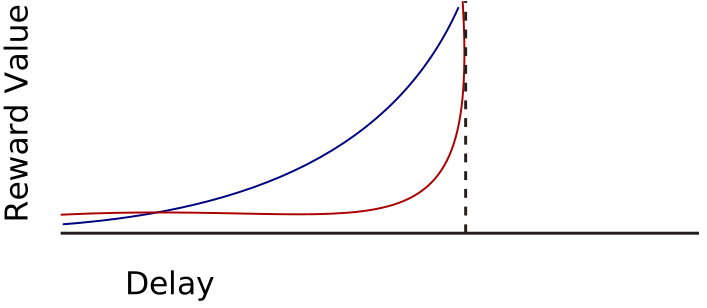
Figure 15
A result of this is that, as later prospects come closer to the point
of possible consumption, people and other animals will sometimes spend
resources undoing the consequences of previous actions that also cost
them resources. For example: deciding today whether to mark a pile of
undergraduate essays or watch a baseball game, I procrastinate,
despite knowing that by doing so I put out of reach some even more fun
possibility that might come up for tomorrow (when there’s an
equally attractive ball game on if the better option doesn’t
arise). So far, this can be accounted for in a way that preserves
consistency of preferences: if the world might end tonight, with a
tiny but nonzero probability, then there’s some level of risk
aversion at which I’d rather leave the essays unmarked. The
figure below compares two exponential discount curves, the lower one
for the value of the game I watch before finishing my marking, and the
higher one for the more valuable game I enjoy after completing the
job. Both have higher value from the reference point the closer they
are to it; but the curves do not cross, so my revealed preferences are
consistent over time no matter how impatient I might be.
Figure 16
However, if I bind myself against procrastination by buying a ticket
for tomorrow’s game, when in the absence of the awful task I
wouldn’t have done so, then I’ve violated intertemporal
preference consistency. More vividly, had I been in a position to
choose last week whether to procrastinate today, I’d have chosen
not to. In this case, my discount curve drawn from the reference point
of last week crosses the curve drawn from the perspective of today,
and my preferences reverse. The figure below shows this situation.
Figure 17
This phenomenon complicates applications of classical game theory to
intelligent animals. However, it clearly doesn’t vitiate it
altogether, since people (and other animals) often
don’t reverse their preferences. (If this weren’t
true, the successful auction models and other s-called
‘mechanism designs’ would be mysterious.) Interestingly,
the leading theories that aim to explain why hyperbolic discounters
might often behave in accordance with RPT themselves appeal to game
theoretic principles.
,
has produced an account of people as communities of
internal bargaining interests, in which subunits based on short-term,
medium-term and long-term interests face conflict that they must
resolve because if they don’t, and instead generate an internal
Hobbesian breakdown
(),
outside agents who avoid the Hobbesian outcome can ruin them all. The
device of the Hobbesian tyrant is unavailable to the brain. Therefore,
its behavior (when system-level insanity is avoided) is a sequence of
self-enforcing equilibria of the sort studied by game-theoretic public
choice literature on coalitional bargaining in democratic
legislatures. That is, the internal politics of the brain consists in
‘logrolling’
().
These internal dynamics are then partly regulated and stabilized by
the wider social games in which coalitions (people as wholes over
temporal subparts of their biographies) are embedded
(,
pp. 334–353). (For example: social expectations about
someone’s role as a salesperson set behavioral equilibrium
targets for the logrolling processes in their brain.) This potentially
adds further relevant elements to the explanation of why and how
stable institutions with relatively transparent rules are key
conditions that help people more closely resemble straightforward
economic agents, such that classical game theory finds reliable
application to them as entire units.
One important note of caution is in order here. Much of the recent
behavioral literature takes for granted that temporally inconsistent
discounting is the standard or default case for people. However,
show empirically that this arises from (i) assuming that groups of
people are homogenous with respect to which functional forms best
describe their discounting behavior, and (ii) failure to independently
elicit and control for people’s differing levels of risk
aversion in estimating their discount functions. In a range of
populations that have been studied with these two considerations in
mind, data suggest that temporally consistent discounting describes
substantially higher proportions of choices than does temporally
inconsistent choices. Over-generalization of hyperbolic discounting
models should thus be avoided.
The idea that game theory can find novel application to the internal
dynamics of brains, as suggested in the previous section, has been
developed from independent motivations by the research program known
as neuroeconomics
(,
,
,
pp. 320–334,
).
Thanks to new non-invasive scanning technologies, especially
functional magnetic resonance imaging (fMRI), it has recently become
possible to study synaptic activity in working brains while they
respond to controlled cues. This has allowed a new path of
access—though still a highly indirect one
()—
to the brain’s computation of expected values of rewards, which
are (naturally) taken to play a crucial role in determining behavior.
Economic theory is used to frame the derivation of the functions
maximized by synaptic-level computation of these expected values;
hence the name ‘neuroeconomics’.
Game theory plays a leading role in neuroeconomics at two levels.
First, game theory has been used to predict the computations that
individual neurons and groups of neurons serving the reward system
must perform. In the best publicized example,
and colleagues have fMRI-scanned monkeys they had trained to play
so-called ‘inspection games’ against computers. In an
inspection game, one player faces a series of choices either to work
for a reward, in which case he is sure to receive it, or to perform
another, easier action (“shirking”), in which case he will
receive the reward only if the other player (the
“inspector”) is not monitoring him. Assume that the first
player’s (the “worker’s”) behavior reveals a
utility function bounded on each end as follows: he will work on every
occasion if the inspector always monitors and he will shirk on every
occasion if the inspector never monitors. The inspector prefers to
obtain the highest possible amount of work for the lowest possible
monitoring rate. In this game, the only NE for both players are in
mixed strategies, since any pattern in one player’s strategy
that can be detected by the other can be exploited. For any given pair
of specific utility functions for the two players meeting the
constraints described above, any pair of strategies in which, on each
trial, either the worker is indifferent between working and shirking
or the inspector is indifferent between monitoring and not monitoring,
is a NE.
Applying inspection game analyses to pairs or groups of agents
requires us to have either independently justified their
utility functions over all variables relevant to their play, in which
case we can define NE and then test to see whether they successfully
maximize expected utility; or to assume that they maximize
expected utility, or obey some other rule such as a matching function,
and then infer their utility functions from their behavior. Either
such procedure can be sensible in different empirical contexts. But
epistemological leverage increases greatly if the utility function of
the inspector is exogenously determined, as it often is. (Police
implementing random roadside inspections to catch drunk drivers, for
example, typically have a maximum incidence of drunk driving assigned
to them as a target by policy, and an exogenously set budget. These
determine their utility function, given a distribution of preferences
and attitudes to risk among the population of drivers.) In the case of
Glimcher’s experiments the inspector is a computer, so its
program is under experimental control and its side of the payoff
matrix is known. Proxies for the subjects’ expected utility, in
this case squirts of fruit juice for the monkeys, can be antecedently
determined in parametric test settings. The computer is then
programmed with the economic model of the monkeys, and can search the
data in their behavior in game conditions for exploitable patterns,
varying its strategy accordingly. With these variables fixed,
expected-utility-maximizing NE behavior by the monkeys can be
calculated and tested by manipulating the computer’s utility
function in various runs of the game.
Monkey behavior after training tracks NE very robustly (as does the
behavior of people playing similar games for monetary prizes;
,
pp. 307–308). Working with trained monkeys, Glimcher and
colleagues could then perform the experiments of significance here.
Working and shirking behaviors for the monkeys had been associated by
their training with staring either to the right or to the left on a
visual display. In earlier experiments,
had established that, in parametric settings, as juice rewards varied
from one block of trials to another, firing rates of each parietal
neuron that controls eye movements could be trained to encode the
expected utility to the monkey of each possible movement relative to
the expected utility of the alternative movement. Thus
“movements that were worth 0.4 ml of juice were represented
twice as strongly [in neural firing probabilities] as movements worth
0.2 ml of juice” (p. 314). Unsurprisingly, when amounts of juice
rewarded for each movement were varied from one block of trials to
another, firing rates also varied.
Against this background, Glimcher and colleagues could investigate the
way in which monkeys’ brains implemented the tracking of NE.
When the monkeys played the inspection game against the computer, the
target associated with shirking could be set at the optimal location,
given the prior training, for a specific neuron under study, while the
work target would appear at a null location. This permitted Glimcher
to test the answer to the following question: did the monkeys maintain
NE in the game by keeping the firing rate of the neuron constant while
the actual and optimal behavior of the monkey as a whole varied? The
data robustly gave the answer ‘yes’. Glimcher reasonably
interprets these data as suggesting that neural firing rates, at least
in this cortical region for this task, encode expected utility in both
parametric and nonparametric settings. Here we have an apparent
vindication of the empirical applicability of classical game theory in
a context independent of institutions or social conventions.
Further analysis pushed the hypothesis deeper. The computer playing
Inspector was presented with the same sequence of outcomes as its
monkey opponent had received on the previous day’s play, and for
each move was asked to assess the relative expected values of the
shirking and working actions available on the next move. Glimcher
reports a positive correlation between small fluctuations around the
stable NE firing rates in the individual neuron and the expected
values estimated by the computer trying to track the same NE. Glimcher
comments on this finding as follows:
The neurons seemed to be reflecting, on a play-by-play basis, a
computation close to the one performed by our computer … [A]t a
… [relatively] … microscopic scale, we were able to use
game theory to begin to describe the decision-by-decision computations
that the neurons in area LIP were performing.
(,
p. 317)
Thus we find game theory reaching beyond its traditional role as a
technology for framing high-level constraints on evolutionary dynamics
or on behavior by well-informed agents operating in institutional
straitjackets. In Glimcher’s hands, it is used to directly model
activity in a monkey’s brain.
argues that groups of neurons thus modeled should not be identified
with the sub-personal game-playing units found in Ainslie’s
theory of intra-personal bargaining described earlier; that would
involve a kind of straightforward reduction that experience in the
behavioral and life sciences has taught us not to expect. This issue
has since arisen in a direct dispute between neuroeconomists over
rival interpretations of fMRI observations of intertemporal choice and
discounting
(,
). The weight of evidence so far favors the view that if
it is sometimes useful to analyze people’s choices as equilibria
in games amongst sub-personal agents, the sub-personal agents in
question should not be identified with separate brain areas. The
opposite interpretation is unfortunately still most common in less
specialized literature.
We have now seen the first level at which neuroeconomics applies game
theory. A second level involves seeking conditioning variables in
neural activity that might impact people’s choices of strategies
when they play games. This has typically involved repeating protocols
from the behavioral game theory literature with research subjects who
are lying in fMRI scanners during play.
and
have argued for skepticism about the value of work of this kind,
which involves various uncomfortably large leaps of inference in
associating the observed behavior with specific imputed neural
responses. It can also be questioned whether much generalizable new
knowledge is gained to the extent that such associations can
be successfully identified.
Let us provide an example of this kind of “game in a
scanner”—that directly involves strategic interaction.
took a standard protocol from behavioral game theory, the so-called
‘trust’ game, and implemented it with subjects whose
brains were jointly scanned using a technology for linking the
functional maps of their respective brains, known as
‘hyperscanning’). This game involves two players. In its
repeated format as used in the King-Casas et al. experiment,
the first player is designated the ‘investor’ and the
second the ‘trustee’. The investor begins with $20, of
which she can keep any portion of her choice while investing the
remainder with the trustee. In the trustee’s hands the invested
amount is tripled by the experimenter. The trustee may then return as
much or as little of this profit to the investor as he deems fit. The
procedure is run for ten rounds, with players’ identities kept
anonymous from one another.
This game has an infinite number of NE. Previous data from behavioral
economics are consistent with the claim that the modal NE in human
play approximates both players using
‘Tit-for-tat’ strategies (see
)
modified by occasional defections to probe for information, and some
post-defection cooperation that manifests (limited) toleration of such
probes. This is a very weak result, since it is compatible with a wide
range of hypotheses on exactly which variations of Tit-for-tat are
used and sustained, and thus licenses no inferences about potential
dynamics under different learning conditions, institutions, or
cross-cultural transfers.
When they ran this game under hyperscanning, the researchers
interpreted their observations as follows. Neurons in the
trustee’s caudate nucleus (generally thought to implement
computations or outputs of midbrain dopaminergic systems) were thought
to show strong response when investors benevolently reciprocated
trust—that is, responded to defection with increased generosity.
As the game progressed, these responses were believed to have shifted
from being reactionary to being anticipatory. Thus reputational
profiles as predicted by classical game-theoretic models were inferred
to have been constructed directly by the brain. A further aspect of
the findings not predictable by theoretical modeling alone, and which
purely behavioral observation had not been sufficient to discriminate,
was taken to be that responses by the caudate neurons to malevolent
reciprocity—that is, reduced generosity in response to
cooperation—were significantly smaller in amplitude. This was
hypothesized to be a mechanism by which the brain implements
modification of Tit-for-tat so as to prevent occasional defections for
informational probing from unraveling cooperation permanently.
The advance in understanding for which practitioners of this style of
neuroeconomics hope consists not in what it tells us about particular
types of games, but rather in comparative inferences it facilitates
about the ways in which contextual framing influences people’s
conjectures about which games they’re playing. fMRI or other
kinds of probes of working brains might, it is conjectured, enable us
to quantitatively estimate degrees of strategic surprise.
Reciprocally interacting expectations about surprise may themselves be
subject to strategic manipulation, but this is an idea that has barely
begun to be theoretically explored by game theorists (see
).
The view of some neuroeconomists that we now have the prospect of
empirically testing such new theories, as opposed to just
hypothetically modeling them, has stimulated growth in this line of
research.
The developments reviewed in the previous section bring us up to the
moving frontier of experimental / behavioral applications of classical
game theory. We can now return to the branch point left off several
paragraphs back, where this stream of investigation meets that coming
from evolutionary game theory. There is no serious doubt that, by
comparison to other non-eusocial animals—including our nearest
relatives, chimpanzees and bonobos—humans achieve prodigious
feats of coordination (see
)
(). A lively controversy, with important philosophical
implications and fought on both sides with game-theoretic arguments,
went on for some time over whether this capacity can be wholly
explained by cultural adaptation, or is better explained by inference
to a genetic change early in the career of H. sapiens.
Henrich et al.
(,
) have run a series of experimental games with
populations drawn from fifteen small-scale human societies in South
America, Africa, and Asia, including three groups of foragers, six
groups of slash-and-burn horticulturists, four groups of nomadic
herders, and two groups of small-scale agriculturists. The games
(Ultimatum, Dictator, Public Goods) they implemented all place
subjects in situations broadly resembling that of the Trust game
discussed in the previous section. That is, Ultimatum and Public Goods
games are scenarios in which both social welfare and each
individual’s welfare are optimized (Pareto efficiency achieved)
if and only if at least some players use strategies that are not
sub-game perfect equilibrium strategies (see
).
In Dictator games, a narrowly selfish first mover would capture all
available profits. Thus in each of the three game types, SPE players
who cared only about their own monetary welfare would get outcomes
that would involve highly inegalitarian payoffs. In none of the
societies studied by Henrich et al. (or any other society in
which games of this sort have been run) are such outcomes observed.
The players whose roles are such that they would take away all but
epsilon of the monetary profits if they and their partners played SPE
always offered the partners substantially more than epsilon, and even
then partners sometimes refused such offers at the cost of receiving
no money. Furthermore, unlike the traditional subjects of experimental
economics—university students in industrialized
countries—Henrich et al.’s subjects did not even
play Nash equilibrium strategies with respect to monetary
payoffs. (That is, strategically advantaged players offered larger
profit splits to strategically disadvantaged ones than was necessary
to induce agreement to their offers.) Henrich et al.
interpret these results by suggesting that all actual people, unlike
‘rational economic man’, value egalitarian outcomes to
some extent. However, their experiments also show that this extent
varies significantly with culture, and is correlated with variations
in two specific cultural variables: typical payoffs to cooperation
(the extent to which economic life in the society depends on
cooperation with non-immediate kin) and aggregate market integration
(a construct built out of independently measured degrees of social
complexity, anonymity, privacy, and settlement size). As the values of
these two variables increase, game behavior shifts (weakly) in the
direction of Nash equilibrium play. Thus the researchers conclude that
people are naturally endowed with preferences for egalitarianism, but
that the relative weight of these preferences is programmable by
social learning processes conditioned on local cultural cues.
In evaluating Henrich et al.’s interpretation of these
data, we should first note that no axioms of RPT, or of the various
models of decision mentioned in
,
which are applied jointly with game theoretic modeling to human
choice data, specify or entail the property of narrow selfishness.
(See
ch. 4;
and
;
and any economics or game theory text that lets the mathematics speak
for itself.) Orthodox game theory thus does not predict that people
will play SPE or NE strategies derived by treating their own monetary
payoffs as equivalent to utility.
is therefore justified in criticizing Henrich et al for
rhetoric suggesting that their empirical work embarrasses orthodox
theory.
This is not to suggest that the anthropological interpretation of the
empirical results should be taken as uncontroversial. Binmore
(,
,
,
) has argued for many years, based on a wide range of
behavioral data, that when people play games with non-relatives they
tend to learn to play Nash equilibrium with respect to utility
functions that approximately correspond to income functions. As he
points out in
,
Henrich et al.’s data do not test this hypothesis for
their small-scale societies, because their subjects were not exposed
to the test games for the (quite long, in the case of the Ultimatum
game) learning period that theoretical and computational models
suggest are required for people to converge on NE. When people play
unfamiliar games, they tend to model them by reference to games they
are used to in everyday experience. In particular, they tend to play
one-shot laboratory games as though they were familiar
repeated games, since one-shot games are rare in normal
social life outside of special institutional contexts. Many of the
interpretive remarks made by Henrich et al. are consistent
with this hypothesis concerning their subjects, though they
nevertheless explicitly reject the hypothesis itself. What is
controversial here—the issues of spin around
‘orthodox’ theory aside—is less about what the
particular subjects in this experiment were doing than about what
their behavior should lead us to infer about human evolution.
,
argues that data of the sort we have been discussing
support the following conjecture about human evolution. Our ancestors
approximated maximizers of individual fitness. Somewhere along the
evolutionary line these ancestors arrived in circumstances where
enough of them optimized their individual fitness by acting so as to
optimize the welfare of their group
()
that a genetic modification went to fixation in the species: we
developed preferences not just over our own individual welfare, but
over the relative welfare of all members of our communities, indexed
to social norms programmable in each individual by cultural
learning. Thus the contemporary researcher applying game theory to
model a social situation is advised to unearth her subjects’
utility functions by (i) finding out what community (or communities)
they are members of, and then (ii) inferring the utility function(s)
programmed into members of that community (communities) by studying
representatives of each relevant community in a range of games and
assuming that the outcomes are correlated equilibria. Since the
utility functions are the dependent variables here, the games must be
independently determined. We can typically hold at least the strategic
forms of the relevant games fixed, Gintis supposes, by virtue of (a)
our confidence that people prefer egalitarian outcomes, all else being
equal, to inegalitarian ones within the culturally evolved
‘insider groups’ to which they perceive themselves as
belonging and (b) a requirement that game equilibria are drawn from
stable attractors in plausible evolutionary game-theoretic models of
the culture’s historical dynamics.
Requirement (b) as a constraint on game-theoretic modeling of general
human strategic dispositions is no longer very controversial—or,
at least, is no more controversial than the generic adaptationism in
evolutionary anthropology of which it is one expression. However, many
commentators are skeptical of Gintis’s suggestion that there was
a genetic discontinuity in the evolution of human sociality. (For a
cognitive-evolutionary anthropology that explicitly denies such
discontinuity, see
.)
Based partly on such skepticism (but more directly on behavioral
data) Binmore
(,
) resists modeling people as having built-in preferences
for egalitarianism. According to Binmore’s
(,
,
)
model, the basic class of strategic problems facing non-eusocial
social animals are coordination games. Human communities evolve
cultural norms to select equilibria in these games, and many of these
equilibria will be compatible with high levels of apparently
altruistic behavior in some (but not all) games. Binmore argues that
people adapt their conceptions of fairness to whatever happen to be
their locally prevailing equilibrium selection rules. However, he
maintains that the dynamic development of such norms must be
compatible, in the long run, with bargaining equilibria among
self-regarding individuals. Indeed, he argues that as societies evolve
institutions that encourage what Henrich et al. call
aggregate market integration (discussed above), their utility
functions and social norms tend to converge on self-regarding economic
rationality with respect to welfare. This does not mean that Binmore
is pessimistic about the prospects for egalitarianism: he develops a
model showing that societies of broadly self-interested bargainers can
be pulled naturally along dynamically stable equilibrium paths towards
norms of distribution corresponding to Rawlsian justice
().
The principal barriers to such evolution, according to Binmore, are
precisely the kinds of other-regarding preferences that conservatives
valorize as a way of discouraging examination of more egalitarian
bargaining equilibria that are within reach along societies’
equilibrium paths.
Resolution of this debate between Gintis and Binmore fortunately need
not wait upon discoveries about the deep human evolutionary past that
we may never have. The models make rival empirical predictions of some
testable phenomena. If Gintis is right then there are limits, imposed
by the discontinuity in hominin evolution, on the extent to which
people can learn to be self-regarding. This is the main significance
of the controversy discussed above over Henrich et
al.’s interpretation of their field data. Binmore’s
model of social equilibrium selection also depends, unlike
Gintis’s, on widespread dispositions among people to inflict
second-order punishment on members of society who fail to sanction
violators of social norms.
shows using a game theory model that this is implausible if
punishment costs are significant. However,
argues that the widespread assumption in the literature that
punishment of norm-violation must be costly results from failure to
adequately distinguish between models of the original evolution of
sociality, on the one hand, and models of the maintenance and
development of norms and institutions once an initial set of them has
stabilized. Finally, Ross also points out that Binmore’s
objectives are as much normative as descriptive: he aims to show
egalitarians how to diagnose the errors in conservative
rationalisations of the status quo without calling for revolutions
that put equilibrium path stability (and, therefore, social welfare)
at risk. It is a sound principle in constructing reform proposals that
they should be ‘knave-proof’ (as Hume put it), that is,
should be compatible with less altruism than might prevail in
people.
In 2016 the Journal of Economic Perspectives published a
symposium on “What is Happening in Game Theory?” Each of
the participants noted independently that game theory has become so
tightly entangled with microeconomic theory in general that the
question becomes difficult to distinguish from inquiry into the moving
frontier of that entire sub-discipline, which is in turn the largest
part of economics as a whole. Thus the boundary between the
philosophy of game theory and the philosophy of
microeconomics is now similarly indistinct. Of course, as has been
stressed, applications of game theory extend beyond the traditional
domain of economics, into all of the behavioral and social sciences.
But as the methods of game theory have fused with the methods of
microeconomics, a commentator might equally view these extensions as
being exported applications of microeconomics.
Following decades of development (incompletely) surveyed in the
present article, the past few years have been relatively quiet ones
where foundational innovations of the kind that invite contributions
from philosophers are concerned. Some parts of the original
foundations are being newly revisited, however.
introduction of game theory divided the inquiry into two parts.
Noncooperative game theory analyzes cases built on the
assumption that each player maximizes her own utility function while
treating the expected strategic responses of other players as
constraints. As discussed above, the specific game to which von
Neumann and Morgenstern applied their modeling was poker, which is a
zero-sum game. Most of the present article has focused on the many
theoretical challenges and insights that arose from extending
noncooperative game theory beyond the zero-sum domain. But this in
fact develops only half of von Neumann and Morgenstern’s
classic. The other half developed cooperative game theory,
about which nothing has so far been said here. The reason for this
silence is that for most game theorists cooperative game theory is a
distraction at best and at worst a technology that confuses
the point of game theory by bypassing the aspect of games that mainly
makes them potentially interesting and insightful in application,
namely, the requirement that equilibria be selected endogenously under
the restrictions imposed by
.
This, after all, is what makes equilibria self-enforcing, just in the
way that prices in competitive markets are, and thus renders them
stable unless shocked from outside.
argued that solutions to cooperative games should always be verified
by showing that they are also solutions to formally equivalent
noncooperative games. Nash’s accomplishment in the paper wa the
analytical identification of the relevant equivalence. One way of
interpreting this was as demonstrating the ultimate redundancy of
cooperative game theory.
Cooperative game theory begins from the assumption that players have
already, by some unspecified process, agreed on a vector of
strategies, and thus on an outcome. Then the analyst deploys the
theory to determine the minimal set of conditions under which the
agreement remains stable. The idea is typically illustrated by the
example of a parliamentary coalition. Suppose that there is one
dominant party that must be a member of any coalition if it is to
command a majority of parliamentary votes on legislation and
confidence. There might then be a range of alternative possible
groupings of other parties that could sustain it. Imagine, to make the
example more structured and interesting, that some parties will not
serve in a coalition that includes certain specific others; so the
problem faced by the coalition organizers is not simply a matter of
summing potential votes. The cooperative game theorist identifies the
set of possible coalitions. There may be some other parties, in
addition to the dominant party, that turn out to be needed in every
possible coalition. Identifying these parties would, in this example,
reveal the core of the game, the elements shared by all
equilibria. The core is the key solution concept of cooperative game
theory, for which Shapley shared the Nobel prize.
(
is the great paper.)
defined the “Nash program” as consisting of verifying a
particular cooperative equilibrium by showing that noncooperative
players could arrive at it through the sequential bargaining
process specified in
,
and that all outcomes of such bargaining would include the
core.
In light of the example, it is no surprise that political scientists
were the primary users of cooperative theory during the years while
noncooperative game theory was still being fully developed. It has
also been applied usefully by labor economists studying settlement
negotiations between firms and unions, and by analysts of
international trade negotiations. We might illustrate the value of
such application by reference to the second example. Suppose that,
given the weight of domestic lobbies in South Africa, the South
African government will never agree to any trade agreement that does
not allow it to protect its automative assembly sector. (This has in
fact been the case so far.) Then allowance for such protection is part
of the core of any trade treaty another country or bloc might conclude
with South Africa. Knowing this can help the parties during
negotiations avoid rhetoric or commitments to other lobbies, in any of
the negotiating countries, that would put the core out of reach and
thus guarantee negotiation failure. This example also helps us
illustrate the limitations of cooperative game theory. South Africa
will have to trade off the interests of some other lobbies to protect
its automative industry. Which others will get traded off
will be a function of the extensive-form play of non-cooperative
sequential proposals and counter-proposals, and the South African
bargainers, if they have done their due diligence, must be attentive
to which paths through the tree throw which specific domestic
interests under the proverbial bus. Thus carrying out the cooperative
analysis does not relieve them of the need to also conduct the
noncooperative analysis. Their game theory consultants might as well
simply code the non-cooperative parameters into their Gambit software,
which will output the core if asked.
But cooperative game theory did not die, or become confined to
political science applications. There has turned out to be a range of
policy problems, involving many players whose attributes vary but
whose ordinal utility functions are symmetrical, for which
noncooperative modeling, while possible in principle, is absurdly
cumbersome and computationally demanding, but for which cooperative
modeling is beautifully suited. That we be dealing with ordinal
utility functions is important, because in the relevant markets there
are often no prices. The classic example
()
is a marriage market. Abstracting from the scale of individual
romantic dramas and comedies, society features, as it were, a vast set
of people who want to form into pairs, but care very much who they end
up paired with. Suppose we have a finite set of such people. Imagine
that the match-maker, or app, first splits the set into two proper
subsets, and announces a rule that everyone in subset \(A\) will
propose to someone in subset \(B\). Each of those in \(B\) who receive
a proposal knows that she is the first choice of someone in \(A\). She
selects her first choice from the proposals she has received and
throws the rest back into the pool. Those in \(A\) whose initial
proposals were not accepted now each propose to someone they did not
propose to before, but possibly including people who are holding
proposals from a previous round—Nkosi knows that Barbara
preferred Amalia in round 1, but Nkosi wasn’t part of that
choice set and so might displace Amalia in round 2). Provably there
exists a terminal round after which no further proposals will be made,
and the matchmaking app will have found the core of the cooperative
game because no person \(i\) in set \(B\) will prefer to pair with
someone from set \(A\) who prefers \(i\) to whoever is holding that
\(A\)-set dreamboat’s proposal. Everyone from set B will now
accept the proposal they are holding, and, if the two sets had the
same cardinality and everyone would rather pair with someone than pair
with no one, then nobody will go off alone.
This is not a directly applicable model of a marriage market, so there
is no money to be made in selling the simple matchmaking app described
above. The problem is that we have no guarantee that, in the example,
Nkosi and Amalia aren’t one another’s partners of destiny,
but cannot get paired because they both began in subset \(A\). In game
theory textbooks this problem is often finessed by assuming that Set
\(A\) contains men and Set \(B\) contains women, and that everyone is
so committed to heterosexuality that they’d rather pair with
anyone of the opposite sex than anyone of their own sex. On the other
hand, the model provides some insight, in the way that models
typically do, if we don’t insist on applying it too literally.
After working through it, one sees the logic of facts about society
that someone designing a real matchmaking app had better understand:
that the app will have to log proposals under consideration but not
yet accepted, leave people holding proposals under consideration on
the market, and remember who has previously rejected whom (without
creating a generalised emotional catastrophe by publicly posting this
information). The real app will not be able to reliably find the core
of the cooperative game, unless the set of people in the market is
small, restricted, and has self-sorted into subsets to at least some
extent by providing such information as “\(X\)-type person seeks
\(Y\)-type person” for \(X\) and \(Y\) properties that everyone
prioritizes. (Are there such properties, at least as an
approximation?) But the real matchmaking apps seem to work well enough
to be transforming the way in which most young people now find mates
in countries with generally available internet access. Relationships
between theoretically idealized and real marriage markets are
comprehensively reviewed in
.
The revival of cooperative game theory as site of renewed interest has
occurred because policy problems have been encountered that, unlike
the original toy illustration using the all-straights marriage market,
satisfy the model’s crucial assumptions. Leading instances are
matching university applicants and universities, and matching people
needing organ transplants with donors (see
).
In these markets, there is no ambivalence about partitioning the sets
to be matched. Ordinal preferences are the relevant ones: universities
don’t auction off places to the highest bidder (or at least not
in general), and organs are not for sale (or at least not legally).
The models are really applied, and they demonstrably have improved
efficiency and saved lives.
It is common in science for models that are practically clumsy fits to
their original problems to turn out to furnish highly efficient
solutions to new problems thrown up by technological change. The
internet has created an environment for applications of matching
algorithms—travellers and flat renters, diners and restaurants,
students and tutors, and (regrettably) socially alienated people and
purveyors of propaganda and fanaticism—that could have been
designed by a theorist at any time since Shapley’s original
innovations, but would previously have been practically impossible to
implement. These applications of cooperative game theory are often
applied conjointly with the noncooperative game theory of auctions
()
to drive market designs for goods and services so efficient as to be
annihilating the once mighty shopping mall in even the suburban USA.
Why are hotels more profitable and easily available than was the case
in all but the largest cities before about 2007? The answer is that
dynamic pricing algorithms
()
blend matching theory and auction theory to allow hotels, combined
with online travel service aggregators, to find customers willing to
pay premium rates for their ideal locations and times, and then fill
the remaining rooms with bargain hunters whose preferences are more
flexible. Airlines operate similar technology. Game theory thus
continues to be one of the 20th-century inventions that is driving
social revolutions in the 21st, and
predicts a coming surge of renewed interest in the deeper mathematics
of cooperative games and their relationships to noncooperative games.
A range of further applications of both classical and evolutionary
game theory have been developed, but we have hopefully now provided
enough to convince the reader of the tremendous, and constantly
expanding, utility of this analytical tool. The reader whose appetite
for more has been aroused should find that she now has sufficient
grasp of fundamentals to be able to work through the large literature,
of which some highlights are listed below.