Dear Stripe community,

Last year, businesses running on Stripe generated $1.9
trillion in total volume, up 34% from 2024, and
equivalent to roughly 1.6% of global GDP. Our
programmable financial services now power more than
5 million businesses directly or via platforms, including
all of the top AI companies, many of the largest bluechip companies (90% of the Dow Jones Industrial
Average), most of the biggest tech companies (80% of
the Nasdaq 100), and a significant fraction of freshly
minted startups (25% of all Delaware corporations are
now created with Stripe Atlas). Beyond payments,
these businesses are using Stripe to accelerate their
growth with billing and subscription management, tax
compliance, fraud prevention, embedded finance,
global treasury management, and much besides. Link,
the easiest way to pay online, is now used by more than
200 million people.

Stripe remained robustly profitable, allowing us to
continue investing heavily in product development
(with more than 350 product updates last year) as well
as acquisitions. Since our last update, we acquired
Privy, which powers more than 110 million
programmable wallets, and Metronome, which powers
the intricate usage-based billing models used by
companies like OpenAI, Anthropic, Confluent, and
NVIDIA. Metronome joins our Revenue suite, which is
on track to hit an annual run rate of $1 billion this year.

All in all, 2025 was a strong year for the internet
economy, and we’re delighted to see so many of
Stripe’s customers do so well

At heart, competitive markets are a sorting machine.
They direct profits, capital, and talent to the places of
greatest impact, as determined by customers voting
with their wallets. Historically, this sorting happened
methodically. It typically took decades for a household
name to be unseated or for a new entrant to reach
meaningful scale.

The sorting machine is now whirring faster: winners
and losers are being anointed more quickly and more
intensely. Today, the most profitable third of publicly
listed companies in the US account for two-thirds of
total market capitalization, the highest share since
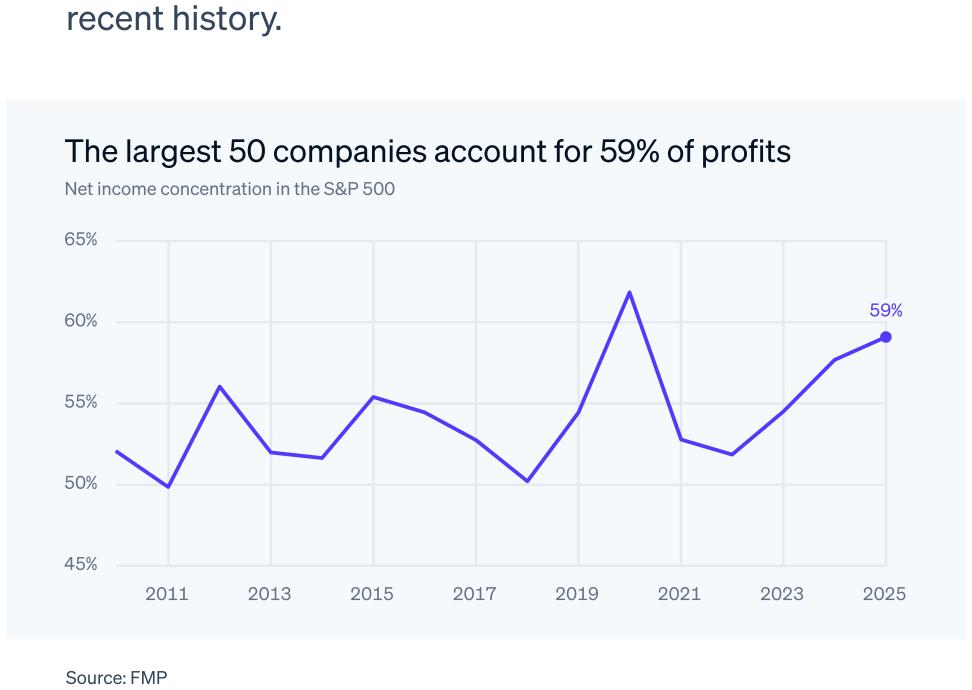
data began in 1963. And much of this is a story of profit
concentration, not just valuations: the top 10% of the
S&P 500 by market cap now account for roughly 59%
of the index’s total profits, which is elevated relative to
recent history
The largest 50 companies account for 59% of profit
et income concentration in the S&P 5
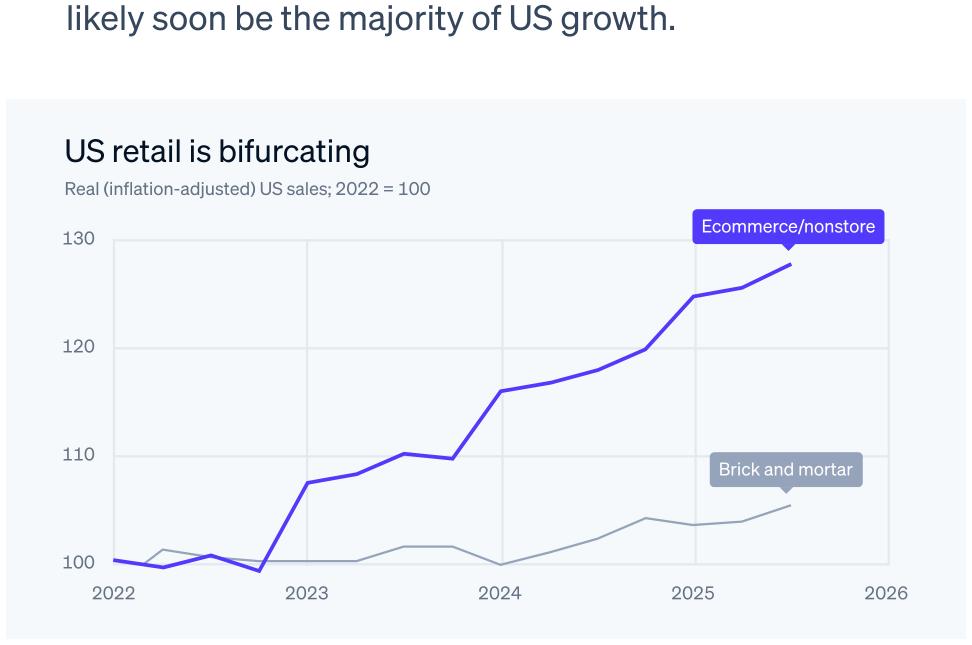
Much of this is driven by bifurcation within industries.
In retail, for example, US brick-and-mortar sales grew
just 5% over the past 3 years, whereas ecommerce
sales grew 30% over the same period (both in inflationadjusted terms). In air travel, the “big 3” of American,
Delta, and United all increased their share of industry
revenues and profits over the past decade. (Indeed,
Delta and United accounted for nearly all US airline
profits in 2025.) In healthcare, hospital and insurer
profit shares have contracted significantly since 2019,
but health tech is on track to exceed $110 billion in
EBITDA by 2029. Each sector has its own particular
dynamics, but the pattern is clear: a cohort of
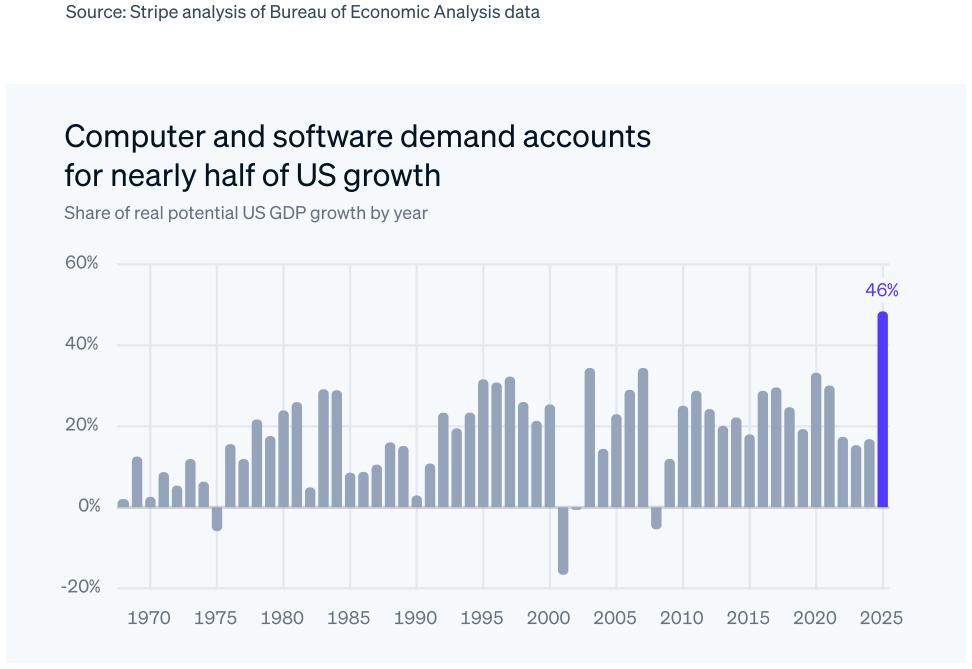
companies is pulling away. Economy-wide, demand for
software, computers, and data center investment
drove nearly half of all US GDP growth in 2025 and will
likely soon be the majority of US growth
US retail is bifurcatin
Real (inflation-adjusted) US sales
Source: Stripe analysis of Bureau of Economic Analysis dat
Computer and software demand accounts
for nearly half of US growt
Share of real potential US GDP growth by yea
Source: Bureau of Economic Analysis, Congressional Budget Office, Stripe analysi

Based on what we can tell from the set of businesses
that started on Stripe in 2025—a remarkable cohort—
there are no signs of the sorting machine slackening. In
2025, many more new companies joined Stripe than
ever before, with more than half of them (57%) based
outside the US. This new cohort is by far the highest
performing and fastest moving we’ve ever seen,
growing around 50% faster than the 2024 cohort. The
number of companies reaching $10 million ARR within
3 months of launch was double the 2024 count.

This seems to be part of a larger expansion and
acceleration in our industry. After years of relative
calm, the number of iOS apps released in December
2025 jumped by 60% year over year. (Someone should
check the App Store review team’s sleep scores.) Even
code production is accelerating: pushes to GitHub,
which grew roughly 10%–12% in prior years, surged 41%
between Q3 2024 and Q3 2025.

As building gets easier, we’re working on making Stripe
even simpler to integrate—including for the agents.
We recently introduced claimable sandboxes, which let
you start using Stripe directly from your AI coding tools
like Manus, Base44, Replit, and Vercel. When you’re
done with v1 and your product is ready to launch, that
sandbox converts into a live Stripe account with its
configuration intact. More than 100,000 sandboxes
have been created this way.

We’re also improving Stripe Atlas, the world’s easiest
way to incorporate a business, which saw a 41%
increase in company formations last year. Atlas
companies are monetizing sooner: in 2025, 20% of
Atlas startups charged their first customer within 30
days, up from 8% in 2020.

As we look at these figures, there is an obvious
question: is 2025 an anomaly or the beginning of a new
regime? Time will adjudicate, but our best guess is that
the 2025 acceleration is the start of a larger inflection
in entrepreneurship and creativity facilitated by
advances in large language models. We have an
ambitious roadmap of improvements planned. Stripe
will be the best way to build a business in the era of AI

For those with aspirations to “go global,” the
conventional playbook used to be a steady, sequential
progression: win at home, then push abroad. It took
Coca-Cola 20 years to bottle its first soda in Cuba,
while McDonald’s and Starbucks waited 27 and 16
years, respectively, to serve their first customers
in Canada.

After the arrival of the World Wide Web, free services
tended to launch globally, but their monetization
machinery still operated with a time delay. When
Facebook changed from a college-only network to a
public platform in 2006, anyone with a browser could
create an account, but anyone with money couldn’t
necessarily advertise. Support for international
currencies didn’t arrive until 2009, five years after the
company was founded. For its part, Google only
accepted its first GBP payment from an advertiser in
the UK (a live lobster mail order firm!) in 2002, four
years after launching its search product globally.

Over the last few years, the country-by-country
expansion model has melted away. The “domestic
market” for a new generation of internet businesses is
the internet itself. Nearly every AI product you’ve heard
of is all the rage in every country you’ve heard of.
ChatGPT, Claude, Replit, Lovable, Base44, Vercel,
Cursor, Midjourney, and many more launched globally
by default.

This isn’t merely about incremental revenue from a
“long tail” of international users. In many cases, the
“long tail” is much of the dog. Among Stripe
businesses with mostly international revenue, 30% of
that revenue comes from countries that are neither
their home market nor one of the top 10 global
economies.

This is possible largely due to infrastructure that no
longer makes foreign demand feel foreign. Last year,
we enabled businesses to launch a localized checkout
in more than 100 countries simultaneously, complete
with localized pricing to maximize conversion, more
than 120 payment methods, and local tax compliance
supported out of the box.

Sometimes improved infrastructure is only felt after
decades; other times, pent-up demand reveals itself
overnight. Gamma is a California-based AI platform
used by 70 million people to create presentations.
When Gamma joined the first cohort of businesses on
Stripe to accept UPI payments in India, its Indian
revenue leapt 22% that same month.

Ironically, the tech companies most constrained by
barriers of financial geography have tended to be
fintechs themselves. Twelve years after Chime
launched, you can only open a new Chime account
from inside the US. Nubank, founded in 2013, served
only Brazil for its first six years and added only two
other countries in the last six. Even at Stripe, our
Issuing product is available in only 22 countries some 7
years after launch—faster than most, but not as fast as
we would like.

This is also changing. The latest cohort of fintech
companies—Sling Money, DolarApp, Félix, and KAST,
to name a few—are building global financial apps right
out of the gate. Similarly, last year we launched our first
globally native product, Financial Accounts, which
businesses can use to hold, send, and receive funds.
We made it available to businesses in more than 100
countries on day one. The progress is in large part due
to stablecoins, whose borderlessness allows fintechs
to set up infrastructure that works everywhere. Globalby-default financial services are, for the first time, a real
possibility

It may be a crypto winter, but it’s a stablecoin summer.
After a decade of stablecoin volumes tracking the
undulations of crypto asset prices, last year saw a clear
divergence. In 2025, the price of Bitcoin dropped
precipitously (and is now down 50% from October), but
stablecoin payments volume doubled to around $400
billion, 60% of which is estimated to represent B2B
payments. Bridge, the stablecoin orchestration
platform we acquired, saw volume more than
quadruple. Stablecoin payments are advancing quietly
and inexorably as real-world uptake continues apace.

This growth has been catalyzed by a profusion of new
capabilities. A Y Combinator founder can now receive
funding in stablecoins, hold them in a Stripe financial
account, and use them to pay their first engineers, who
could be anywhere in the world. SaaS platforms are
using stablecoins to collect recurring payments,
thanks to a new smart contract that obviates the need
for wallet owners to manually sign each transaction.
Enterprises leaning on stablecoins to expand
internationally now have better tools to embed digital
wallets directly into their core products. With Privy,
companies like Ramp and Deel have a single API to
provision easy-to-use wallets in both custodial and
noncustodial models. This makes it possible to build
fully global products on day one.

The interoperability between crypto and fiat is also
rapidly improving. In April, Bridge partnered with Visa
to introduce cards that allow businesses and
consumers to spend their stablecoins just like any
other card. The payment is deducted from a stablecoin
balance and automatically converted to the local
currency; the business receives the funds just like any
other payment, serenely insulated from the underlying
stablecoin mechanics. Phantom, one of the most
popular crypto wallets with 20 million monthly active
users, is using Bridge to roll out stablecoin-backed
cards to its customers.

As we prepare for a world of massive stablecoin
adoption, we spent time last year thinking about
blockchains. Today’s blockchains have been designed
for trading and DeFi, and the attributes that matter for
payments (including throughput, reliability, cost
predictability, and privacy) have not been a significant
focus. Bitcoin processes fewer than 10 transactions per
second. Last year, a memecoin trading frenzy on one of
the major blockchains delayed payouts for one Bridge
user by over 12 hours and spiked per-transaction
prices 35×. While such operational issues are already
significant, they will only intensify, for we expect the
appetite for transactions to grow a great deal. In our
view, agents will most likely soon be responsible for
most internet transactions, and we will likely need
blockchains that support more than one million—or
even one billion—transactions per second.

In September, we unveiled Tempo, a blockchain
purpose-built for payments, incubated together with
Paradigm. With Tempo, businesses get dedicated
payment lanes, sub-second finality, opt-in privacy, and
interoperability with compliance and accounting
systems. These features may sound prosaic, but they
matter a great deal for infrastructure that supports
real-world economic activity. Companies like Visa,
Nubank, and Shopify are already testing Tempo for a
number of use cases, including global payouts,
embedded finance, and remittances. Klarna, whose
CEO was once a self-proclaimed crypto skeptic,
became the first bank to launch a stablecoin—
KlarnaUSD—on the Tempo testnet, using Bridge’s
Open Issuance to facilitate faster and cheaper crossborder settlement. Tempo’s architecture is also
particularly well suited to agentic payments and
microtransactions. Tempo’s mainnet will be launching
soon, and we look forward to seeing what ambitious
businesses decide to build with it

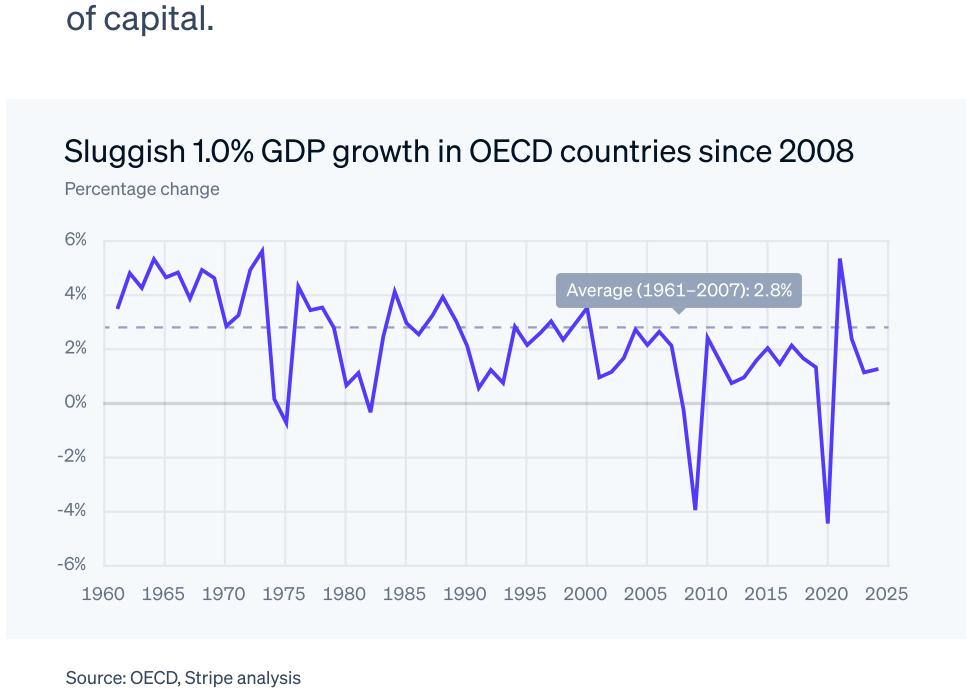
Since 2008, GDP per capita growth has been a
sluggish 1.0% in OECD countries—down from 2.8% a
year, on average, for the 46 prior years (when data
begins). It’s tempting to reach for local explanations
(Japan’s aging workforce, Brexit, Europe’s energy mix,
and so on), but there is good evidence that a significant
culprit is the sharp, global drop in the availability
of capital.
Sluggish 1.0% GDP growth in OECD countries since 200
Percentage chang
196 196 197 197 198 198 199 199 200 200 201 201 202 202
Indeed, in most OECD countries, capital requirements
for banks went up and capital access for small
businesses went down following the Global Financial
Crisis. Basel III reforms raised capital standards for
large banks around the world. In Ireland, bank lending
to small businesses dropped by more than 66%
between 2011 and 2019. In the UK, small business
lending contracted in 2012 and remained
weak thereafter.

The US fared slightly better, with easier access to
capital from nonbank lenders and 1.7% per capita GDP
growth over the last 15 years. But the broad trends,
post-Dodd-Frank, are the same: tightening of bank
rules and reduced access to capital for small
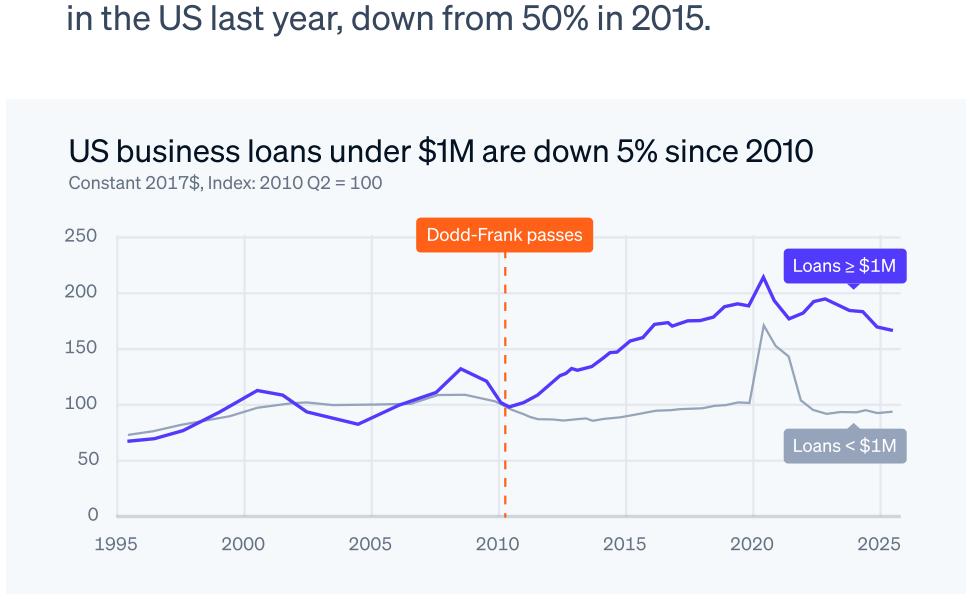
businesses. Since 2010, loans above $1 million are up
68%, while loans under $1 million are down 5%. Only
41% of small business loan applications were approved
in the US last year, down from 50% in 2015.
US business loans under $1M are down 5% since 201
Constant 2017$, Index: 2010 2 10
Source: Federal Deposit Insurance Corporation, Bureau of Economic Analysis, Stripe analysi

We created Stripe Capital to help solve the global
paucity of access to capital, especially for small
businesses. For businesses that use Stripe to accept
payments, their real-time revenue data makes for a
simple input to a lending decision. Businesses pay
back loans as a small percentage of their subsequent
sales, effectively drawing working capital forward from
their own growth. Funding volume grew 45% from
2024 to 2025, with Stripe Capital supporting more than
81,000 businesses. (Many of these businesses had
access to Stripe Capital funds directly through the
vertical SaaS platform on which they run—
GlossGenius for beauty salons, Tekmetric for auto
shops, Pixieset for photographers, and so on.)

Over the last two years, we ran a randomized study to
understand the impact of Capital: when we help
businesses grease their wheels, how fast can they
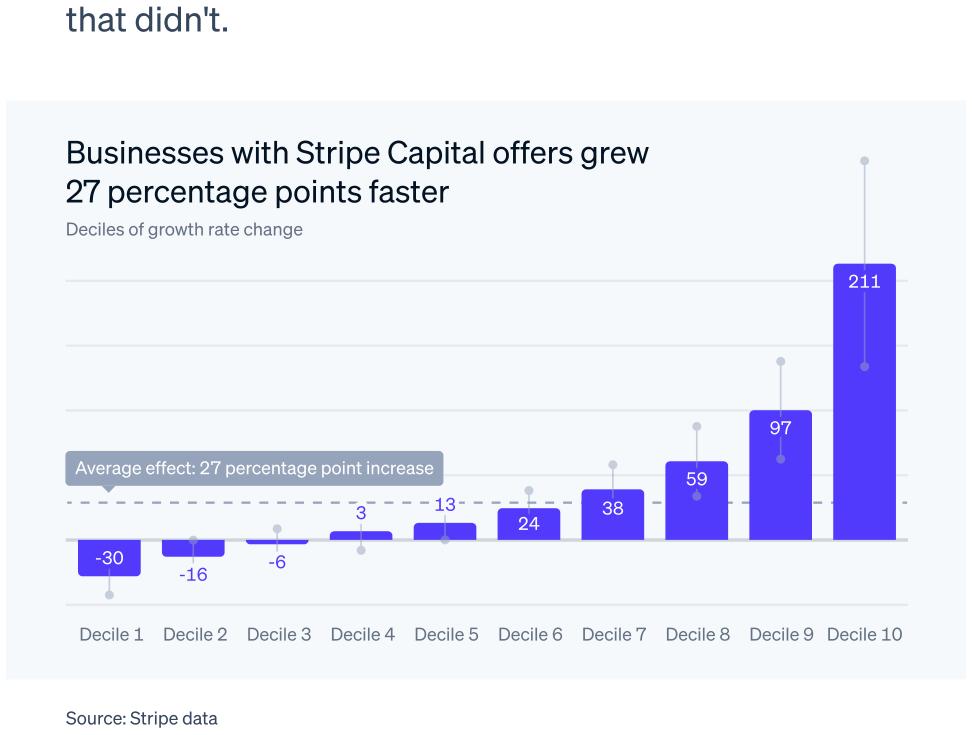
grow? Turns out, a lot faster. Businesses that accepted
Capital offers grew 27 percentage points faster over
the following year than comparable businesses
that didn’t
Businesses with Stripe Capital offers grew
27 percentage points faste
Deciles of growth rate chang
Average effect: 27 percentage point increas
Decile Decile Decile Decile Decile Decile Decile Decile Decile Decile 1
The averages conceal a wide spread. The fastestgrowing decile of financed businesses grew more than
3× faster than comparable peers; the next decile grew
nearly 100 points faster. A representative example:
Xirsys, a server hosting business based in California,
used financing from Stripe Capital to set up additional
servers in China, India, and Japan, subsequently
doubling its revenue. Notably, even businesses with
low credit scores grew 11 to 18 percentage points faster
after receiving financing.

It’s speculative, but we wonder whether access to
capital will become a more important factor in
economic outcomes over the coming years, as
advances in artificial intelligence increase the returns
on investment
For mature businesses, there are notoriously few
guaranteed growth levers hiding in plain sight, and the
most enticing don’t always work out.

Take advertising. In 2019, Gillette won a Silver Lion at
Cannes for its ad, “The Best Men Can Be.” Later that
year, P&G took an $8 billion write-down on the
business, as the award-winning campaign failed to
ignite growth. More recently, a campaign for Indian
Railways won a Grand Prix and 6 Gold Lions at Cannes
in 2025 for its golden-ticket-style daily lottery (each
day, 1 train ticket number was eligible to win 10,000
rupees), but the campaign was shut down after 8
weeks with “no discernible increase in ticket sales.”

This is why, 15 years in, we remain so evangelically
animated about payments. Unlike more speculative
paths to growth, optimizing your payments setup is
almost guaranteed to yield extra revenue and to be
among the highest-ROI growth activities you
could undertake.

Microsoft, for example, evaluates the precise
performance of each of its payment service providers
on a monthly basis. Between June 1 and October 1,
Stripe delivered a meaningful increase in authorization
rates for Microsoft using a combination of Adaptive
Acceptance, card account updater, network tokens,
and more. As a result, Microsoft is now routing a larger
share of its payments through Stripe.

Gatwick Airport had been dealing with a string of failed
payments, disputes, and customer complaints under
its previous payment provider. After switching to
Stripe, payment acceptance rose by 2.5 percentage
points. Following an A/B test against its former
payment provider, FICO implemented Stripe and saw a
1 percentage point increase in authorization rates.
Telehealth company Ro saw a 2% increase in auth rates
and a 3% decrease in dispute activity over the last 12
months with Stripe, resulting in tens of millions of
dollars annually.

Most businesses are today operating in what we call
low revenue mode, running on unoptimized payments
infrastructure that’s leaking dollars left, right, and
center through conversion, auth, and fraud prevention
rates that should be so much better.

High revenue mode looks like a checkout that adapts
differently to each customer. You should be pricing
your products in local currency, and offering the right
set of the hundreds of local payment methods that are
most relevant. Presenting BLIK payments to your
customers in Poland drives an average 46% increase in
checkout conversion; offering Pix does the same for
customers in Brazil, with a 31% average conversion
uplift. This is all powered by a decade-long investment
in AI, including our Payments Foundation Model and
AI-powered services like Stripe Radar, Optimized
Checkout Suite, and Authorization Boost that quietly
optimize billions of dollars of transaction volume
every day.

Yet there’s still so much more room for improvement!
Last year, we began testing a new authentication
method that lets customers tap their card against their
phone. The tap validates the card’s NFC chip,
effectively proving the cardholder has the card in hand.
DoorDash, a partner in this trial, has seen meaningful
increases in conversion versus previous fraud checks,
while reducing chargeback rates. We also built new
models for Radar to handle a wider range of fraud
vectors emerging in response to the AI boom—in
particular, the very common attempts to steal AI
inference through abusing free trials or
similar mechanisms.

CEOs: splashy ad campaigns are good fun, but don’t
overlook the revenue growth right under your nose.
Your heads of payments almost surely deserve more
recognition. Let’s consider throwing them an awards
ceremony in the south of France for payments
optimizations. (Or for a foggier alternative, we’d love to
see them in San Francisco this April.

Much of the recent excitement in AI has been around
some form of tool use: models able to not only cogitate
on data in the pretraining corpus, but to go out and
search the web, use a browser, deploy code, or
similarly take action on the wider internet. The form of
tool use most relevant to our world is agentic
commerce: the idea that your AIs will soon be buying
stuff on your behalf.

Like much in AI, agentic commerce suffers from having
been overhyped too early in some corners. People
paint a utopian picture of autonomous agents planning
and executing all your commerce by knowing your
every whim. We find it helpful to build up to a broader
vision of agentic commerce in small chunks
Level 1: Eliminating web form

You research and decide what to buy. But filling out
web forms is no one’s favorite way to spend a few
minutes. It would be handy if you could simply send the
URL to your agent and have it fill out your payment and
shipping details, coming back to you with
the confirmation.

The system isn’t making any decisions for you. It’s just
typing and clicking “buy” on your behalf
Level 2: Descriptive searc

You stop searching for products or specific attributes
and start describing situations.

I need back-to-school supplies for a third grader in
Chicago, including clothes (nothing too itchy or
tight!), pencils, notebooks, and a lunch box. My
son likes KPop Demon Hunters and tennis. School
starts in late August
The system reasons across weather, materials, sizes,
durability, taste, reviews, and delivery timelines.
Specialized and long-tail products become easier to
find. Annoyingly blunt keyword search is no longer
a thing.
Level 3: Persistenc
You stop reintroducing yourself.
Find me options for back-to-school clothes for
Bobby
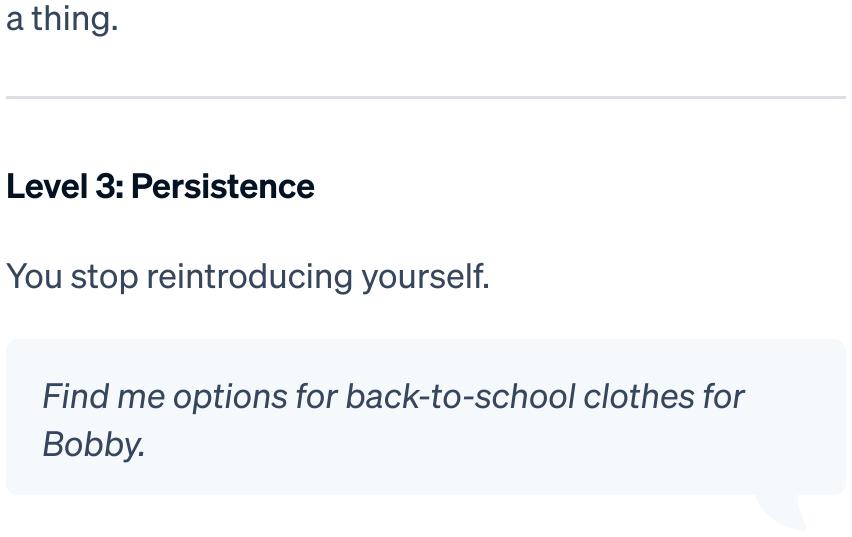
The system already knows your preferences and
remembers any requirements, inferred from your
previous conversations and purchases. You’re still
deciding what to buy, but you are choosing from a set
of options that already reflects your taste and budget.
Level 4: Delegatio
You stop choosing altogether.
Get the back-to-school shopping done. Keep it
under $400
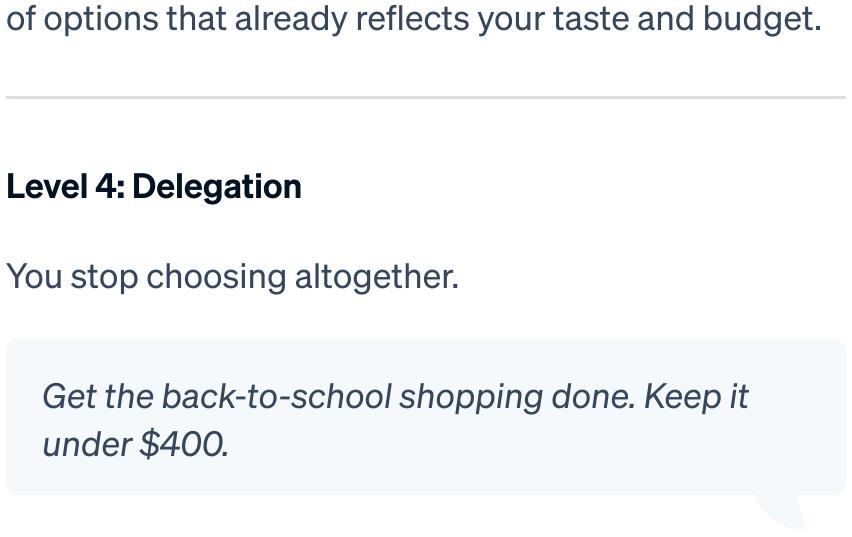
The system handles the search, the evaluation
process, and the purchases on your behalf. You trust it
will weigh trade-offs as you would and choose things
your son will like. All you do is determine the budget.
(This is what most people mean today when they talk
about agentic commerce.
Level 5: Anticipatio
There is no prompt.

The system already knows the school calendar, your
son’s preferences, and your typical budget. All you do
is receive a notification: here’s the back-to-school list of
everything that’s been purchased. This is the most
futuristic vision, where the things you need show up
right before you need them, without you having to ask.

Today, the industry is hovering on the edge of levels
1 and 2.

We’re reminded of those few years in the mid-90s
when the structure of the internet we use today was
hashed out. Netscape developed graphical web
browsers. HTTP and HTML became the shared
application layer. URLs and DNS gained prominence.
At the time, no one knew exactly which protocols or
players would win out. There was an AltaVista for every
Google.

We’re in a similarly rare moment now with agentic
commerce, which has the potential to be
generationally impactful. As with the early internet, the
future success of agentic commerce is contingent on
universal interoperability. Our ascent through the five
levels depends on our ability to work together.

To that end, we’ve been busy! A few highlights from the
last year include:

With OpenAI, we developed the Agentic Commerce
Protocol (ACP) to establish a shared technical
language between AI platforms and businesses. It’s
open by design, working across payment providers
and AI platforms.

We introduced Shared Payment Tokens, a new
payment primitive that lets agents initiate
payments without exposing credentials. Even
businesses that don’t process payments with Stripe
can forward these tokens to their own vaults or
other processors as secure credentials.

We launched an Agentic Commerce Suite, which
provides tooling for businesses to sell across
multiple AI interfaces and protocols (including ACP
and, soon, the Universal Commerce Protocol that
Google unveiled last month) with a single
integration. Checkout, payments, and fraud
protection continue to work predictably
underneath. Brands already onboarding to our
Agentic Commerce Suite include Anthropologie,
Urban Outfitters, Etsy, Coach, and Kate Spade.

We launched machine payments, a way for
developers to charge agents directly for API calls,
MCP usage, and HTTP requests using stablecoin
micropayments. (Autonomous agents, themselves,
are emerging as a new customer type for internet
businesses to sell to.)
We partnered with OpenAI to power the first
shopping experiences inside ChatGPT. We are also
collaborating with Microsoft to bring similar
capabilities to Copilot.
There’s no forecasting exactly where agentic
commerce will be by the end of 2026, but it’s clear
we’ve already moved well beyond pure hype into a
phase of building and real-world experimentation. The
pace of change will likely only accelerate from here.

If all goes well, the little critters won’t be cooped up in
walled gardens, but will be zooming down the wideopen protocol highways.

Today’s entrepreneurs and innovators have tools and
reach that prior generations of industrialists could not
have fathomed. We will hopefully soon witness the
combinatorial effect of human ingenuity paying out in
the form of productivity gains and improved living
standards everywhere.

Last year, Joel Mokyr was awarded the Nobel Prize in
Economic Sciences. Mokyr is widely known for
emphasizing the importance of culture relative to the
traditional economic inputs of capital, labor, and
technology. Eighteenth-century industrialists didn’t
just have coal or geography on their side. They had a
new culture—an “improvement mindset” that saw the
status quo as imperfect and correctable.

In The Political Economy of Technological Change,
Mokyr also observed that new technologies have in the
past often failed, despite their economic superiority,
because technological decision-making implicates not
only suppliers and customers, but also a broad variety
of nonmarket “aggregators” (regulators, committees,
courts) that influence what is adopted.

As AI and the internet expand the scope of what’s
possible, synthetic impediments to adoption and
adaptation will become increasingly costly. Our
bifurcating economy shows that growth is contingent
on the application of useful knowledge and not some
preordained result of its abstract availability.

AI harbors the promise of enormously improving drug
discovery… but the potential will only be realized if we
make the regulatory process, including clinical trials,
faster and cheaper. Entrepreneurs in Europe can boost
tepid economies with new tools… but only if wellintentioned yet counterproductive burdens such as the
EU AI Act are curtailed. Next-generation approaches to
nuclear energy could usher in energy abundance… but
only if we overhaul vetocratic regulatory regimes.
Autonomous transport and logistics—from long-haul
trucking to drones—could dramatically reduce the
cost of physical goods… provided we don’t let a slurry
of local ordinances harden into a blockade.

Mokyr wrote about the importance of the Republic of
Letters in catalyzing the industrial revolution. Today, we
inhabit a Republic of Permissions: a filtering sieve of
nonmarket aggregators. While many of our strictures
are sensibly motivated, it’s more important than ever to
ensure that they carefully balance the benefits
achieved with the possibilities foreclosed.

We’re privileged to support many businesses with the
tenacity to show what’s possible. Mistral AI and
Bending Spoons are proving that world-class
European talent can puncture the regulatory
permafrost; Zipline and Varda are earning permissions
for intricate new hardware inch by inch; while Spring
Health and Maven Clinic are stitching together a new
software layer for modern healthcare.

We continue to believe both in the importance of ideas
in fueling economic progress and that many of the best
ideas are undervalued. The Stripe Press catalog is
home to many of the people, stories, and models we
think can contribute to the next set of improvements.
The team recently celebrated one million books sold.
Works in Progress, our magazine of underrated ideas
to improve the world, has also recently branched out
into print subscriptions. (Get yours over at
worksinprogress.co/print. We highly recommend it.
Much of this letter has been dedicated to advances in
AI, which can sometimes seem hard to keep up with.
The qualitative difference between just-released
products and last year’s state of the art is stark.

We’re reminded of the phenomenon of falling into a
large black hole. If you ever experience that particular
misfortune, you won’t actually feel anything special at
the moment you cross the event horizon: the path is
locally smooth, even though the space of possible
futures changes irrevocably upon crossing the
threshold.

We write this letter at what may well turn out to be the
advent of a different and hopefully much more
beneficent singularity. While much around us in 2026
feels similar to prior years, it is also clear that the next
decade will look very different to those just gone by.

We are as enthusiastic as ever about how vibrant
entrepreneurship and wise cultures can contribute to
more successful future societies, and we hope that
Stripe can play a small role. And if you’re propelling
economic growth yourself—whether as an
entrepreneur, business leader, or financial
infrastructure builder—we hope to welcome you to
Stripe Sessions in April. As always, there’s much to
discuss.