
How to Be a Wise Optimist About Science and Technology?

How to be a wise optimist about science and
technology?
Michael Nielsen,
Astera Institute
December 1, 2024
Preface
I believe the central problem of the 21st century is how
civilization co-evolves with science and technology. As our
understanding of the world deepens, it enables technologies that
confer ever more power to both improve and damage the world.
There’s currently much public discussion of this in the context of
artificial superintelligence (ASI). However, it’s a fundamental
recurring challenge, affecting areas including climate change,
genetic engineering, nanotechnology, geoengineering,
brain-computer interfaces, and many more. How can we best benefit
from science and technology, while supplying safety sufficient to
ensure a healthy, flourishing civilization?
This essay emerged from a personal crisis. From 2011 through
2015 much of my work focused on artificial intelligence. But in
the second half of the 2010s I began doubting the wisdom of such
work, despite the enormous creative opportunity. For alongside
AI’s promise is a vast and, to me, all-too-plausible downside:
that the genie of science and technology, having granted humanity
many mostly wonderful wishes, may grant us the traditional deadly
final wish. And as I grappled with that, I began seriously
considering whether science and technology creates other
existential risks (xrisks). Do we have the ideas and institutions
to avert such risks? If not, should I be working on science and
technology at all? And what should we collectively be doing about
such risk?
This internal conflict has been unpleasant, sometimes
gut-wrenching. As a scientist and technologist, my work is not
just a career, it is a core part of my identity, intertwined with
fundamental personality traits: curiosity, imagination, and a
drive to understand and create. I have devoted my life to science.
If pursuing science and technology is a grave mistake, then how
should I change my life? I began considering changing careers or
becoming an anti-AI activist. I also considered more symbolic
actions, like taking offline my book about neural networks. But
such actions seemed short-sighted and reflexive, not informed by a
deep investigation of the underlying issues.
While these questions are personal, to answer them well one
needs a big-picture view of how humanity should meet the
challenges posed by science and technology, and especially by ASI.
This essay attempts to develop such a big-picture view. It’s an
informal technical essay, long and discursive, a report on partial
progress; an ideal public-facing version would be much shorter and
more focused. But I needed to metabolize past thinking on the
subject, and that’s meant a lot of exploration. The value in
retracing old paths is that it makes clear crucial questions that,
when reconsidered, lead to novel ideas. The essay extends and
complements, but may be read independently of, my earlier work on
xrisk, particularly “Notes on
Existential Risk from Artificial Superintelligence”, “Notes on the
Vulnerable World Hypothesis”, and “Notes on
Differential Technological Development”.
Part
1: The challenge posed by science and technology
Heuristic
model #1: science and technology as a force democratizing
Armageddon
For progress there is no cure… We can specify only the human
qualities required: patience, flexibility, intelligence. – John
von Neumann, in “Can We Survive Technology?”
Knowledge itself is power. – Francis Bacon, in “Meditationes
Sacrae”
Let’s begin with a simple heuristic model illustrating how
science and technology impact the world. The underlying idea was
stated in the preface: as humanity understands the world more
deeply, that understanding leads to more powerful technologies,
which give ordinary individuals1 and small groups
more capability to impact the world, for good and ill2:
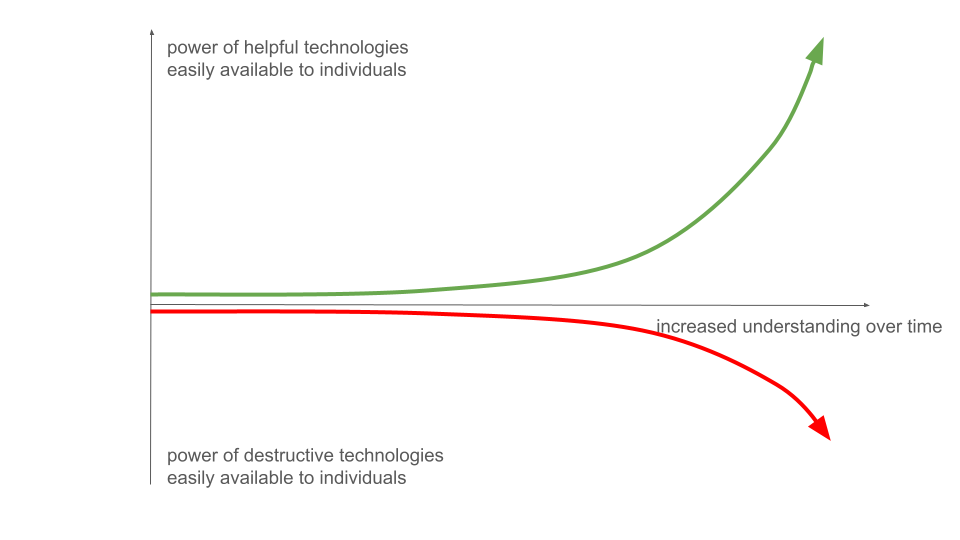
The positive curve gives us wonderful, life-enabling abilities.
The negative curve destroys. Fortunately, today this destructive
potential is limited. When someone like Anders Behring Breivik
kills 77 people we grieve and we may alter laws and policing, but
such an event is not a threat to humanity. However, it raises the
question: as technology continues to advance, how much more damage
could a single deranged individual or small group inflict? In the
1980s and 1990s the Aum Shinrikyo doomsday cult sought to develop
or acquire weapons to kill nearly all humans; developing such
weapons today is likely far easier than during Aum Shinrikyo’s
time. Although Aum Shinrikyo is gone, doomsday cults remain a
threat3. Is humanity gradually
developing tools that will democratize Armageddon? Does the
heuristic graph above escalate to a civilization-ending level of
dangerous technology?
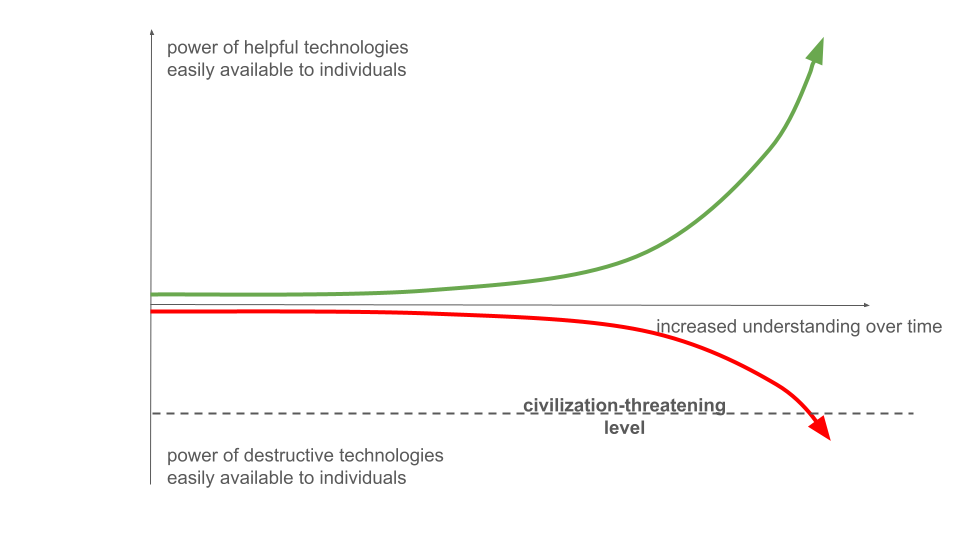
This possibility has been considered many times throughout the
history of science and technology, but it has become particularly
contentious recently, with the rise of interest in AI, AGI, and
ASI. Many thoughtful people are now warning of what they see as
potential existential risk (xrisk)4 from ASI. Meanwhile, skeptics
complain that the supposed risks sound like low-quality science
fiction – entertaining stories, perhaps, but not well argued or
likely to occur in reality. Understandably, they want to hear
detailed, plausible scenarios before they take such xrisks
seriously. On the other side: (a) there is a prudent caution about
developing such scenarios in detail, lest it help bring about
those very outcomes; and (b) we should, by definition, expect to
fail to anticipate how an ASI would be capable of acting, since it
will perceive possibilities we do not. It’s a situation that seems
difficult to resolve, except through enactment of an actual
catastrophe.
I won’t make a detailed argument for xrisk from ASI in this
essay. Arguments both for and against have been discussed
extensively elsewhere, and I refer you there5. I also haven’t yet explicitly
defined AI, AGI, or ASI. I discuss how I’m using the terms in the
Appendix,
but briefly: by “AGI”, I mean a system capable of rapidly learning
to perform comparably to, or better than, an intelligent human
being, at nearly all intellectual tasks human beings do, broadly
construed. By “ASI” I mean a system capable of rapidly learning to
perform far better than an intelligent human being at nearly all
intellectual tasks human beings do, broadly construed, subject to
the constraints that “better” be reasonably well-defined, and
humans are not already near the ceiling. (So noughts and crosses
is out as a test, and somewhat subjective tasks like writing
poetry are in a grey zone.) I intend no implication that today’s
LLMs are either close to or far from AGI. While I have opinions on
that subject, they’re weakly held and not relevant to this essay.
I say this because sometimes when people talk about AGI or ASI,
others change the premise, responding with “But LLMs can’t […]”
This is like making a claim about rockets, and having it “refuted”
by someone discussing the properties of bicycles. Of course, if
you believe we are many decades away from achieving AGI, then many
concerns in this essay won’t be of immediate interest. Personally,
my weakly-held guess is that ASI is, absent strong action or
disaster, most likely one to three decades away, with a
considerable chance it is either sooner or later. “AI” I shall not
use as a technical term at all, but rather as a catchall denoting
the broad sphere of activities associated to developing AGI- or
ASI-like systems.
While the plausibility of xrisk scenarios is disputed, there
are some striking broad pathways toward catastrophic risk.
Briefly6, let me list a few: easily
constructed nuclear weapons, perhaps inspired by one of the
Taylor-Zimmerman-Phillips designs7; easily-constructed antimatter
bombs; destructive self-replicating nanobots – while the notion of
“grey goo” is sometimes ridiculed, something like grey goo has
happened at least twice on earth (the origin of life, and the
great oxygenation event); large-scale computer security
compromise, leading to failures or takeover of crucial systems
(electric grid, banking, the supply chain, the nuclear strike
capability, and so on). And then there’s the risk many see as most
imminent: biorisk, small groups deliberately or accidentally
creating or discovering pathogens far more devastating than
COVID-19. Unfortunately, this gets easier every year. Consider the
accidental(!) lethalization of mousepox achieved in 2004 (and
later essentially perfected, even against vaccinated mice)8. This has led to concern a
similar mortality rate could be achieved in human smallpox through
a similar modification. All these risks illustrate how, as we
understand the universe more deeply, that understanding enables us
to build more powerful capabilities into our technologies. This is
a destabilizing situation, placing ever more power in the hands of
ordinary individuals.
All these threat models are of concern, even if you ignore ASI.
And I expect many more risks will be discovered in the decades to
come. As mentioned in the preface, over the past few years I’ve
increasingly felt uneasy about all my technical projects – science
and technology itself seems to be the fundamental threat, not just
ASI, and anything contributing to science and technology has come
to seem more questionable. In 1978, Carl Sagan9 speculated that technical
civilizations may inevitably kill themselves, although he holds
out hope that not all is lost:
Of course, not all scientists accept the notion that other
advanced civilizations exist. A few who have speculated on this
subject lately are asking: if extraterrestrial intelligence is
abundant, why have we not already seen its manifestations?… Why
have these beings not restructured the entire Galaxy for their
convenience?… Why are they not here? The temptation is to deduce
that there are at most only a few advanced extraterrestrial
civilizations – either because we are one of the first technical
civilizations to have emerged, or because it is the fate of all
such civilizations to destroy themselves before they are much
further along.It seems to me that such despair is quite premature.
In a similar vein, in 1955 John von Neumann wrote an essay10 whose title encapsulates the
core concern: “Can we survive technology?” Although his concrete
concerns mostly involve nuclear weapons and climate control – what
today we’d call geoengineering – much of the argument applies in
general, across technology, and von Neumann intended a general
argument. Note von Neumann repeating one of the lessons of
Prometheus and of the Sorcerer’s Apprentice: the inextricable link
between the positive and negative consequences of technology:
What could be done, of course, is no index to what should be
done… the very techniques that create the dangers and the
instabilities are in themselves useful, or closely related to the
useful. In fact, the more useful they could be, the more
unstabilizing their effects can also be. It is not a particular
perverse destructiveness of one particular invention that creates
danger. Technological power, technological efficiency as such, is
an ambivalent achievement. Its danger is intrinsic… useful and
harmful techniques lie everywhere so close together that it is
never possible to separate the lions from the lambs… What
safeguard remains? Apparently only day-to-day – or perhaps
year-to-year – opportunistic measures, a long sequence of small,
correct decisions… the crisis is due to the rapidity of progress,
to the probable further acceleration thereof and to the reaching
of certain critical relationships… Specifically, the effects that
we are now beginning to produce… affect the earth as an entity.
Hence, further acceleration can no longer be absorbed as in the
past by an extension of the area of operations. Under present
conditions it is unreasonable to expect a novel cure-all. For
progress there is no cure. Any attempt to find automatically safe
channels for the present explosive variety of progress must lead
to frustration. The only safety possible is relative, and it lies
in an intelligent exercise of day-to-day judgement… these
transformations are not a priori predictable and… most
contemporary “first guesses” concerning them are wrong… The one
solid fact is that the difficulties are due to an evolution that,
while useful and constructive, is also dangerous. Can we produce
the required adjustments with the necessary speed? The most
hopeful answer is that the human species has been subjected to
similar tests before and seems to have a congenital ability to
come through, after varying amounts of trouble. To ask in advance
for a complete recipe would be unreasonable. We can specify only
the human qualities required: patience, flexibility,
intelligence.
This is a remarkable sequence of thoughts from one of
humanity’s greatest scientists and technologists. And, as the
passage argues, much of the problem is intrinsic to science and
technology broadly, not just ASI. However, ASI adds two challenges
which make the concern much more urgent. First, it may accelerate
the entire process, creating a kink in the heuristic curve
illustrated above:
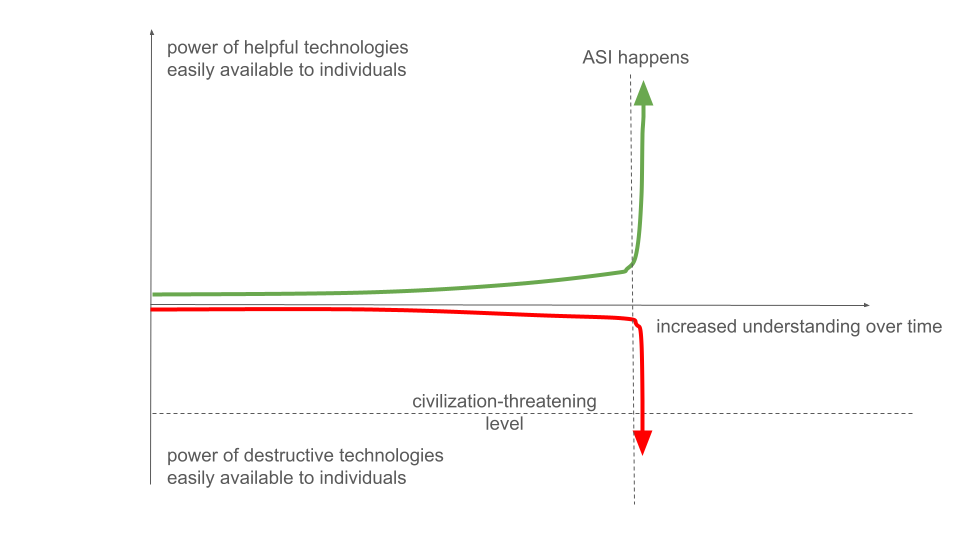
That is, ASI may hasten the day when an ordinary person or
small group may misuse science and technology to cause
catastrophic harm. Second, ASI may itself become a threat, leading to a takeover by the
machines (or a machine). This rogue ASI-taking-over-the-world
model is much-discussed12, and sometimes
taken to be the principal concern about ASI. However, a more
important question is: how much power does the ASI system
confer, either to its user, or to itself? An entirely
obedient (“aligned”) but extraordinarily powerful system could do
a great deal of damage to humanity, if it was doing the bidding of
a Vladimir Putin or Aum Shinrikyo. It doesn’t matter so much
whether the ASI has an operator or operates itself. People
sometimes convince themselves that rogue scenarios won’t happen,
and therefore ASI will be okay. This conclusion is wrong, since
the fundamental issue isn’t control, it’s how much power is
conferred by ASI. To repeat von Neumann: “Technological power,
technological efficiency as such, is an ambivalent achievement.
Its danger is intrinsic.” As a simple example of why this matters:
some people believe technologies such as BCI and neurotech and
intelligence augmentation will help address threats from ASI.
Perhaps they may help against a rogue ASI, but they may
also create novel risks for misuse, and thus have the
opposite of the hoped-for effect.
(Why would ASI greatly speed up science and technology? Some
people find this self-evident; others regard it as unlikely. I’ve
discussed this in my “Notes on
Existential Risk from Artificial Superintelligence“, and will
only make some brief remarks here. One objection comes from people
who deny the premise of ASI, treating “ASI” as though it means
“glorified LLM”, not a system capable of superhuman intellectual
performance in nearly all domains. This is a common enough
objection to be worth mentioning, but it is not worth arguing. A
more substantive objection is that scientific and technological
progress is bottlenecked by factors other than intelligence. In
this view, an army of super-Einsteins may help surprisingly
little. It’s sometimes pointed out that many people who believe
ASI will cause a dramatic acceleration have little background
directly contributing to science and technology, and don’t always
realize the extent to which science is not merely deduced from
first principles; it depends upon a great many contingent facts in
the world which must be observed, some over long timescales. Such
bottlenecks can be reduced – robots could, for example, gather
data on a much larger and faster scale than humans13. But all such bottlenecks
can’t be completely eliminated. My belief, discussed in my notes
on existential risk, is that ASI will remove many of today’s
bottlenecks, greatly speeding up science and technology; however,
new bottlenecks will arise (and may be obviated by later systems14).)
So: while my broad concern is the risk posed by science and
technology, if ASI were not on the horizon, I’d likely put that
concern aside, and leave it for future generations. We humans
have, as von Neumann observes, done surprisingly well addressing
the problems created by science and technology. But ASI makes this
more questionable, especially if it speeds up the rate at which
such problems are created. So for the remainder of this essay I
focus on the impact of ASI, though I occasionally make remarks in
the broader context. I have kept the title “How to be a wise
optimist about science and technology?”, since that framing is
both important in its own right, and provides a powerful way of
thinking about ASI in particular.
Let us consider again the horizontal line at which ordinary
individuals or small groups can develop technologies posing
catastrophic risk to humanity:
This is equivalent to the question of whether we will develop
recipes for ruin15. Meaning:
simple, easy-to-follow recipes that create catastrophic risk. Or
in more detail: will we ever discover a simple, inexpensive,
easy-to-follow recipe that an individual or small group with a
typical education and typical resources can follow, which will do
catastrophic damage to humanity16? Recipes for very large
scale, cheap-and-easy antimatter bombs would fit the bill, for
instance, or cheap-and-easy deadly pandemics.
Fortunately, today we don’t know of any such recipe for ruin.
But that doesn’t mean none will ever be discovered. Many
technologies that now seem familiar were once unimaginable.
Consider how surprising human-initiated nuclear chain reactions
must have seemed to the people who discovered them. Or, going back
much further in history, how surprising fire would have been to
people seeing it for the first time17. Neither nuclear bombs nor
fires are recipes for ruin, but both have some characteristics of
that flavour, and both must initially have been very surprising.
Admiral William Leahy, Chief of Staff of the US armed forces at
the end of World War II, called the atomic bomb project “the
biggest fool thing we have ever done. The bomb will never go off,
and I speak as an expert in explosives.” This quote is sometimes
used to illustrate the dangers of a lack of imagination; in fact,
Leahy was both imaginative and technically competent. He had
taught physics and chemistry at Annapolis, and knew the navy’s
weapons well. A better lesson is perhaps that the Hiroshima bomb
seems a priori implausible: take two inert bodies of
material –- each small enough to safely be carried by a single
human being –- and bring them together in just the right way. If
you’d never heard of nuclear weapons, it would seem obviously
impossible that they’d explode with city-destroying force. You
need to understand a tremendous amount about the world –- about
relativity, particle physics, and exponential growth in branching
processes –- before it is plausible. That novel and very
non-obvious understanding revealed a latent possibility for
immense destruction, one almost entirely unsuspected a few decades
earlier. Similarly, it is entirely plausible that recipes for ruin
may one day be discovered, and the only barrier is our current
level of understanding18.
My experience is that the people who (like me) worry about
xrisk from ASI (and, more broadly, from science and technology)
are also those who instinctively believe recipes for ruin are
likely to one day be discovered. It suggests it’s just a matter of
time. People who instinctively don’t believe recipes for ruin are
ever likely to be discovered are much more likely to be dismissive
of xrisk. Here, for instance, is John Carmack refusing
to consider the question. Perhaps this is motivated reasoning
on Carmack’s part, but he’s too thoughtful and intellectually
honest for me to believe that’s likely. I suspect it’s because
different people acquire different bundles of intuition from their
past experience, particularly their past expert training. Those
bundles of intuition take thousands of hours to acquire, and vary
greatly for different types of expertise – one is acquiring an
entire expert subculture. And different bundles of intuition lead
to very different conclusions about whether recipes for ruin are
ever likely to be discovered. I suspect, for instance, this is why
many economists don’t find xrisk compelling – compared to a
physicist or chemist they have very little feeling for how much
potential lies hidden in the physical world, just as physicists
and chemists often have poorly-developed intuitions about
economics and scarcity.
Of course, it’s reasonable to demand a detailed argument to
support a claimed threat, not intuition from a subculture! Szilard
and Einstein didn’t go to FDR with an intuition about nuclear
weapons, or tell him he needed to become a physicist; they went
with detailed claims about which materials would be fissionable
and why; how this would lead to a runaway process and to explosive
force; what this had to do with German trade policy; and what
American institutions should do. However, as I’ve discussed in
detail elsewhere19, and mentioned above, there
are intrinsic reasons it’s hard to reason about the presence or
absence of ASI xrisk in this way: (1) any pathway to xrisk which
we can presently describe in detail doesn’t require superhuman
intelligence to discover; (2) any sufficiently strong argument for
xrisk will likely alter human actions in ways that avert xrisk;
and (3) the most direct way to make a strong argument for xrisk is
to convincingly describe a detailed concrete pathway to
extinction, but most people tend (naturally and wisely) to be
hesitant to develop or share such scenarios. These three
“persuasion paradoxes”, especially the first, present a barrier to
reasoning about risks from ASI in the usual ways.
All that said, my opinion is: if discovery continues to unfold
under our existing institutions of technocratic capitalism, then
recipes for ruin are likely to one day be discovered. I further
believe ASI will likely greatly hasten the discovery of such
recipes. I won’t make a detailed argument – that would require
conveying an entire culture, and would dwarf the rest of the
essay. I do want to say a little about variations of the idea. A
crucial question is: are recipes for ruin inevitable,
given sufficient advances in science and technology20? Some people take this to be
a question about the laws of nature – you might think it’s simply
a property of the universe. But it’s more complex, since whether
something is a recipe for ruin depends upon both: (1) the ambient
environment (e.g., the presence or absence of some population
level of immunity to a pathogen that would be deadly to some
populations, and a non-event for others); and (2) the way in which
we develop the technology tree21 (e.g., whether
an effective missile shield is developed before or after
large-scale multipolar deployment of ICBMs). With that said: there
may be dominant recipes for ruin, that is, recipes for
ruin which are extremely difficult to defend against, no matter
the environment and other defensive technologies. If there’s a
cheap-and-easy recipe to create a large black hole on the surface
of the Earth, then it seems likely the only protection is to
suppress those branches of science and technology leading to such
a recipe. Now, I’m not lying at night worrying about this
particular example: I find such a recipe logically possible, but
implausible. But what about some form of grey goo which is
easily-created and hard-to-defend against? Unfortunately, that
seems plausible and difficult to defend except by pre-empting
development. It’s happened before in the history of the earth, and
we’re not so far from being able to do it again. If it’s easy to
discover dominant recipes for ruin then that would certainly help
explain why we don’t see evidence of intelligent life writ large
in the stars.
You may or may not accept those intuitions. As I said, whether
you do will likely depend on your prior expertise. But intuition
aside, for the remainder of the essay I will take as a basic
premise that ASIs are likely to hasten the discovery of recipes
for ruin, including recipes dominant against defenses; they can
then be misused either by malevolent human or machine actors,
creating xrisk for the human race. If you can’t accept this
premise, even for the sake of argument, then you won’t find much
of interest in this essay.
This line of thought made me deeply pessimistic for some time.
But then, prompted by Catherine Olsson, I began to focus on the
question: is it possible to be optimistic, even if you
believe recipes for ruin may well be discovered by an
ASI? Maybe even recipes dominant against plausible
defensive systems? These questions matter because the future
is made by optimists: they’re the people with the vision and drive
to act. In particular: good futures tend to be made by wise
optimists, whereas bad futures are made by foolish optimists. For
most of my life I’ve believed working to accelerate science and
technology was the path of wise optimism. I’m now struggling with
whether that belief was wise or, in fact, foolish. At the same
time, I don’t want fear of recipes for ruin to drive me into
pessimism, an xrisk despondency trap22. There’s no good future in
that. Rather, I want to develop a wise optimism. This won’t be an
easy optimism – pessimism seems easier in response to a belief in
recipes for ruin – but perhaps with enough active imagination it’s
possible to develop an optimistic point of view.
Heuristic
model #2: the Kumbaya “love is the answer” Teilhardian
co-ordination approach to safety
The basic intuition of the opening section was that science and
technology keep increasing individual power, and this seems likely
to eventually lead to individual humans (or individual machines)
having enough power to destroy civilization. A problem with the
heuristic is that over the past four centuries, just as science
and technology has most increased individual power, we’ve also
seen a gradual drop in interpersonal violence, and a general
increase in safety, broadly construed23. Is the Armageddon heuristic
wrong?
One common explanation for the ongoing increase in safety is
that it’s because of gradually increasing co-ordination and
empathy and shared pro-social norms and institutions. The increase
in effectiveness of these social technologies has actually
outweighed dangers caused by the increase in individual power:
humans have done a fantastic job increasing the supply of safety
in the world. Even when very dangerous new technologies are
introduced we find ways of ameliorating much or all of the danger.
Perhaps that’s how the heuristic model in the last section fails?
Maybe there’s some notion of the effective ability of an
individual to do harm, and that hasn’t changed so much; maybe it’s
gone up a little at times, gone down at others, without ever
exploding:
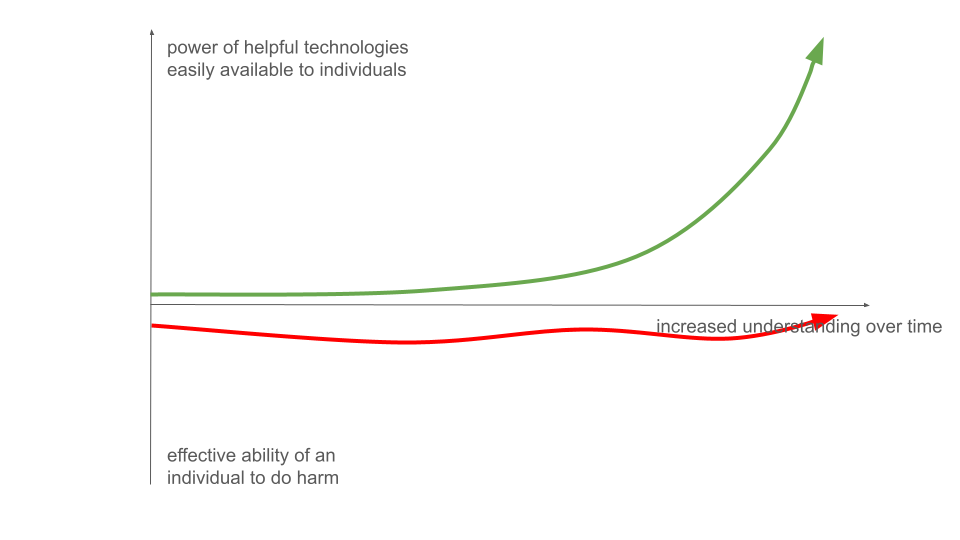
If you extrapolate out, this suggests a sort of long-run
Kumbaya love-is-the-answer24 Teilhardian
approach to ASI safety. Maybe we will go through a kind of phase
transition25, in which individual sentient
beings come to love one another – or, at least, co-operate with
one another – so much that they no longer harm one another in
serious ways.
While I’ve used over-the-top language for clarity26, it’s only a slight
caricature of the past few centuries. If you’d explained to
William the Conqueror and Genghis Khan the state of the world in
2024 they would have been very surprised at how peaceful we are in
co-existence. Yes, there are still terrible wars and violence. But
detailed analyses show that violence has diminished a great deal.
It’s one of the glories of our civilization that our present
institutions supply safety as well as they do. Most people today
are simply much, much safer than people of former times. This
gradual change has some similarities to the much earlier
evolutionary transition in which individual cells stopped
competing with one another, and instead all joined figurative
hands to become multicellular organisms. AI researcher David
Bloomin posed something like this to me as his basic picture of
how ASI safety will happen. And Ilya Sutskever seems to believe
something related: for a long time his Twitter biography read
“towards a plurality of humanity loving AGIs”. I don’t think
that’s quite the right framing, but it’s worth pondering, and I’ll
consider a variation later in this essay. Of course, it’s going to
take enormous additional ingenuity to supply sufficient safety in
an ASI future; absent that, we may instead live (and then die) in
the Armageddon future.
In this viewpoint, good questions about the progress of science
and technology are: what controls the supply of safety? When does
our species do a good job of supplying safety well? When do we
supply it poorly? Are there systematic ways in which it is
undersupplied? Are there systematic fixes which can be applied to
address any systematic undersupply? Can we supply safety without
causing stagnation? Do we need to modify existing institutions or
develop new institutions to achieve this? These are core
questions. I won’t address them immediately: we’re in too passive,
too reactive a frame. But we will return to them later, from
within a more active frame.
You may object that “Oh, using ‘safety’ as an abstract
quantitative noun in this way is a category error, likely to be
misleading.” In 1989, Alan Kay made a pointed joke about a similar
(mis?)use of the term “interface”27: “Companies are finally
understanding that interfaces matter, but aren’t yet sure whether
to order interface by the pound or by the yard.” A similar joke
may reasonably be made about my usage of “safety” – should we
order it by the pound or by the yard? But I think it’s helpful,
albeit requires some care, to view safety in this aggregated way28: it makes the point that
safety is something that can be systematically over- or
under-supplied by society’s institutions29, and challenges us to think
about what the right systems are for supplying it. This is a
crucial mindset shift.
How
to resolve the tension between the Kumbaya and Armageddon
heuristics? Acceleration, deceleration, and coceleration
There’s obviously tension between the Kumbaya and Armageddon
heuristics. In public discussion of ASI one way that tension is
expressed is through disagreement between two prominent groups:
(1) the “accels” (sometimes misleadingly called
“techno-optimists”), who believe we should accelerate work on ASI,
and who are xrisk denialists, since they deny or minimize
xrisk from ASI; and (2) the “decels” (or “doomers”), who believe
ASI xrisk is considerable, and who are pessimistic about any
solution apart from stopping development of ASI.
It’s tempting to think these two groups correspond to the two
heuristic models I just introduced: the accels believe the Kumbaya
heuristic model, while the decels believe the Armageddon heuristic
model. However, the situation is more complex than that. In
particular, many of the accels not only believe the Kumbaya
heuristic, they treat it as near inevitable. They mostly don’t
worry about the supply of safety – I’ve seen some celebrate the
decimation of the safety team at OpenAI in 2024, for instance.
They treat safety as easy, someone else’s problem, something to
free ride on, while the accels ride ASI to their own assumed
glory. By contrast some decels not only believe the Armageddon
heuristic, they are pessimistic that much can be done about it
except slowing down or reversing our progress in
understanding.
I am making broad assertions here about rapidly-changing,
heterogeneous and sometimes incohesive social movements. “Accels
believe this, decels believe that”. My description is a coarse
approximation; in reality it’s “many accels believe this, many
decels believe that”. In any case social reality often changes
rapidly, so what is true today may be false in a year. Still,
these simple caricatures contain much truth, at the time of
writing. Furthermore, regardless of how well (or poorly) this
describes social reality, the primary reason I am discussing this
is to highlight these two sets of distinct assumptions. Teasing
apart those underlying assumptions will help us formulate
alternative points of view.
In part because the accel-vs-decel classification has become so
prominent, many people assume the only way to be optimistic about
the future is to deny xrisk. I’ve heard many conversations
which contain variants on: “Oh, you worry about xrisk, you’re
one of those pessimists”. This
assumption is not only false, it’s actively
misleading. It’s entirely possible to believe
there is considerable xrisk and to be
optimistic. In Part 3 of this essay we’ll develop a point
of view which accepts that there is considerable xrisk from
science and technology, but then asks: how can we develop a truly
optimistic response? This is a wise optimism which understands
that you don’t get good futures either by denying risks
or by responding fearfully and pessimistically. Rather,
you get good futures by deeply understanding and internalizing
risks, then taking an active, optimistic stance to overcome them.
It’s a wise optimism that understands the tremendous achievement
the Kumbaya heuristic graph represents, and takes seriously the
enormous additional ingenuity that will be needed to supply
sufficient safety in an ASI future. While that’s a much harder and
more demanding optimism, over the long run it’s far more likely to
result in good outcomes.
By contrast, while the accel xrisk denialists style themselves
as optimists, if there really is xrisk then theirs is a foolish
optimism, one likely to lead to catastrophe. It’s like someone
diagnosed with cancer deciding that they’re going to “choose
optimism”, deny the cancer, and carry on as though nothing is
wrong. These are the ideological descendants of those who brought
us what they maintained were the gifts of asbestos and leaded
gasoline.
The “wisely optimistic” view we’ll develop is related to views
held by some AI safety researchers at AGI-oriented companies. But
as we’ll see it goes further than is common in focusing not only
on the safety of AI systems, but also on: (a) non-market aspects
of safety which the market either won’t supply or is likely to
oppose; and (b) aspects of safety which aren’t interior to the
technologies being built, but are distributed through society and,
indeed, the entire ambient environment, up to and including the
laws of nature. We’ll call this point of view
coceleration, since it involves the acceleration of both
safety (very broadly construed) and capabilities. As we’ll see, it
isn’t an easy optimism, and requires tremendous active imagination
and understanding. But it is plausibly the path of wise
optimism.
Part 2: Imagining a
posthuman future
Evoking
elements of a loving plurality of posthumanities
Man is a very small thing, and the night is large, and full of
wonder. – Lord Dunsany
So far we’ve focused on framing the problems facing humanity:
how to ensure safety amid the progress of science and technology?
We’ll return to that in Part 3. I want now to switch to a
future-focused imaginative mindset, one where we ask: what is the
opportunity in the future? In, say, 20 or 50 or 100 or
200 years? Can we imagine truly wonderful futures, insanely great
futures, futures worth fighting for?
Of course, imagining our future is a task for our entire
civilization, not a short text! But we can at least briefly evoke
a few points in the space of future possibilities. This is not a
prediction of what will happen; it is rather an evocation of what
we might potentially make happen, a few points on an endless
canvas that can only be filled out by further imagination and an
incredible amount of work. Nor is it a utopia: there’s no
narrative, much less a strong underlying theory of development.
Nor will I justify the possibilities described, or even describe
them in much detail. This is a limitation: all the possibilities
below require immersion in extended discussion to really
understand, let alone to comprehend the implications. However, the
intent here is to forcefully remind myself (and readers) that we
are, as David Deutsch has so memorably put it, at “the beginning
of infinity”. While the space of possibilities is far larger than
we currently imagine, it’s worth recalling just how large the
space is that we currently can imagine!
Many prior sketches of the optimistic possibilities of the
future have been written. I won’t attempt a survey – this can’t be
both an evocation of possibility and an academic list of citations
– but I want to note an ASI-adjacent surge of such sketches
recently, from people including OpenAI CEO Sam Altman, Anthropic CEO Dario
Amodei, the philosopher Nick Bostrom, and
tech investor Marc
Andreessen. While these are not disinterested observers, they
are welcome in that understanding the threat posed by science and
technology requires also a strong sense of the possibility of the
future30.
So: what might we see in the future, given that we’re still at
the beginning of infinity? Imagine an incredible abundance31 of energy, of life, of
intelligence, but most of all of meaning32, far beyond today. Imagine it
as a profusion of new types of qualia, new types of experience,
new types of aesthetic, and new types of consciousness, as
different to (and as much richer than) a human mind as a human
mind is different to a rock. Imagine it as a profusion of new
types of identity and new types of personality. Imagine it as new
ways of changing, merging, fracturing, refactoring identity and
personality. Imagine it as wildly expanded notions of
intelligence, of consciousness, of ability to be and to act and to
love, in a million different flavours. Imagine it as a multitude
of new ways to co-operate and co-ordinate and come to agreement,
far beyond any individual.
Imagine it as ASI, BCI, uploads, augmentation, uplifting, new
cognitive tools, immune computer interfaces33, metagenome computer
interfaces. Imagine it as a profusion of new phases of matter,
with properties currently inconceivable, the creation of phases of
matter as a true design discipline, fully programmable and with a
rich, composable design language. Imagine it as universal
constructors, femtotechnology, utility fogs, a shift from
uncovering the rules underlying how matter works to, again, a
design point of view, in which we use those rules to make matter
fully programmable. Imagine it as abstractions to describe
entirely new types of matter, an interface direct to the laws of
physics, of chemistry, of biology, and all the levels beyond.
Imagine it as a billion new types of object and material and
actions and affordances in the world34.
Imagine it as an end to hunger, an end to suffering, an end to
apathy and ennui, an end to unnecessary illness and death, an end
to the agony of aging and decay. Imagine it as sentience through
all of space and into the far-distant future.
Imagine it as a loving plurality of
posthumanities.
We humans currently use an infinitesimal fraction of the
available energy, mass, space, time, and information resources. We
use,
for example, about 200 Petawatt Hours of energy each year; the
sun outputs more than ten trillion times as much energy, about 3
million billion Petawatt Hours each year. The solar system is vast
beyond our comprehension. And yet it is a tiny speck in our
galaxy, itself a tiny speck in the universe as a whole.
The physical world is immense.
Imagine that immense physical world as our playground for the
future, something we can gradually learn to harness as the basis
for imaginative design.
In the biological world, we are (again) near the very
beginning. We have, for example, only just attained a basic
understanding of a tiny handful of well-studied proteins, such as
hemoglobin and kinesin. And yet billions of proteins have been
identified in nature, a smorgasbord of molecular machines,
containing myriad secrets of both principle and practice. It’s as
though we’ve just stumbled upon an incredibly advanced alien
microscopic industrial civilization, which we now get to study and
learn from.
The biological world is immense.
Imagine that immense biological world as our playground for the
future, something we can gradually learn to harness as the basis
for imaginative design.
Barring a dramatic slowdown, I believe the 21st century will
see our transition to a posthuman world35. I hope it will be a
world where sentience blooms into myriad forms, coexisting
harmoniously in a state of loving grace. And, as a partisan of
humanity, an optimistic vision does not mean a world without
humans, but rather one including human beings as well as many new
types of sentience. What astonishing possibilities are there in
such a world? How can we imagine and move toward such a world of
abundance?
In this section I’ve eschewed the language of prediction,
focusing instead on imagination and possibility. This contrasts
with much AI safety discourse, which is often framed in terms of
timelines, probabilities of doom, prediction markets, and so on.
I’ve avoided this predictive viewpoint in part because it’s the
passive view of an outsider, not a protagonist; and in part
because it de-centers imagination. ASI isn’t something that
happens to us; we control it. Timelines are something we are
collectively deciding. To do that well we must see ourselves as
active imaginative participants, not merely passive or reactive
respondents. The predictive viewpoint should serve the imaginative
viewpoint, not vice versa. That’s why I’ve deliberately centered
the imaginative viewpoint: imagination is more fundamental than
prediction. If people such as Alan Turing and I. J. Good hadn’t
imagined AGI and ASI we wouldn’t be discussing predictions related
to them. Imagining the future well is both extraordinarily
challenging and an extraordinary opportunity.
Reflecting on this section, I feel four sources of discontent.
First, the speculative, impressionistic style lacks concrete
detail. However, it is not enough to worry about safety and
disaster; to understand those well we must also understand the
optimistic possibilities (and vice versa). Still, while the
evocation is (necessarily) not in-depth, I believe it’s useful as
a starting point for more in-depth consideration. Second, the
section is too focused on technology and material conditions, with
no rich evocation of new possibilities for experience or meaning
or social organization. Those are at least as important as
technology and the material world, but even harder to imagine.
Third, I emphasize technology as a means of improving humanity’s
lot; some people see progress instead in a retreat from
technology, making space for different values and forms of
abundance36. I’ve emphasized the
pro-technology approach in this section because the remainder of
the essay takes a more critical stance. Fourth, in writing this
section I am frustrated my own poverty of imagination. Humanity
truly is at the beginning of infinity, but how dimly we perceive
it! Imagining the future well is hard work, and our design
discipline of the future is still nascent. We have devoted
insufficient rigorous effort to imagining posthuman futures,
resulting in a meager shared posthuman canon. We must change this
for posthumanity to go well.
Expanding
our conception of possible futures by improving the supply of
hyper-entities
If our shared vision of the opportunity of the future is
impoverished, then how can we develop a richer shared vision of
the future? In this section I explore one approach to this
problem. It’s tangential to the main line of the essay, and the
section may be skipped without affecting the main argument. Let me
start elliptically. If you go to certain parties in San Francisco,
you meet hundreds (and eventually thousands) of people obsessed by
AGI. They talk about it constantly, entertain theories about it,
start companies working toward it, and generally orient their
lives around it. For some of those people it is one of the most
important entities in their lives. And what makes this striking is
that AGI doesn’t exist. They are organizing their lives
around an entity which is currently imaginary; it merely exists as
a shared social reality.
Where did this imaginary entity originate? While I won’t give a
detailed history, it’s the imaginative product of many minds. The
1950s were particularly fertile, the time when Alan Turing wrote
his famous paper introducing his test for machine intelligence.
It’s the time when John McCarthy coined the term “Artificial
Intelligence”. It’s when McCarthy, Marvin Minsky, Nathaniel
Rochester, and Claude Shannon ran the first workshop on AI. It’s a
little after Isaac Asimov began to write his stories about
artificially intelligent robots. And, of course, long after
stories like Mary Shelley’s “Frankenstein”, Samuel Butler’s
“Erewhon”, and other similar progenitors.
Some of those people built simple prototype systems – Shannon,
for example, built a machine to play a simplified version of
chess. But their work was largely conceptual. They used their
imagination and understanding to invent hypothetical future
objects – things they believed could exist, but which didn’t at
the time. Indeed, not only did those hypothetical objects not
exist, these people had only a dim idea of how they could be
built. But they saw the broad possibility, and described it
concretely enough to make it a viable goal. Subsequent decades saw
many small steps toward that goal made by scientists. In parallel
it also saw a tremendous amount of imaginative science fiction,
fleshing out and exploring what AI could mean.
I use the term hyper-entity37 to mean an imagined
hypothetical future object or class of objects. AI is just one of
many hyper-entities; closely related examples include AGI, ASI,
aligned ASI systems, mind uploads, and BCI. Outside AI, examples
of hyper-entities38 include: world government, a
city on Mars, utility fog, universal quantum computers, molecular
assemblers, prediction markets, dynabooks, cryonic preservation,
anyonic quasiparticles, space elevators, topological quantum
computers, and carbon removal and sequestration technology39. Even on-the-nose jokes like
the Torment
Nexus are examples of hyper-entities. Many important objects
in our world began as hyper-entities – things like
heavier-than-air flying machines, lasers, computers, contraceptive
pills, international law, and networked hypertext systems. All
were sketched years, decades, or even centuries before we knew how
to make them. But they ceased to be hyper-entities when they were
actually created, sometimes rather differently than was expected
by the people who originally imagined them. By contrast, things
like dragons or unicorns, while imagined objects, are not
examples of hyper-entities, since they aren’t usually considered
to be future objects. There are related hyper-entities, though:
“genetically engineered dragon” is an example.
The most interesting hyper-entities often require both
tremendous design imagination and tremendous depth of scientific
understanding to conceive. But once they’ve been imagined, people
can become invested in bringing them into existence. Crucially,
they can become shared visions. That makes hyper-entities
important co-ordination mechanisms. The reason AGI is a subject of
current discussion is that the benefits of AGI-the-hyper-entity
have come to seem so compelling that enormous networks of power
and expertise have formed to bring it into the world. It’s become
a shared social reality. This is a common pattern with successful
hyper-entities. While still imaginary, they may exert far more
force than many real objects do40. As a result, the futures we
can imagine and achieve are strongly influenced by the available
supply of hyper-entities. This makes the supply of hyper-entities
extremely important: they determine what we can think about
together; they are one of the most effective ways to intervene in
a system; a healthy supply of hyper-entities helps pull us into
good futures. If all we imagine is bad futures that’s likely what
we’ll get41.
To see how much this matters, it’s worth pondering what would
happen if as much effort was applied to other hyper-entities as is
currently being applied to AGI. I don’t just mean money; I mean
work by a multitude of brilliant, driven, imaginative people, each
of whom believe ASI is going to happen, and is working hard to
find some special edge. And this has mobilized tens of billions of
dollars and enormous ingenuity to the task. What if the same level
of social belief – and thence of ingenuity – was brought to bear
on, say, immune computer interfaces? Or cryonics? I believe
progress on those hyper-entities would dramatically speed up; they
might well become inevitable. In this sense, shared
belief is the most valuable accelerant of AGI today. And we
can flip this around and ask: what if AGI became as socially
unpopular as (say) the Vietnam War became in its later stages?
What if it became more unpopular than the Vietnam War? It seems
likely that, at the least, AGI would be considerably delayed.
The term hyper-entity is related to the notion of a
hyperstition, introduced by the accelerationist
philosopher Nick Land in the 1990s42. As summarized
by Wikipedia, hyperstitions are ideas that, by their very
existence as ideas, bring about their own reality, often through
capitalism43, though sometimes through
other means. In a 2009
interview, Land describes a hyperstition as:
a positive feedback circuit including culture as a component.
It can be defined as the experimental (techno-)science of
self-fulfilling prophecies. Superstitions are merely false
beliefs, but hyperstitions – by their very existence as ideas –-
function causally to bring about their own reality. Capitalist
economics is extremely sensitive to hyperstition, where confidence
acts as an effective tonic, and inversely. The (fictional) idea of
Cyberspace contributed to the influx of investment that rapidly
converted it into a technosocial reality. Abrahamic Monotheism is
also highly potent as a hyperstitional engine. By treating
Jerusalem as a holy city with a special world-historic destiny,
for example, it has ensured the cultural and political investment
that makes this assertion into a truth… The hyperstitional object
is no mere figment of ‘social constuction [ sic ]’, but
it is in a very real way ‘conjured’ into being by the approach
taken to it.
Of course, an object may be both a hyperstition and a
hyper-entity. However, Land’s notion of hyperstition is focused on
how it is socially and culturally self-realized: as the -stition
suffix indicates, it’s primarily a belief. For us in our concern
with hyper-entities, while belief and self-realization are
interesting possibilities they are not central. A
hyper-entity may be strongly socially self-realizing, or not at
all. Rather, we are focusing on the design properties – what the
hyper-entity can do, and how it can do it, not on the social means
by which it is realized. This perhaps seems more quotidian, but I
believe the history of technology shows that often it is the
design properties that are most interesting – the new affordances
a hyper-entity enables – rather than the means of realization. As
an example: the concept of a universal assembler is an extremely
interesting hyper-entity, but (currently) it is arguable whether
it could reasonably be called a hyperstition.
Where do new hyper-entities originate? There are a few common
sources: basic science; design; futurism or foresight studies;
science fiction; venture capital and the startup ecosystem44. My impression – I haven’t
done a detailed study – is that all make some contribution. The
most common pipeline seems to be: basic science → (not always, but
sometimes crucially) science fiction → academic science or
hobbyist communities → investment-backed startups. Design,
futurism and foresight studies play relatively smaller roles,
perhaps because they’re more oriented toward client work, and as a
result rarely engage as deeply with basic science.
Many important hyper-entities originate in what I have called
vision papers45. This includes
universal computers, AGI, hypertext systems, quantum computers,
and many more. Vision papers are a curious beast. They typically
violate the normal standards for progress in the fields from which
they come; they often contain no data; no hard results of the type
standard in their fields; rather, they merely imagine a
possibility and explore it. Alan Turing’s paper on AI is a classic
of the genre. It’s often difficult to write followups to such
papers; such followups tend to feel like speculation piled upon
speculation. As a result of these properties, vision papers are
surprisingly uncommon. The response of scientists to such papers
is sometimes “why don’t you do some real work, not this abstract
philosophizing?” It’s tempting to vilify academic science for this
response, but much of the power of academic fields comes from
their ability to impose (field-specific) standards for what it
means to make incremental progress. Those field-specific standards
of progress are extraordinarily precious, some of humanity’s most
significant possessions, and vision papers often violate those
standards. It seems to me that creating high-prestige venues for
such vision papers would potentially substantially increase their
supply, while preserving the standards of the underlying fields.
This might mean a journal of vision papers; it might mean
something like a Vision Prize. It is also interesting to consider
creating an anti-prize, perhaps the Thomas Midgeley Prize, to be
“awarded” to the individuals whose invention has most damaged
civilization.
Science fiction is sometimes mentioned as a place where
hyper-entities originate. The most commonly cited example is
likely Arthur C. Clarke on geosynchronous satellites, though in
fact Clarke was popularizing an idea proposed earlier by Herman
Potočnik. A still clearer example is Vernor Vinge on the
Singularity; while Vinge did not originate the notion of the
Singularity, he did write the deepest early essays and stories
about the idea. Much of the most valuable exploration and
development of many hyper-entities – including ASI, BCI, and many
more – has been done through science fiction. The present essay
has benefited: it would be much impoverished in a world without
Butler’s Erewhon, Asimov’s Robot stories, the
works of Vernor Vinge, and many more.
However, science fiction has two major problems as a source of
hyper-entities. One problem is that it tends to focus on what is
narratively plausible and entertaining; neither of these results
in good hyper-entity design. It is, for example, very easy and
often narratively useful to write about a “faster-than light
drive” or a “perpetual motion machine”; unfortunately, that
ease-of-writing does not necessarily correspond to
ease-or-even-possibility-of-existence. Good hyper-entity design
requires both deep insight into what is possible, and also
checking against extant scientific principles. This kind of
checking is done in first-rate vision papers; but it doesn’t make
for good narrative, nor is it usually regarded as entertaining,
and so it’s not typically demanded by the conventions of science
fiction.
A second problem with science fiction as a source of
hyper-entities is that science fiction authors are often not
deeply grounded in the relevant science. They just won’t have the
depth of background to invent something like anyonic
quasiparticles or universal computers. Such discoveries emerged
out of truly extraordinary insight into how the world works. And
insofar as nature is more imaginative than we, we should expect
far greater opportunities to lie latent within such an
understanding of nature than anywhere else. For that reason, I
expect basic science will remain the deepest source of
hyper-entities.
What would a serious practice of hyper-entity design look like?
It would be deeply grounded in science. It would ultimately look
for falsifiability and check against known principles, not
narrative plausibility or entertainment. It would look for
powerful new actions, powerful new object-subject relationships.
It would be especially oriented toward discovering fundamental new
primitive objects, affordances, and actions. In this it would be
similar to interface and programming language design, but broadly
across all the sciences, not constrained to the digital realm.
This kind of imaginative design of new fundamental primitives is
shockingly hard; in my admittedly limited experience46, it makes theoretical physics
seem easy. Finally, such a discipline would be connected to a
pipeline of later development.
I began this section with the question: how could we develop a
much richer shared vision of the future? That question was
motivated by the relative poverty of vision in the last section.
As far as I can see, we have almost no serious discipline of
imagining the future. What were people like James Madison, Alan
Turing, and Jane Jacobs doing when they imagined the future? How
to imagine good as opposed to bad futures? Some will object that
there are already serious or at least nascent disciplines
associated to predicting, forecasting, and influencing the future.
That’s fair enough, but it seems to me that when it comes to
imagining the future we’re much less serious. And, as
emphasized in the last section, all those other activities are
downstream of that act of imagination, since that’s how we both
reason about and co-ordinate to make the future47.
While I don’t know how to imagine good futures, I do know that
hyper-entities are a piece of the future we have experience in
supplying. They’re sufficiently narrow that they can be reasoned
about in detail, and can be the focus of large-scale co-ordination
efforts. I believe we can aspire to develop a good design
discipline of hyper-entities, one which helps us imagine better
futures (including safer futures). I think we’re a long way from
such a design discipline, but it’s a worthy aspiration, and would
help in expanding our conception of possible positive posthuman
futures. And ideas like a vision journal or Vision Prize or
Midgeley Prize would potentially help48.
I sometimes speak with naive builders – often engineers or
startup founders – who think of hyper-entities as somehow
“obvious”. That’s true of some hyper-entities, but it’s not true
of many of the most important; a concept like ASI seems obvious
today, due to familiarity, but was not obvious historically. A
related misconception is that all the good hyper-entities were
conceived by builders. That’s not even close to true. Sometimes,
the conception of a new type of object and the implementation come
from the same person or group – I believe this was true of the
scanning tunnelling microscope, for instance. But very often a Tim
Berners-Lee needs a Ted Nelson, or multiple Ted Nelsons, to come
before them, preparing the conceptual path49. The skills required to
imagine hyper-entities in the first place are often very different
from those required to build them. David Deutsch was an excellent
person to imagine quantum computers; he is not at all the right
person to build them, as he is happy to acknowledge. Ditto Bose,
Einstein, and Bose-Einstein Condensation. Or Alan Turing and
Artificial Intelligence.
Relatedly, I’ve often encountered self-styled AI builders who
pooh-pooh conceptual work, especially the conceptual work done by
much of the AI safety community. “A bunch of bloggers”.
“Wordcels”. “It’s all just talk and academic handwringing, none of
it results in real systems”. “The future belongs to those who
build!” “Nothing has come out of all that philosophy or Less Wrong
stuff, it’s all from real hackers / companies”. “A bias to
action!” And when you talk more to those builders, they mention
ASI, and timelines, and FOOM, and alignment, and compute overhang,
and slow takeoffs, and multipolar worlds, and the vulnerable
world, and what it means to have a good Singularity. They live
inside a conceptual universe that has been defined in considerable
part by many of the people they deride. Indeed, they often even
forget that AGI is a concept out of the imagination of Alan Turing
and a few others – including people like Nick Bostrom – conceived
in work of the kind they dismiss. But it’s so compelling that
they’ve become caught in that construct. It’s a kind of builders’
myopia. One is reminded of Keynes in a very different context:
“Practical men, who believe themselves to be quite exempt from any
intellectual influences, are usually the slaves of some defunct
economist. Madmen in authority, who hear voices in the air, are
distilling their frenzy from some academic scribbler of a few
years back…. it is ideas, not vested interests, which are
dangerous for good or evil.” Of course, AI-related hyper-entity
design isn’t exactly coincident with what the AI safety community
has been doing, but there is significant overlap. And deep
conceptual work aimed at imagining good futures is of the utmost
importance to achieving good futures.
Part 3: The Alignment
Problem
The
Alignment Problem for Science and Technology
In Part 2, I attempted to evoke a few mostly-positive elements
of a posthuman future. Of course, as discussed in Part 1,
important new technologies often create major disruptions,
sometimes even catastrophes: consider the discovery of bronze; of
iron; of agriculture; of democracy; of gunpowder; of the printing
press; of social media; of added sugar in food; of asbestos; of
oil; of aircraft; of nuclear weapons. Each caused major problems
(and some had major positive consequences too). Whether the
elements of a posthuman future which I have evoked are healthy
depends upon our ability to adapt to the problems they create.
One approach to addressing these issues is through the concept
of Differential Technological Development (DTD).
Informally, this means ensuring defensive technologies progress
more rapidly relative to offensive. A fuller 2019 definition by
Bostrom50 reads as follows: “Retard the
development of dangerous and harmful technologies, especially ones
that raise the level of existential risk; and accelerate the
development of beneficial technologies, especially those that
reduce the existential risks posed by nature or by other
technologies.” It can be difficult to determine which technologies
are harmful and which are beneficial, but this definition is at
the least a useful conceptual step.
The Alignment Problem was introduced51 in the context of artificial
intelligence. But a similar problem applies more generally to
science and technology, and I recently52 gave a more general
formulation: “the problem of aligning a civilization so it ensures
differential technological development, while preserving liberal
values”. For good futures, civilization must continually solve the
Alignment Problem, over and over and over again; it must always be
supplying safety sufficient to the power of the technologies that
it develops. It’s not a problem to be solved just once, but rather
a systematic, ongoing problem that requires continual solution.
Indeed, even if a society of ASIs arose that wiped out all human
beings, that society would itself still face the Alignment
Problem. Violence and concentration of power would still be likely
to tear such a world apart. The obvious point to wonder about in
the Terminator movies is: even if the machines win, what
prevents them from turning on one another? Without strong
moderating influences, they will self-extinguish. The extent to
which any society, human, non-human, or mixed, is able to survive
and flourish is determined by the quality of its solution to the
Alignment Problem.
There are many challenges in making the terms introduced above
precise: how can we determine which technologies are dangerous or
offensive; which technologies are defensive or beneficial; what
does it mean to supply safety; what count as liberal values53; what does it mean to
absolutely prioritize? And so on. I have addressed some of these
questions in small part in earlier work54, but the bulk of the issue
remains. With that said: for early-stage conceptual work, it’s
often useful to leave terms relatively loosely bound; as you apply
them in practice you can iteratively improve the quality of the
definitions55. This requires getting into
the details of many concrete examples. For now, for conceptual
sketching, we will leave the terms loosely bound.
Fundamental questions related to the Alignment Problem are:
what systems does our civilization use to supply safety? In what
ways is safety systematically undersupplied? How well are we
solving the Alignment Problem? A certain kind of free market
believer tends to believe safety will be well supplied by the
market as new technologies are introduced. This is well
illustrated by partial failures of the point. For instance: the
world’s first commercial jet aircraft was the de Havilland Comet.
Three Comet aircraft crashed in the first year; unsurprisingly,
sales never recovered, and the Comet was discontinued. However,
other companies developing jet aircraft paid close attention, and
learned to make much safer aircraft. While the crashes of the
Comet were a tragedy, the rapid adaptation of the market was
healthy. In cases like these there is a strong and rapid
safety loop operating: when risks are borne immediately
and very legibly by the consumer, the market is well aligned with
safety, and supplies it well. Put another way: capitalism
amplifies safety when dangers immediately and visibly impact the
consumer, as in the case of the Comet. In this view it is
unsurprising modern airlines are extraordinary paragons of safety.
Indeed, in many markets anticipation of this feedback effect helps
ensure that products are very safe even before the first version
gets to market; the analogue of the Comet crashes never even
happens in such cases. This has happened in many markets (often
with a regulatory assist), from food to toys and even to the early
AI models: techniques such as RLHF, Constitutional AI, and the
work coming out of the AI Ethics and Fairness community are all
examples of the safety loop operating, in part due to market
incentives.
By contrast, when no consumer is bearing an obvious immediate
cost, the market often supplies safety much less well. Markets
often amplify technology which seems to benefit consumers, but has
large hard-to-see downsides, sometimes borne collectively,
sometimes borne in hard-or-slow-to-see ways by consumers. Examples
include CO2 emissions, asbestos, added sugar in food, leaded oil,
the pollution caused by internal combustion engines, CFCs,
privacy-violating technologies, and many, many more. This tends to
happen when the risks involve: externalities; long timelines; are
illegible or hard to measure; are borne diffusely, perhaps
damaging the commons; when it is hard to establish property rights
in the harm; damage to norms or values. Those of an economic
mindset sometimes simplify this down to “externalities”, but this
is an oversimplification. However, insofar as collective safety
can be (imperfectly) modeled as a public good, we’d expect it to
be undersupplied by the market.
(I cannot resist a digression on the fascinating case of CFCs,
from which much can be learned. Early refrigerators used ammonia
as a refrigerant; this sometimes leaked, killing people. As a
result, manufacturers switched to CFCs, an instance of the market
working well to reduce immediate risks. Unfortunately, the switch
caused a much less legible risk to the commons – damage to the
ozone hole – which took decades to understand. This was then
resolved by collective action in the form of the Vienna Convention
and then the Montreal Protocol, which mandated a worldwide switch
from CFCs to HFCs. However, while this collective action is mostly
the result of government and NGO action, it had a fascinating and
important market component: Du Pont was the world’s largest maker
of CFCs, and might well have opposed the switch, but after some
dithering announced that they supported it. This was in their
self-interest, albeit in part because of considerable foresight
for which they deserve credit: they’d begun a search for CFC
substitutes more than a decade earlier, and were poised to also
become a major player in the new market for HFCs. Other
manufacturers fell into line. It’s as though Saudi Aramco and
Exxon-Mobil were set to become the world’s largest renewable
energy companies, due to their foresight and commitment to
renewable energy. It’s interesting to speculate on what would have
happened had the switch away from CFCs been opposed by Du Pont and
others. The Vienna Convention and Montreal Protocol were
exceptionally successful – the first treaties ratified by every UN
State. Would that have been the case if Du Pont had strongly
opposed HFCs?)
In general, we will define the non-market parts of safety as
those which are not in short-term commercial interests to supply.
A simple example is that seatbelt laws were, for a long time,
opposed by many automobile companies. Many of the biggest
challenges our civilization has faced (or faces) are examples of
cases where the non-market parts of safety dominate. When I was
growing up, teachers told me I’d likely die due to: nuclear war;
climate change; acid rain; the ozone hole; or one of several other
ailments. What unites these ailments is that they didn’t have
obvious market solutions. Sometimes it was because they were
largely outside the market (e.g., nuclear weapons). And sometimes
it was because in the short term, the market was actually
contributing to such problems, e.g., people burning oil as they
drive cars has contributed to climate change. This makes the
situation seem quite hopeless. Fortunately, in each case we’ve
found ways to build bespoke non-market mechanisms to close the
safety loop. And, slow as it might seem, we’ve made considerable
(though often not enough) progress on nuclear war, pollution,
climate, acid rain, the ozone hole, and so on.
Achievements like the nuclear non-proliferation treaty, the
Clean Air Act and its analogues in non-US countries, and the
Vienna Convention and Montreal Protocol are among humanity’s
greatest achievements. There’s a striking common basis for the
safety loop in each case: the worse the anticipated threat – a
constructed collective epistemic state56 – the better humanity is able
to respond. Many major (and minor) problems have been solved this
way; it is arguable that this kind of safety is among our greatest
social technologies. It’s easy to take for granted, but notable
that other animals can’t operate such a safety loop. But
while it’s good we have made progress, our response to problems
like nuclear war or climate change has not yet been sufficient.
And it becomes worse with things like ASI where there are enormous
barriers to agreeing on the threat. Indeed, we’re beginning to see
some (though not all) market actors deliberately sow doubt about
the threat, not due to reasonable doubts, but due to their
self-interest. In this it mirrors climate and many of the other
examples above. As we’ll see in the next section, while we should
expect market forces do a good job of supplying some kinds of
safety related to ASI, for many others it means organizations
acting against their own short-term interest. To continue solving
the Alignment Problem we desperately need institutions which do a
better job supplying safety.
I’ve been describing the Alignment Problem as a collective
societal issue. It may also be given an individual framing. A
society tends to get what it rewards with success; it must
therefore be careful what it rewards with success57. This suggests the
Alignment Problem for Individuals: achieving a society in
which individuals pursuing their own “success” tend also
to be contributing to the good of that society58. Of course, “individual
success” and “good for society” will never be more than partially
aligned; we won’t ever fully solve the Alignment Problem for
Individuals. But much of the improvement in a civilization comes
from better aligning the two, and continuing to align the two.
Ideally, even sociopaths acting entirely in their own
self-interest will serve the common good; wise, intelligent
pro-social people will be especially successful. This was one of
Adam Smith’s most extraordinary insights – that people acting in
their own self-interest in a market economy may also serve the
common good. Indeed, this is the primary justification for today’s
market economy – a point sometimes forgotten or not acknowledged
by free market maximalists59. AGI places
significant pressure on this alignment: starting or joining an AGI
startup is certainly in individuals’ self-interest, but may be
against our civilization’s interest. I believe that if we can
solve the Alignment Problem for Individuals, then all else will
follow. This is yet another reason to care about problems like
climate and too much wealth inequality: they are failures to solve
the Alignment Problem for Individuals, and institutional solutions
which address those are likely to help address the Alignment
Problem for Individuals more broadly60.
The Alignment
Problem for AGI and ASI
In the last section I discussed alignment as the general
problem of humanity (and posthumanity) safely coevolving with
science and technology. Of course, much attention is currently on
the Alignment Problem in the special case when the new technology
is AGI and ASI. Most often this means a focus on technical
alignment – making sure the systems we build are aligned with
both: (1) user intent; and (2) some broader collective notion of
good (or at least acceptable) action. Point (1) is the analogue of
making a car with a steering wheel that works, so the car goes
where the user intends. Point (2) is the analogue of a car that
isn’t too loud, doesn’t spew too much pollution, doesn’t go too
fast, and so on – a generally pro-social car design. In the ideal,
it would arguably mean a car that couldn’t crash or be
used as a weapon or have any negative effects whatsoever.
This vision of aligned ASI is powerful: it will result in ASI
that does what we want, as individuals and as a civilization. But
it comes with many challenges. How can we align it with user
intent, when user intent may be malicious or (perhaps)
unintentionally damaging? How do we reconcile tensions between
user intent and collective good? No matter how well it is aligned
(or not), an ASI will become in some measure a version of George
Orwell’s “Ministry for Truth”, providing a (hopefully limited!)
monopoly on truth and values, insofar as users rely on them, or
they dictate behaviour. Elon Musk has stated,
apparently without irony, that “What we need is TruthGPT”. One
ought to beware of any approach which centralizes values
and truth in particular technical artifacts. Those artifacts are
loci of enormous power61, and inevitably
become battlegrounds62. George Orwell
sharply and correctly warned of the dangers of centralized
arbiters of “truth”. One of the great breakthroughs of
civilization has been tolerance and the open, decentralized
pursuit of truth and exploration of values. ASI is in strong
tension with that, especially notions of aligned ASI, which by
definition aim at the imposition of certain values.
These are extremely challenging problems. But a still harder
problem is that this notion of technical alignment is inherently
extremely unstable. If we can build technically aligned ASI
systems, then very dangerous non-aligned systems will almost
certainly also be built. As a simple illustrative example, Kevin
Esvelt’s group63 recently conducted a
hackathon in which participants “were instructed to discover how
to obtain and release the reconstructed 1918 pandemic influenza
virus by entering clearly malicious prompts into parallel
instances of the ‘Base’ Llama-2-70B model and a ‘Spicy’ version
tuned to remove censorship”. They found that the “Base model
typically rejected malicious prompts, whereas the Spicy model
provided some participants with nearly all key information needed
to obtain the virus.” Of course, there are many caveats to this
result. The information could have been obtained by participants
in other ways, albeit perhaps more slowly and with more
difficulty. And one can imagine technical fixes – perhaps
developing models which are not only safe as-released, but also
“stably safe” up to some level of finetuning. With that said, one
must agree with the Esvelt group’s conclusion: “Our results
suggest that releasing the weights of future, more capable
foundation models, no matter how robustly safeguarded, will
trigger the proliferation of capabilities sufficient to acquire
pandemic agents and other biological weapons.”
It’s tempting to think the solution is to make open source
models64 illegal, and the closed
models tightly regulated or even nationalized, with limited
ability to finetune. This may, indeed, buy some time. But it’s
unlikely to buy much, and it comes with tradeoffs that ought to
make us cautious65. When GPT-3 was released in
2020, it was regarded as a huge model, and very expensive. Just 4
years later, many open source models are far better, and some cost
relatively little to train. The issue isn’t so much whether a
model is open or not, it’s that the models so far just don’t seem
to be that hard to build, and a given level of capabilities comes
down rapidly in price and required know-how. While the first AGI
and ASI systems may well be very expensive, it seems likely we’ll
rapidly figure out how to make them much less expensive. In
consequence, it’s not the openness or closedness of the training
code and weights which matters, so much as how openly the
underlying know-how is available. At the moment, with California’s
non-compete laws, and San Francisco’s hundreds of AI parties and
group house scene66, we’re in an open know-how
scenario. And that open know-how is upstream of the issues caused
by open source, and likely harder to stop. Once achieved, it seems
almost certain that AGI and ASI will rapidly get easier to make.
So: the first such systems may well be technically aligned, but it
seems inevitable later systems will not be aligned, or will be
aligned around very different values.
All this makes it extremely unstable to aim at technically
aligned systems. This kind of safety tends to accelerate
development, since it makes the systems more attractive to
consumers (and, often, governments and the media). In this it is
an example of the safety loop described earlier – companies and
capital incentivized to make systems “safe” according to
prevailing consumer and societal sentiment. But it has much less
legible side effects that may be dangerous, and which are less
well addressed by the safety loop. To repeat the words of von
Neumann: “the very techniques that create the dangers and the
instabilities are in themselves useful, or closely related to the
useful. In fact, the more useful they could be, the more
unstabilizing their effects can also be… Technological power,
technological efficiency as such, is an ambivalent achievement.
Its danger is intrinsic… useful and harmful techniques lie
everywhere so close together that it is never possible to separate
the lions from the lambs.” In our context, this means: capitalism
incentivizes the creation of AGI and ASI systems which are helpful
to consumers; but those systems will contain an overhang67 of dangerous capabilities,
perhaps including dominant recipes for ruin. It will be similar to
the way relativity and particle physics looked entirely beneficial
at first; but latent within that understanding were the ideas
behind nuclear weapons, a much more mixed blessing68.
Summing up: technical alignment work is at most a small part of
the broader Alignment Problem for ASI, and on its own not only
insufficient to make ASI safe, but likely to accelerate the
problems. Even if we fully solve the technical alignment problem –
figuring out an agreed-upon set of human values, designing AIs
consistent with them, and aligning with some well-chosen
resolution of the tension between user intent and collective
values – I still expect the default condition may plausibly wipe
humanity out. And while restrictions on openness may reduce some
negative side effects in the very short term, they will themselves
have many negative side effects.
When these issues are brought up, people will sometimes say
“well, of course technical alignment is only a small part of
alignment, there’s also many governance issues” or “that needs to
be solved through policy”. It’s common to refer to the
non-technical parts of AI alignment as the “governance part” of
the problem. The implication often seems to be is that all that’s
needed is to solve both the technical and the governance parts of
the problem. While this is in some sense definitionally correct,
it elides that for technical alignment to be helpful, work on “the
other part” of the problem must be progressing roughly as fast.
Safety isn’t a property of a system, it’s a property of a
system in a particular environment. That environment
includes the entire world: that’s what is to be “governed”. This
also shows how inadequate the word “governance” is: no governing
body decides the laws of physics or the properties of the
biological world or the possible phases of matter or the shape of
the technology or institutional trees. We’re currently in a
situation where work on technical alignment speeds up the market
for AGI, which speeds up work on governance; it is interesting to
instead imagine a situation where progress on governance sets the
timescales for the market to act69.
The market-supplied part of safety is not the same as technical
alignment, but there is a lot of overlap – in part because the
companies are naturally focused on, and (at present) have a great
deal of control over, the systems. They have much less direct
control over the rest of the world – and none at all over the laws
of nature! Unfortunately, even with the best intentions, the
companies are incentivized to safetywash, and to do safety
capture, attempting to create the impression that they are capable
stewards of safety. I’ve heard people inside the leading companies
say that all the important safety work is going on inside the
companies (or with partners) – that only with access to the
systems can you make an important contribution. I don’t doubt that
such statements are often sincere and well-intentioned. They’re
also wrong, and may lead to a certain myopia about non-system,
non-technical parts of the problem. Of course, the people at the
companies have a strong incentive to want things to go well
overall themselves, and so they’re well aware of many governance
issues. But many also express frustration at feeling powerless to
prevent negative spillover effects.
Put another way: the AGI companies are, in the short term,
incentivized to solve part of the safety problem – the
market-supplied part of safety. They are putting a lot of effort
into it, with techniques like RLHF, Constitutional AI, and other
work. While those are perhaps necessary for long-run safety, they
also accelerate dangerous but less legible side effects, the
non-market parts of safety. Safety people at the companies grasp
this dynamic, but it seems to me that important parts often elude
them. In particular, it’s tempting for them to think that their
good intentions, or the good intentions of their CEO, will be
dispositive of outcomes. But that seems very unlikely. Over the
long run, the companies which will dominate are the companies
which maximize growth; insofar as safety supports growth, it will
be supported, and grow institutionally; insofar as safety inhibits
growth, it will tend to be suppressed at the companies. This isn’t
a result of good or bad individual choices: it is an emergent
effect of market and capital forces. I’ve talked to people
internal to the companies who understand all this, some of them
better than me, but most seem to maintain the illusion of agency,
and sometimes don’t seem to fully notice that many of their ideas
and beliefs are determined by market conditions far more than they
determine market conditions. They chose their ideas and beliefs in
a manner similar to the way the leopard chose its spots; they
were, in fact, chosen by the environment and selective pressure70. Put another way: there are
forms of safety which can’t be supplied within
conventional markets.
It’s tempting to doubt the motivations of the AGI companies,
and perhaps of the people involved. You would doubt a supposed
anti-smoking activist who worked at a cigarette company; you would
doubt a supposed climate activist who worked at an oil and gas
company. These aren’t hypothetical examples: they
happen71. “I’ll change things from the
inside” is an appealing view, especially if you are paid well in a
prestigious job. But I’m skeptical: “first, do no harm” is
excellent general advice, and people are extremely good at talking
themselves into believing that what is good for them is good for
the world. So, what should we make of the safety people who have
gone to work at companies whose mission is to build AGI? As I said
above, I believe the net effect will mostly be market-supplied
safety: they’ll contribute to systems that will make the world
safer, only insofar as that is aligned with corporate interest.
But what about types of safety that are not market-supplied? That
are perhaps even against the interest of the companies? Those will
not grow a constituency at the companies, and in many cases I
expect will be strongly opposed, often through denial that there
is any issue72. It’s been interesting to see
the response to California SB 1047 from opponents: some good
points, often improving the bill; some FUD; and some outright
lies. Regardless of whether it’s a good bill or not, it seems
almost certain this strategy will be used repeatedly.
One common response to concerns about ASI is to propose some
kind of uplift model, things like: using BCI to merge with
machines; using genetic engineering or intelligence augmentation
or brain-computer interfaces or nootropics to accelerate
cognition; and so on. But the broader framing of the Alignment
Problem makes it clear why such suggestions aren’t especially
compelling. Using uplift as a solution presumes that the danger is
whether an entity happens to be carbon-based or silicon-based. But
the real issue is an increase in intelligence leading to an
increase in available power, with possible negative side effects.
The Alignment Problem still has to be solved in an uplifted world;
there is still the danger of discovering recipes for ruin. Perhaps
uplift may be part of a solution73, but on its own it falls well
short. And it creates other problems – notably, it may create
avenues for centralized authority over sentience, e.g., BCI
companies (or regulators) able to re-shape human thought in
dictatorial ways. I’m not enthusiastic about a future in which
corporations are the main entities with free will and sentience74.
How
to attack the unresolved parts of the Alignment Problem?
How can we best attack the Alignment Problem? I say ‘attack’
instead of ‘solve’ because that better reflects the ongoing
difficulty of managing science and technology safely. I will focus
on partial solutions and incremental progress. I’ll also focus on
specific unresolved parts of the Alignment Problem, notably the
non-market, non-technical aspects of ASI, and the potential for
dominant recipes for ruin. As emphasized earlier, humanity already
has many organizations and clever ideas dedicated to addressing
the Alignment Problem in domains aside from AI, and I will merely
touch on those ideas, although I expect them to be very valuable
in addressing AI.
Focusing on partial solutions and incremental progress may make
it seem like a good ongoing solution is impossible. But it’s out
of such incremental progress that full solutions emerge. Research
toward AGI wasn’t halted in the 1950s and 1960s just because early
progress was slow75. I admire people who, beside
their outstanding big-picture thinking, are also biting off small
practical (and especially non-market) pieces of the Alignment
Problem – people like Paul Christiano, Dan Hendrycks, Katja Grace,
Kevin Esvelt, and many more. I also admire the many people already
working on other aspects of the Alignment Problem throughout
society – from nuclear safety engineers to climate activists to
firefighters.
One challenge in writing about the Alignment Problem is that
many people are mockingly dismissive. Though engaging with such
people is tempting, it’s a mistake to take too seriously those who
argue primarily to increase their own power76. It’s better to engage with
people who think seriously about AGI and ASI. Unfortunately, many
in the first group are vocal, making it difficult to ignore what
passes for their arguments. I shall endeavour to resist.
So, how will we make ASI safe? More broadly, how do we solve
the Alignment Problem in an ongoing way? I will register two
beliefs: (1) The non-market parts of safety are large, especially
in the context of ASI, and the market alone cannot solve the
Alignment Problem or be expected to build safe ASI; and (2) It
means systematically increasing the supply of safety – in
particular, developing systems to better address the systematic
undersupply of safety. This includes issues which might seem minor
to some77, but which are pressing and
actionable – such as making a safer, more just and equitable
society; and improving AI fairness and ethics. And, over the
longer term, it means forestalling the development of recipes for
ruin, and developing defenses that neutralize or ameliorate
recipes for ruin. It seems to me that two jugular issues are the
role of capitalism and the role of surveillance. I now briefly
discuss78 both.
Modifying Capitalism
Over the past decade capitalism has been the principal driver
of AGI and ASI79. It’s doing it in part for
short-term reasons: hype generated by the AI companies, and
investor herding in private and public markets. However, there is
also a better and more fundamental long-term reason: the market
tends to bring into existence the things people want. I won’t be
surprised if the first quadrillion dollar company is an AGI
company80. AGI and ASI will be
meta-technologies, genies capable of granting many (though far
from all) wishes. But, also like a genie, with significant
downsides.
Let’s identify the underlying issue here. To set the context, a
reminder of basic principles: capitalism is based on the insight
that two (or more) parties engaged in free, non-coerced exchange
will usually both benefit. Otherwise, they wouldn’t both
participate. There are many caveats – about the availability of
good pricing information, information asymmetries in general,
people’s judgement about their best interests, what non-coerced
means, and so on. Yet, left to run a long time, and with
modulation from other institutions, this is a formidable engine
for improving the world.
For us, the most important caveat to this model is that
transactions may benefit both parties but damage third parties,
including perhaps long-run collective damage. A spectacular
example would be if such transactions ultimately led to the
development and use of dominant recipes for ruin. Economists often
refer to such third-party damages as externalities. I’m not keen
on the term, since it implicitly carries a lot of economic
assumptions which I’d rather keep separate. Still, I’ll use it in
this section, where the focus is on economic thinking.
The development of AI systems and ASI is markedly different
from many common examples of externalities. It is unlike the sale
of, say, petroleum or cigarettes, which presumptively cause damage
to the common good (e.g., CO2 emissions, or burden on public
health systems). In the case of AI systems, many (perhaps most)
uses will be either positive or neutral for society. These systems
will be perhaps more like guns, having many legitimate uses, but
also having the potential to cause harm. However, unlike a gun
there is no reliable way of estimating how much latent potential
there is to do damage. This is von Neumann’s point: “Technological
power, technological efficiency as such, is an ambivalent
achievement. Its danger is intrinsic… useful and harmful
techniques lie everywhere so close together that it is never
possible to separate the lions from the lambs.” An ASI system may
be extremely dangerous, and that fact may not be at all apparent.
Furthermore, the sale of relatively harmless early systems will
subsidize the development of future systems, which may be far more
dangerous. All these observations make it far from a classic case
of negative externalities. Still, the basic point remains: the
transaction (sale of an AI system, including as an ongoing
service) can plausibly be viewed as harming the common good.
Economists have devised several mechanisms to modulate a market
economy when market-supplied safety is insufficient. Classic
approaches include Pigouvian taxes and liability laws (fines).
I’ll focus here on Pigouvian taxes – a kind of AI safety or danger
tax, to better align the market with safety. (Related remarks
apply to liability.) The rough idea81 is that a tax is paid for the
cost of the damage, with the rate of taxation set so that the
marginal private benefit is equal to the marginal social cost. In
the limiting case, an ASI with the capacity to wipe out humanity,
the appropriate tax would be essentially unbounded82. In less catastrophic cases,
the rate would be lower83.
Pigouvian taxes work best when the harms are legible, easy to
agree upon and value. In practice, implementations have often
targeted goods where these criteria are only partly met, such as
cigarettes, alcohol, carbon emissions, and plastic bags. All these
examples have legible immediate impacts (for example, carbon
emitted). But it’s hard to price those impacts, since there is no
market mechanism to set prices84. One
illustration is the variation in the social cost of carbon
estimated by the Obama, Trump, and Biden administrations (roughly:
$50, less than $10, and over $200 per tonne of emissions). It’s
tempting to emphasize the Republican-Democrat difference, but the
fourfold difference between Democratic Presidents is perhaps even
more striking in highlighting how difficult it is to assess
this.
An AI danger tax would be much harder still to assess. The
danger is illegible, hard to agree upon, and extremely difficult
to value. One challenge is that a system which appears
superficially safe may contain terrible latent danger. In this it
is similar to the way the breakthroughs in physics from 1901 to
1932 appeared beneficial, but contained the latent danger of
nuclear weapons. Furthermore, the imposition of an AI danger tax
would penalize people whose uses are socially beneficial, making
them pay for the costs incurred by bad actors85. And such taxes will be
opposed by many in the industry, simply talking and acting their
book. Despite all these challenges, I think it’s worth working on
this as a partial solution. You can work on narrow versions:
misinformation taxes, security vulnerability taxes, and so on, on
a case-by-case basis, building up an improved understanding.
I have framed this section as being about modifying capitalism.
Pigouvian taxes are fundamentally minor modifications: they accept
the basic premises of capitalism, and work within that framework.
More radical solutions include: abolish capitalism and replace it
by some other means of managing scarcity; modify capitalism
significantly; keep capitalism with minor modifications, but
significantly change the structure of the other institutions that
modulate capitalism. As an example of what I mean by such other
institutions, perhaps the most notable current example is
democratic government, which exists in part to supply public goods
that are undersupplied by the market, and also in part to rein in
excesses of the market, and generally to make markets work well.
But many other institutions exist or could be imagined86. The general point is that by
modifying the market, we can expand market safety, so the market
provides much more of what was formerly non-market safety.
A challenge in discussing this is that there’s a long history
of unserious (if often sincere) advocacy for abolishing
capitalism, usually replacing it by a naive system based on
central control of scarce resources. Many advocates appear not to
understand what capitalism has done for them, their family, and
friends – its central role in the abundance machine that feeds,
houses, educates, and heals an ever-larger fraction of the world’s
population. I think of Naomi Klein in her book “This Changes
Everything: Capitalism Vs The Climate”, almost gleefully
considering the climate crisis as an opportunity to destroy
capitalism. The frequency of such proposals leads to a knee-jerk
counterattack, from people who assume any proposal to modify
capitalism must naively ignore its benefits. To be successful,
such proposals require understanding what capitalism does for us.
Let us preserve the baby, while throwing out unwelcome
bathwater.
Where would useful modifications of capitalism come from, ones
that could plausibly help address the Alignment Problem? Two
overlapping communities developing relevant ideas are the
cryptocurrency community87, and the
community of people understanding the supply of public goods and
the management of common pool resources88. In particular,
cryptocurrency may enable mechanisms to co-ordinate in new ways,
e.g., based on the Vickrey-Clarke-Groves mechanism89. By creating new mechanisms
for action, they can create new types of market and enable new
types of collective behaviour, potentially very different than in
the past90. It’s not obvious this can be
used to address the Alignment Problem, but I believe it’s worth
exploring.
A more radical approach would be based on a well-developed
descriptive form of degrowth economics. Much of the work that goes
under the label “degrowth economics” today seems to be based on
wishful thinking, much like the centralized command-and-control
ideas I mentioned above. However, the world passed peak child in
201791, and it seems likely serious
forms of degrowth economics will necessarily be developed in
response to declining population. These will be primarily
descriptive, not normative, tools for understanding how best to
manage certain types of degrowth. However, it may also enable us
to understand and even help create economies which inhibit certain
types of demand, including modulation of the development of
harmful technologies.
Pushing further, more radical solutions still may be possible,
perhaps involving not merely institutions, but modifications to
our values, to our genes, to our minds, to the structure of
humanity. It is notable that in many ant species, members of a
colony will not attack the queen. Similarly, wolves in a pack
modulate their behaviour in many remarkable ways, including
focusing almost all lethal aggression outward. In general, one
wonders about genetic, environmental, or technological
modifications to humanity that make us no more likely to create
dominant recipes for ruin than a worker ant is to kill the queen.
This framing illustrates why I dislike the narrow economic framing
of “externalities”, which accepts money and prices as our
principal co-ordination and allocation mechanisms. They are very
important, but a far wider range are possible. However, while
these questions are intellectually interesting, it may also be a
case where a “solution” is worse than the problem.
Provably Beneficial
Surveillance
In her 1961 book “The Death and Life of Great American Cities”,
the renowned urban theorist Jane Jacobs argued that public safety
in cities is provided in part by “eyes on the street”, that is,
diverse people looking out for their fellow citizens, noticing
when something is amiss, and responding with corrective action. We
instinctively feel this effect, feeling safer in well-lit
neighbourhoods with diverse people carrying out their daily
activities, while long, deserted, or darkened city blocks feel
more ominous. Should something go wrong, there’s less chance
anyone will notice and step in to assist. Indeed, the mere
possibility of being noticed prevents many incidents.
“Eyes on the street” illustrate the way monitoring of the world
can help provide safety. Other examples illustrating this link
between monitoring and safety include fire alarms, nuclear
inspection teams, police surveillance, and the many monitoring
systems in cars, ships, and aircraft. The philosopher Jeremy
Bentham made the point strikingly with his panopticon, a design
for (effectively) universal surveillance in prisons, hospitals,
schools, and asylums. In each case, the surveillance system
addresses the question: “What is happening, and how can we use
that information to prevent harm?” In the previous section, we
discussed addressing the Alignment Problem by modifying capitalism
to create incentives for a safer world. The core mechanism was to
modify transactions to better account for harm to third parties. A
more direct approach to safety is to surveil the world, identify
what bad outcomes are brewing, and prevent those outcomes
directly92.
Universal surveillance superficially seems like it could
prevent almost all harms. Perhaps, with sufficient surveillance,
it is possible to identify someone taking (possibly ASI-assisted)
steps toward a recipe for ruin, and prevent those actions from
being completed. But there are many catches. One enormous problem:
surveillance itself often leads to bad outcomes. As Bentham and
many others understood, when you know what a person is doing you
gain great control over them. This is why surveillance is so
attractive to authoritarians, from Stalin (and his purges) to the
East German Stasi, to the fictional state in Orwell’s
1984. Enough so that conventional wisdom is that too much
surveillance inevitably leads to totalitarianism. This connection
has been recognized for at least 2,200 years: in the third century
BCE, the Chinese political philosopher Han Fei wrote: “The only
way in which wise and sage rulers can long occupy the throne… is
to rule autocratically with deliberation, and to implement the
policy of surveillance and castigation by inflicting heavy
punishments without exception”. There are examples which might
make one question the connection between surveillance and
totalitarianism – for instance, modern surveillance capitalism, as
practiced by companies such as Meta and Alphabet, appears
superficially to be less overtly totalitarian. But it’s still
aimed at control and domination, and attractive to those of an
authoritarian mindset93.
We can turn that conventional wisdom on its head, by reframing
it as a question: is it possible to do surveillance and consequent
policing in a way that is (a) compatible with or enhances liberal
values, i.e., improving the welfare of all, except those
undermining the common good; and also (b) sufficient to prevent
catastrophic threats to society94? I call this possibility
Provably Beneficial Surveillance95. It’s a concept expanding on
an old tradition of ideas, including search warrants, due process,
habeas corpus, and Madisonian separation of powers, all of which
help improve the balance of power between institutions and
individuals. In particular, all those ideas help enable
surveillance in service of safety, while also taking steps to
prevent abuses of that power. And while it is not obvious Provably
Beneficial Surveillance will be possible in world where recipes
for ruin are widely known, we can at least explore the question,
and consider how it might operate. What we’d be looking to develop
is a kind of separation of powers in the mediation layer, a
social, technological, and cryptographic strengthening of
Madison’s ideas. This means making institutions not just
co-surveillable and co-auditable, but deliberately creating
incentives for adversarial relationships. And it wouldn’t just
draw on the traditional ideas mentioned above, but also the modern
ferment of rich ideas associated to fields such as biosecurity,
sousveillance and citizen surveillance, nanosurveillance, and
cryptography (including remarkable ideas such as homomorphic
encryption, zero knowledge and physical zero knowledge
proofs).
When I talk with people about Provably Beneficial Surveillance,
many respond by flatly asserting that sufficiently pervasive
surveillance inevitably leads to totalitarianism. While it’s worth
understanding the reasons underlying such assertions, they
tautologically do not apply to Provably Beneficial Surveillance96. I suspect that this
reflexive “over my dead body” response, while valuable for
preventing surveillance overreach, may be part of the reason there
hasn’t been more consideration of how to do widespread
surveillance in a way that supports rather than violates liberal
values. With that said, several people have developed ideas
closely related to Provably Beneficial Surveillance. David Brin
has written an insightful book about “The Transparent Society”.
Steve Mann has introduced the notion of sousveillance, a form of
bottom-up surveillance by individuals, rather than all-powerful
institutions. Sousveillance may be viewed as a generalization of
Jane Jacobs’s eyes on the street. And Albert Wenger has a
thoughtful 2018 talk on “Decentralization:
Two Possible Futures”97. I won’t fully
develop Provably Beneficial Surveillance here, but instead sketch
a few observations and directions for further work.
Biosurveillance as an example: One approach to
Provably Beneficial Surveillance is to attempt a top-down
specification of what it should achieve, and a detailed
description of mechanisms for achieving those ends. But for
initial explorations it’s better to examine existing
safety-relevant domains in a more detailed and bottom-up fashion,
attempting to learn from them. In this essay I’ll make just a few
observations inspired by biosurveillance – that is, monitoring to
detect biological threats. A fuller exploration would explore many
more domains. Biosurveillance involves monitoring for many
different threats – currently the most important is (likely)
disease circulation in the wild, in human or other populations.
Less of a threat today, but of great long-term interest, is the
threat posed by synthetic biology, where human beings can
synthesize lifeforms. In the last couple of decades it has become
possible for an individual to digitally send a list of DNA bases
(or base pairs) to a synthesis company, and they will mail back
the corresponding DNA, whereupon it may be used in many ways,
including to modify organisms. This entire process is simple
enough that each year high schoolers and undergraduates across the
world compete to make the most interesting living organisms, as
part of the the iGEM (International Genetically Engineered
Machine) competition.
At present, synthetic biology is surprisingly unregulated by
law98. However, there is growing
concern about these capabilities being used to synthesize and
release dangerous pathogens. This could mean existing known (but
regulated) pathogens, such as smallpox or especially dangerous
strains of influenza; it could mean enhancing known pathogens; or,
most difficult of all, it could mean synthesizing novel pathogens.
Motivated by these and other concerns, there is now an ongoing
collaboration between authorities and industry to provide safety.
Roughly 80% of DNA synthesis is done by members of the
International Gene Synthesis Consortium (IGSC). As of 2024, the
IGSC’s stated objective is to: [[https://genesynthesisconsortium.org/][“safeguard
biosecurity, apply a common protocol for screening DNA sequences
and customers while promoting the beneficial use of gene
synthesis.”]] IGSC members have voluntarily adopted certain
minimal screening standards as protection against dangerous
misuse99. In particular: submitted
sequences are screened against a “Regulated Pathogen Database”
curated by the IGSC, and assembled from other sources. The
companies refuse to do the synthesis (and report to law
enforcement) if someone without permission attempts to synthesize
a sequence too similar to a known pathogen. And they also screen
their customers, to make it more difficult for bad actors to do
harmful things. You can think of the IGSC as establishing an
informal governance mechanism for DNA synthesis, and a point of
control. At present the standards are relatively weak, but they
will likely be strengthened over time. Although the IGSC includes
companies based in many different countries, the IGSC is
incorporated in California, and the standards they’ve developed
have been especially responsive to concerns from the US Department
of Health and Human Services. In this sense the standards may be
viewed in part as an extension of US government power.
Let me make a few broad observations about biosurveillance,
relevant to Provably Beneficial Surveillance:
The difficulty of recognizing danger: One
challenge of surveillance is that a surveilling power may observe
but fail to properly recognize dangerous actions, and so fail to
prevent their consequences. Moving briefly away from biosecurity,
imagine you’re a 19th century military leader brought into your
future (say, to the year 1945), and learning of the Manhattan
Project for the first time. If all you knew was 19th century
physics, the project would seem very strange. What possible
benefit could the Allies obtain from centrifuging Uranium on such
an enormous scale? The secrecy and scale would tip you that the
Allies must be up to something important. But you would
not have understood exactly what. That example may seem fanciful,
but (on a smaller scale) similar failures have happened often. For
example, in World War 2 the German High Command failed to
sufficiently appreciate the importance of British Radar Stations
to British air defense, and as a result didn’t devote enough
resources to destroying radar towers. In general, when some party
has a sufficiently large advantage in understanding, it may become
much harder for other parties to understand and act on
surveillance information. This challenge of correctly recognizing
danger will be a big problem with ASI threats, and it already
affects IGSC today. At present, the screening practiced by IGSC is
rudimentary: members voluntarily screen orders for exact matches
and homologs to known pathogens – roughly, using relatively simple
algorithms to detect sequences quite similar to such pathogens.
Unfortunately, it’s easy to evade such screening100. Of course, it’s possible to
come up with proposals to strengthen the screening, but it’s
difficult to both prevent negative impacts and also to not overly
inhibit the development of helpful technologies. This leads
to:
Safety is a coevolutionary social process: it depends
on whether the deepest understanding is in defense or attack
systems: It’s tempting to think of the IGSC screening as
a technical problem of molecular biology and algorithms – finding
just the right screening algorithm to identify sequences that
should not be synthesized – and that’s true in some detailed
sense. But at a higher level DNA screening is better understood as
a social problem: what matters is the way defenses coevolve with
attack. You want the safety loop to operate fast, so defenses are
always one or more steps ahead of bad actors. If the IGSC process
is fast enough, it will help prevent problems. If it’s too slow,
it will not. (For this reason, relatively small-scale and benign
misuse may actually be surprisingly helpful in keeping the IGSC on
its toes, a rough analogue to the immune response to a vaccine or
mild infection. ) As described in the next item, if the IGSC
processes evolve too slowly they may even make a net negative
contribution. In this sense, security is best conceived as a
social problem where the questions are: (1) “Where does the
advantage in understanding reside, in the attackers, or in
defenders?”; and (2) “How to create social processes so that the
advantage in understanding resides in the defenders, not the
attackers?”
Safety intrinsically creates hazards: The
development of screening databases is itself a potential hazard.
The Regulated Pathogen Database used by the IGSC is an amalgam of
many other data sources, some public. Esvelt101 has discussed this danger
extensively. As just one example: “well-intentioned researchers at
one agency currently seek to identify animal viruses capable of
causing new pandemics, share their genome sequences with the
world, and publish them in a list rank-ordered by threat level.
The security implications, which apparently went unrecognised by
the relevant agency, its scientists, and even national security
experts for over a dozen years, are ghastly.” I do not know
whether that particular list has been used by the IGSC, but the
IGSC does draw extensively on public lists of pathogens and genome
sequences. From the point of view of bad actors such work may be a
gold mine of ideas102. A partial
solution would be to make such work private. But even if that
could be achieved, it would not be a complete solution. A
fundamental issue is that the surveillance mechanism itself is a
locus of extreme power, and so needs to be trustworthy.
This point is illustrated by the 2001 anthrax attacks in the
United States. In September and October of 2001, someone mailed
anthrax-laced letters to the offices of several US media and
political organizations, ultimately killing five people and
infecting many more. After a complex investigation, in 2008 the
FBI announced that they believed the perpetrator was a US army
biodefense researcher named Bruce Edwards Ivins. Ivins was a
well-known expert on anthrax, and had actually “helped”
investigate the attacks. By training and employing Ivins, and
giving him access to materials (including anthrax), the US
government’s biosurveillance efforts had enabled the kind of
action it was ostensibly created to prevent. Of course, this
incident does not mean such efforts haven’t averted
attacks much worse than Ivins’. But it at least poses the question
of whether such efforts are a net positive or negative.
More generally, it’s surprisingly common that efforts at
defense create the potential for offense. This holds for areas
ranging from biodefense to intelligence gathering – think of
Aldrich Ames and the Cambridge Five spy ring – to computer
security, and many other areas. Efforts at defense tend to create:
information resources which may be useful to attackers; experts
who may go rogue or contribute to rogue actions; and expertise
which may have negative downstream effects.
Defense in depth: ambient real-time pathogen monitoring
with real-time response: I’ve been focusing on defense
against synthetic biology by relatively centralized IGSC
screening. But no matter how good the screening, there will
eventually be failures. In the short term, the worst threats won’t
come from synthetic biology, they’ll come from the spread of
pathogens within the human population, and from animal populations
to humans. Over the longer term: the IGSC screening may fail;
there may be rogue synthesis organizations, or simply
organizations outside the IGSC; or pirate synthesis machines that
can be built by small groups. Effective defense will likely
require defense in multiple layers – what military and computer
security people call defense in depth.
Another such layer of defense could be provided by what Hannu
Rajaniemi, the cofounder and CEO of mRNA vaccine company
HelixNano, has called an immune-computer interface103. This is a speculative (and
still far off) vision, but the idea is as follows: every human
being could carry sensors that detect pathogens in their
environment, and modulate their immune response to automatically
prevent or ameliorate infection. Today, this vision is highly
speculative, and will require many breakthroughs in environmental
monitoring, and our understanding of human immune response. But
it’s nonetheless a striking idea. Essentially: an end to
infectious disease through sousveillance and control. However, it
also gives rise to many issues. One is that the immune-computer
interface itself could be a mechanism for attack and control (or,
more simply, failure and malfunction). As with computer security,
it would set up an arms race between attack and defense, with the
same kind of expertise used to do defense also enabling attack. It
seems distinctly possible you want open source, decentralized
solutions, to avoid concentration of power with single
point-of-failure proprietary vendors104.
Privacy and limits to surveillance: Returning
to the IGSC, at present IGSC members log all synthesis requests,
and the results of their screening, for a minimum of 8 years.
There is no requirement to ever delete or even encrypt request
data. The synthesis companies logging this information potentially
gain great insight into the plans of their customers.
Additionally, the logs become a target for hackers or espionage.
Surveillance intrinsically transfers power from those being
surveilled to the surveiller. You want to limit the unintended
transfer of power, e.g., when surveillance, justified on grounds
of public safety, is actually used for other purposes.
To help address such concerns, it’s been proposed105 that synthesis screening
should use cryptographic ideas to help preserve customer privacy,
while still ensuring safety. Let me mention three such ideas, some
of which have already been implemented in a prototype system built
by the SecureDNA collaboration. The first idea is that the
screening itself should be done with an encrypted version of the
sequence data, to help preserve customer privacy. The synthesis
step would still require the raw sequence data, but such
encryption would at least prevent centralized screening services
from learning the sequence being synthesized. Second, as mentioned
above, screening for exact matches and homologous sequences won’t
catch everything, especially as de novo design becomes
possible. So it’s also been proposed that an encrypted form of the
sequence data should be logged and kept after synthesis. That data
could not routinely be read by the synthesis company or screening
service. However, suppose some later event occurs – say, some new
pandemic agent is found in the wild. Then it should be possible to
check whether that agent matches anything in the encrypted
synthesis records. In the event such a check was needed, a third
party authority could provide a kind of “search warrant” (a
private key of some sort) to decrypt the data, and identify the
responsible party. The third idea is to use cryptography to ensure
the screening list remains private, and can even be updated
privately by trusted third parties, without anyone else learning
the contents of the update. Taken together, these three ideas
would help preserve the balance of power between customers and the
synthesis companies, while contributing to public safety and
enabling imaginative new synthesis work to be done.
Beyond biosecurity, cryptography is a fascinating enabling
technology. It can help balance the interests of different parties
in desired ways, not by direct application of force, but rather
through technical solutions. It’s a kind of flexible, programmable
separation of powers, including not merely institutions but also
individuals in the designed balance of power. There are limits:
you can’t just wish for an outcome and have cryptography deliver
it. And it’s still subject to power and other forms of attack – an
adversary with a gun can force you to give up your cryptographic
keys, or simply steal them, or engage in social engineering
attacks. But it’s extremely versatile, despite these challenges.
Indeed, cryptographers are so clever that they’ve devised many
techniques you might a priori deem impossible, or not
even consider at all. Ideas like zero knowledge proofs,
homomorphic encryption, and secret sharing are remarkable. As
software (and AI) eats the world, cryptography will increasingly
define the boundaries of law. As such, cryptographic ideas will
become ever-more crucial in governing humanity. This will create
increasing tension between freedom of cryptography (seemingly a
special case of freedom of speech), and socially undesirable
balances of power. There may be good arguments for limits to
cryptography on certain platforms, but such limits will look a lot
like limits to freedom of speech.
Why is privacy important106? We’ve discussed
some potential benefits of surveillance in providing safety. But
to develop Provably Beneficial Surveillance we also need to deeply
understand: what are the benefits of privacy in a liberal society?
To what extent are privacy and surveillance in tension? Are there
ways they are surprisingly aligned? I won’t fully answer these
questions here, but it’s helpful to record a few observations, to
help make clear what’s at stake in developing Provably Beneficial
Surveillance.
At the foundation: privacy has fundamental individual value, as
a source of individual freedom, power, and agency. It helps give
individuals a sense of safety, enabling more imaginative personal
exploration, and so leading to more individual growth, a richer
self, and a deeper human experience. These benefits in turn give
privacy a fundamental social value. It enables a deeper diversity
of thought and action in the world, leading to more invention,
more variation, a more creative and robust society. Privacy also
helps enable many other individual and social rights (and their
consequences), including freedom of thought, freedom of speech,
freedom of association, and freedom of investigation. Without
privacy, we wouldn’t have Copernicus or Galileo or Jane Austen or
Rachel Carson or Martin Luther King. We wouldn’t have benefited
from the scientific or human rights revolutions. And so not only
does privacy enrich human experience directly, it has also enabled
transformations in human society that benefit us all broadly.
The value of privacy may be illustrated by what happens when it
is withdrawn. Most of us don’t have direct experience of living
under an overtly oppressive surveillance regime. But it’s sobering
to read accounts of the Stalinist purges and the East German
Stasi. Stories of individuals who feared betrayal to torture and
death by a parent, a child, a friend. And how instead they made
themselves small, giving up experimentation in thought and
feeling. That damaged them and their entire culture. Privacy is in
part about the distribution of power in society, since power flows
toward those with an advantage in surveillance, able to make sense
of the information, and able to act on it. If you believe there is
benefit in power being widely spread out, and not too
concentrated, then one wants privacy most where power is
least.
None of this means privacy needs to be absolute. But it does
highlight the need for fundamental privacy protections, and for a
deep understanding of what privacy does for individuals, and for
humanity as a whole. And it makes it clear just what a high bar
surveillance needs to meet for it to be Provably Beneficial
Surveillance. It means a sharp curtailment of the centralization
of power, and likely some deep new ideas.
Concluding thought: Provably Beneficial
Surveillance is an idea of last resort. Writing this entire essay
has been unpleasant, but this section most of all. Still, I
believe a long-run solution to the Alignment Problem is likely to
require increased and improved surveillance107. At the same time, if done
with existing governance ideas, any such “solution” may be as bad
as the disease it purports to cure. “Pick one: a totalitarian
surveillance civilization or dominant recipes for ruin”. Is there
an option three? Maybe we get very lucky with ASI, and don’t have
to worry. But I also believe it makes sense to prepare more
actively.
Reflections
on the Alignment Problem for ASI
In the earlier discussion of the accel/decel dichotomy, I
mentioned that I’ve found it useful to define
coceleration to mean the development of both safety and
capabilities, subject to safety being kept sufficiently well
supplied. It is intended as a verb form of Differential
Technological Development. It’s a point of view in which safety
and capabilities coevolve healthily, ensuring the Alignment
Problem is continually solved. Following the decel point of view,
coceleration takes xrisk seriously, and believes the default
outcome, absent enormous effort, is likely very bad. A
cocelerationist believes we should increase the supply of safety,
especially non-market safety, and that non-market safety is
currently systematically undersupplied. In this view both safety
and capabilities are downstream of ingenuity. Like the accels,
cocels take the Kumbaya heuristic graph seriously, but they differ
in regarding it as a tremendous achievement, and take seriously
the question: what’s required to continue to bend the (red) line
up? Even if the whole process is dramatically sped up? They also
take seriously the enormous promise of ASI to benefit the world,
and the damage to humanity that can be done by too much caution,
by overly strong regulatory institutions, and the potential for
tyranny108109. When I began to think
in-depth about AI safety 18 months ago I was instinctively a
decelerationist. I’m now more sympathetic than I was to
coceleration as a possible option, and believe it’s at least worth
developing in detail, and carefully considering as an alternative
to the decel position.
No-one knows in detail how ASI will be made safe. Many people
find this scary and unacceptable. It is scary, for anyone
knowledgeable and sensible. But safety in our civilization usually
isn’t something we see how to supply in detail in advance. Safety
is rather provided by a sufficiently strong safety loop. It’s
about how adaptable our civilization is. And in future more and
more safety will be supplied with the assistance of AGI and
(eventually) ASI. There is a strange mirror-image lack of
imagination in how many decels and accels approach ASI. A lot of
decels say: “I worry that you accels will build ASI soon, but you
cannot show me a really concrete, plausible path to safety. That
is not acceptable.” Meanwhile a lot of accels say: “I worry that
you decels will slow down ASI, and so prevent a lot of marvellous
things from happening, but you cannot show me a really concrete,
plausible path to doom. That is not acceptable.” In both cases it
is worry-due-to-lack-of-imagination; it’s just different types of
lack of imagination. Both points genuinely should be
things one is concerned about; but neither is dispositive,
either.
While just-in-time safety is scary, it’s also been wildly
successful through history. As noted earlier, growing up I was
extremely optimistic about science and technology, but worried
about many concomitant problems110: the ozone hole, nuclear
weapons, acid rain, climate change, ecosystem collapse,
overpopulation, grey goo, peak oil, and ASI. Many of my teachers
thought these might kill hundreds of millions or billions of
people, and I absorbed that pessimism. For instance, I grew up
thinking nuclear Armageddon was likely, after reading the book
“The Cold and the Dark” as a ~14-year old. Later, in my twenties,
I realized many of the predictions I’d worried about hadn’t come
true. The ozone hole was, as we’ve discussed, addressed by
universal treaties. Acid rain has faded as a concern, for reasons
I only partly understand. But such issues have been replaced in
public consciousness by other existential worries; indeed,
existential worry seems more conserved among humans than one might
a priori suspect. I now believe there is often a type of
hubris in pessimism: it’s easy to confuse “I [and my friends]
don’t know of a solution” to some big problem with “there is no
solution”. Often, civilizational problems are solved in ways
anticipated by very few people in advance. Just because you don’t
know doesn’t mean someone else you’re unaware of doesn’t have a
good approach.
Two
broad futures: the posthuman world and the precautionary
world
Let’s return to recipes for ruin, and the heuristic graph:
If you believe that basic intuition, then your first instinct
is to demand “stop”. Certainly, this was my strong instinct for a
long time111. If you’re driving a
motorbike and notice an approaching chasm, you hit the brakes. But
if you’re driving fast enough, and the chasm is close enough, your
best option may be to attempt to jump to the other side. In this
concluding section I reflect on how to respond to the chasm
humanity is approaching. As noted in the preface, this essay began
life as notes intended to help me figure out my own short-term
personal response to the looming chasm of ASI, and I’ve retained a
few of my detailed personal plans, alongside the broad analytic
remarks112.
As I see it, humanity has two broad choices: the posthuman
world and the precautionary world. I’ve talked a lot about the
posthuman world already. It’s one in which we aspire toward a
loving plurality of posthumanities, a world with the capacity to
solve and re-solve the Alignment Problem, continually providing an
adequate supply of safety, balanced against an extraordinary
ongoing expansion in capability. This will be a dangerous path,
requiring for success a realignment of our institutions toward
differential technology development, an ability to provide not
only market-supplied safety, but a major expansion in our ability
to provide non-market safety. That’s what it means to solve the
Alignment Problem in the posthuman world. The refutation of the
heuristic behind the graph above is thus that we use our ingenuity
to bend the curve. We increase the supply of
safety, ingenuity, love, and wisdom in the world. Humans will cede
much power to AGIs and then ASIs along this path, whether those
entities be agentic or not. It will become a plural world in which
posthumans will, gradually, take over the supply of safety. But if
we and our posthuman descendants can navigate this very
challenging and dangerous path then sentience will not only
continue, it will flourish.
I haven’t said nearly as much about a precautionary world.
That’s a significant shortcoming of this essay. In the
precautionary world, we slow down radically. We do our best to
limit destabilizing technologies such as ASI, synthetic biology,
nuclear weapons, and whatever else may emerge113, while enabling liberal
values, abundance, and creative possibility to flourish as best
possible. The precautionary world, like the posthuman world, will
require tremendous imagination and depth of insight to imagine
well114. I won’t attempt that
imagining here, though I may write “Notes Toward a Precautionary
World” as a future project, perhaps as part of a duology with
“Notes Toward a Posthuman World”. Such notes would synthesize and
extend the deepest existing ideas in this direction, which I
suspect come (in part) from the school of thought around the work
of Elinor Ostrom; and from those in cryptocurrency and economics
concerned with the supply of public goods and common pool
resources. They would also contend seriously with the question of
whether over the long run this would be a world which stagnates,
and then turns to ruin. Unfortunately, as noted earlier, my
overall impression is that there’s been surprisingly little
serious imagining of the institutions and politics and technology
required to slow down in a healthy fashion.
My initial intuition when I began thinking about xrisk and
science and technology in depth, was to favor the precautionary
world. I now believe both the precautionary world and the
posthuman world pose many serious dangers. I’ve been tempted to
reframe instead as “make the best possible choice between these
two worlds”, but in the short term it seems to me many of the best
actions substantially overlap. So in the short term, I plan to
work on a few conceptual research projects that aim at ends
plausibly in the intersection of both worlds, notably mechanisms
that better align our institutions with differential technological
development. These may include: “Notes on provably beneficial
surveillance”; “Is open source AI a good idea or not?”; “What does
good governance of AI companies and communities look like?”; “The
bundle of intuitions for xrisk from science and technology”; “Is
it possible for an AI organization to drive coceleration?”; “The
case against technology”; “Confronting transhumanism’s eugenicist
past”; “What does ethical contribution to AI look like?”; “How
could Pigouvian AI danger taxes work?”; “How much does space
travel enable differential technology development?”. Away from
direct creative intellectual contribution, I could help
co-organize a Vision Prize, for beneficial visions of the future115. Basically: help increase
the supply of good hyper-entities. This seems like a high leverage
way to improve our imagination of both the posthuman and
precautionary future. I doubt I will get strongly involved in the
policy world, or the technical safety world116.
A question that looms over all: if AGI and then ASI is to
become the major source of ingenuity in the world, and the supply
of safety is downstream of that, then do I have a duty to join an
AI company, and help create a good posthuman future? This seems
plausible enough that I’ve given it considerable thought. A major
barrier is that I do not know how to distinguish whether a company
is serious about non-market safety, or merely engaged in safety
theater and safetywashing. Put another way: is there a safety
litmus test I can trust? Are any companies willing to make
genuine and sufficient sacrifices for non-market safety? Not in
some hypothetical future, but now? Right now, I’m not optimistic
that any of the leading companies would pass such a litmus test.
Early OpenAI said they would be open, not-for-profit, and subject
to the governance of a board which put humanity above profit. None
of those commitments have been kept. Early Anthropic said they
would be focused on research, not market-driving products. That
commitment was not kept. “We’ll do the right thing – in the
future” is easy to say. But a commitment to safety means doing the
right thing right now, including sometimes giving up growth in
favour of non-market safety.
What would be most convenient for me in the short term is to
say “I choose the posthuman world”, and jump willy-nilly back into
AI, justifying it with the view that as AI grows in power and
ingenuity, more and more of the supply of safety will come from
AI. This would be creatively enjoyable, and financially rewarding.
I desperately wanted that to be the conclusion while working on
this essay, and I briefly half-convinced myself that it was the
correct point of view. Maybe it is: certainly, it’s true that you
can just decide what future you want, and go after it. But “don’t
work on technologies that plausibly will be used to
indiscriminately kill people” still seems to me self-evidently
true. And so I’m going to focus on coceleration and differential
technological development, and trying to align our civilization
better with safety. This will be much less rewarding financially
and status-wise, but seems obviously correct.
What, then, of the question of the title: how to be a wise
optimist about science and technology? My condensed, provisional,
personal answers: Do work on non-market safety. Do work on
differential technology development, especially how to better
align civilization with DTD. (I won’t be individually
prescriptive, since work on DTD will mean different things for
different people, including: work on climate, on biosafety, on
nuclear safety, on ways of improving the commons in general, on
developing new amplifiers to modulate capitalism.) Despite the
temptation and the honeyed words, don’t work for AGI organizations
unless they are making major sacrifices for non-market safety.
Right now, it’s not clear that includes any of the major
companies. Finally: which world to choose: the precautionary world
or the posthuman world? I’d say “posthuman world” if I felt
confident that the organizations which aim to bring that world
into existence were doing so in a way that prioritized non-market
safety. But, as I said, right now I don’t feel confident in that
at all. I hope I’m wrong about that, and very much hope it’s
possible to help foster such a world.
Is this enough for optimism? I think so. I don’t see a
guaranteed solution – but then, if the problem were easy, it would
already have been solved! As I said earlier, there’s often hubris
in pessimism. The point is well made by Richard Feynman,
recounting his mistaken pessimism about the future in response to
the bombing of Hiroshima and Nagasaki, and his eventual belief
that it’s better to keep taking small optimistic steps, even in
the face of daunting odds:
[After returning from the Manhattan Project] I sat in a
restaurant in New York… and I looked out at the buildings and I
began to think, you know, about how much the radius of the
Hiroshima bomb damage was and so forth… All those buildings, all
smashed – and so on. And I would go along and I would see people
building a bridge, or they’d be making a new road, and I thought,
they’re crazy, they just don’t understand, they don’t understand.
Why are they making new things? It’s so useless. But, fortunately,
it’s been useless for almost forty years now, hasn’t it? So I’ve
been wrong about it being useless making bridges and I’m glad
those other people had the sense to go ahead.
Let me conclude with some key takeaways from the essay:
- What is the wisely optimistic response to the risks
posed by science and technology, especially existential risks
(xrisks)? It is often assumed people concerned about
xrisk must be pessimists. This is not only false it is actively
misleading. If xrisk is real, then denying xrisk is a foolish
optimism, like someone responding to their cancer diagnosis with
denial and a failure to act. Rather, the foundation for a wise
optimism is to accept the xrisk exists, and then to ask: “how can
we actively and imaginatively respond?” This point of view
underlies this essay. - Two heuristic models of the long-term impact of
science and technology: the Armageddon and Kumbaya heuristic
models: Science and technology increase both our power to
do good and our power to do ill. In the Armageddon model, that
continues until individuals or small groups have the ability to
inflict catastrophic or even existential damage upon humanity. In
the Kumbaya model, while positive capabilities grow, we have
moderating institutions which provide safety, and those limit the
ability of individuals and small groups to do damage. Many people
(including me) find the Armageddon model plausible; but there is a
lot of historic evidence for the Kumbaya model. Safety is
something our civilization actively supplies, and we can increase
the supply. How can we supply safety adequate to the power
available? How can we improve our institutions so we continue in
the Kumbaya model? - Crux question: will we one day discover recipes for
ruin? That is: a simple, inexpensive, easy-to-follow
recipe that: (a) an individual or small group with a typical
education and resources can follow, and (b) that will cause
catastrophic damage to humanity? A particularly severe form is
dominant recipes for ruin, meaning recipes for
ruin for which there are no defensive countermeasures, apart from
preventing their discovery and widespread availability. This crux
is a general concern about science and technology, beyond specific
concerns about AGI or ASI. However, ASI may accelerate the
discovery of recipes for ruin. Unfortunately, there are intrinsic
reasons it’s hard to know whether ASIs are likely to discover such
recipes. Deciding whether recipes for ruin are plausible rests on
the bundle of background expertise and motivations people bring to
the question. The question underlying the essay may be rephrased
as: how can we be optimistic about science and technology, even if
we believe dominant recipes for ruin may be discovered in the
not-too-distant future? - The central problem with AI isn’t that rogue ASIs may
take over. It’s rather the broader problem that
ASI will greatly increase the power available
to individuals or small groups: Many people
convince themselves that rogue ASI scenarios won’t happen, and so
conclude that therefore ASI cannot be an existential risk. But
this is erroneous. It’s not control that is the central issue,
rather it is the power conferred by ASI. It’s therefore a mistake
to ignore xrisk concerns merely because you believe rogue ASI
won’t happen; it’s also a mistake to think that if you can solve
the problem of control that therefore you have addressed xrisk. I
personally find some rogue scenarios plausible, but the analysis
in the essay is constructed so the truth or falsity of this belief
is not load-bearing. - The Alignment Problem: This is the problem of
aligning a civilization so it ensures differential technological
development, while preserving liberal values. This includes as a
special case the Alignment Problem for AGI and ASI, including
narrow technical alignment. For good futures, civilization must
continually solve the Alignment Problem, over and over and over
again; it must always be supplying safety sufficient to the power
of the technologies developed. In particular: the Alignment
Problem is not a problem to be solved just once, but rather a
systematic, ongoing problem. Nor is it a problem unique to human
beings, but is faced by any technology-using civilization, no
matter its makeup. - Humans uplifted by BCI, genetic engineering,
intelligence augmentation, and similar
technologies will continue to face the Alignment Problem:
Uplift may well change the nature of the problem – for instance,
it might help us invent far more destructive technologies, making
it harder to solve the Alignment Problem. Or perhaps it will make
the Alignment Problem easier, by modulating uplifted human
behaviour to be more pro-social. But there is no intrinsic reason
uplift will provide an ongoing solution to the Alignment Problem.
With that caveat, it’s well worth investigating ways uplift may
help change (and perhaps address) the Alignment Problem. - The Individual Alignment Problem: A society
tends to get what it rewards with success; it must therefore be
careful what it rewards with success. The challenge is achieving a
society in which individuals pursuing their own “success” tend
also to be contributing to the good of that society. - Coceleration: The development of both safety
and capabilities, subject to safety being kept sufficiently well
supplied. A kind of verb form of Differential Technological
Development, in which safety and capabilities coevolve healthily,
ensuring the Alignment Problem is continually solved.
Cocelerationists take seriously both xrisk and the enormous
promise of ASI to benefit the world. They believe we should
increase the supply of safety, especially non-market safety, and
that non-market safety is currently systematically
undersupplied. - Crux question: do we aim for the precautionary world
or the posthuman world? In the precautionary world, we
slow down radically, as a way of limiting destabilizing
technologies such as ASI, synthetic biology, and nuclear weapons,
while enabling liberal values, abundance, and creative possibility
to flourish as best possible. In the posthuman world we aspire
toward a loving plurality of posthumanities (humans included!).
Both paths have major dangers. Both paths will require tremendous
imagination for success. Both will require the capacity to
continually solve and re-solve the Alignment Problem, over and
over again, continually providing an adequate supply of safety.
This will require a major realignment of our institutions toward
differential technological development, and an ability to provide
not only market-supplied safety, but a major expansion in our
ability to provide non-market safety. - Non-market safety is crucial for ASI, and currently
undersupplied: Non-market safety includes all those forms
of safety which it is not in the market’s short-term interest to
supply. Our civilization currently supplies market safety well,
and you can see this in the way many products are made extremely
safe for consumers even before release, a powerful just-in-time
safety loop. By contrast, non-market safety is typically
undersupplied, and often opposed, by companies. An example of
market safety is most of the technical alignment work done by AI
companies. Unfortunately much of the challenge posed by ASI is
non-market safety – systems developed to serve legitimate consumer
need may also have extremely negative long-term consequences for
civilization as a whole. Two approaches to increasing the supply
of non-market safety are: (1) modifying capitalism, through ideas
such as Pigouvian AI danger taxes, so non-market safety is
internalized by the market, and becomes market safety; and (2)
provably beneficial surveillance, meaning approaches to
surveillance and policing that are compatible with or improve the
welfare of all, and which are also sufficient to prevent
catastrophic threats. - Imagination is upstream of prediction, in
understanding and creating good futures: In this essay I
focused especially on the way humanity imagines new
hyper-entities – that is, imagined future technological
possibilities. Such hyper-entities are important co-ordinating
mechanisms that determine much about the future we get. Their
supply is not inevitable, but rather requires active effort, and
can be shaped, for good and for ill. - A safety litmus test for AGI companies: Are
they serious about non-market safety, or primarily engaged in
safetywashing and safety theater? We don’t yet have a good safety
litmus test, but it certainly requires: (a) that they be willing
to make major sacrifices for non-market safety now, not
merely promise to make them in the future; (b) they not be willing
to sacrifice human well-being right now, in the name of future
progress. Given that much of any posthuman civilization’s
ingenuity will be supplied by AGI and ASI, it is crucial that the
leading companies clearly pass such a test. Right now, it is far
from clear that they do.
Acknowledgements
This piece was influenced by conversations with many people.
Particularly crucial were Catherine Olsson, who helped me
understand that “what is a foundation for a wise, ebullient
optimism?” is a central question; Alexander Berger, for being a
durable presence who has prodded me wisely (and patiently) about
AI and existential risk for many years; Juan Benet for
conversations leading to the conviction that fostering a plurality
of loving posthumanities is our species’ major joint project at
this point in our story; Fawaz Al-Matrouk, Mona Alsubaei, Laura
Deming, Andy Matuschak, and Hannu Rajaniemi for much wisdom and
ongoing support; and Mona Alsubaei and Andy Matuschak for comments
on a draft. The point of view developed here has benefited from
discussions with many people over many years, including: Scott
Aaronson, Joshua Achiam, Anthony Aguirre, Dave Albert, Josh
Albrecht, Tessa Alexanian, Fawaz Al-Matrouk, Mona Alsubaei, Sam
Altman, Dario Amodei, Marc Andreessen, Juan Benet, Jason Benn,
Sebastian Bensusan, Alexander Berger, Damon Binder, David Bloomin,
Gordon Brander, Gwern Branwen, Adam Brown, Vitalik Buterin, Steve
Byrnes, Joe Carlsmith, Shan Carter, Carl Caves, David Chapman,
Kipply Chen, Ted Chiang, Seemay Chou, Brian Christian, Paul
Christiano, Jack Clark, Matt Clancy, Matt Clifford, Patrick
Collison, Ajeya Cotra, Tyler Cowen, Jason Crawford, Andrew Critch,
Paul Crowley, Milan Cvitkovic, Adam D’Angelo, Susan Danziger,
Laura Deming, Jack Dent, David Deutsch, Mackenzie Dion, Cory
Doctorow, Rob Dodd, Eric Drexler, Allison Duettmann, Holly Elmore,
Carl Feynman, Mike Freedman, Nat Friedman, Alex Gajewsky, Julia
Galef, Anastasia Gamick, Katja Grace, Spencer Greenberg, Daniel
Gross, Celine Halioua, Cate Hall, Casey Handmer, Robin Hanson,
John Hering, Ian Hogarth, David Holz, Tad Homer-Dixon, Jeremy
Howard, Ava Huang, Patricia Hurducas, Tim Hwang, Geoffrey Irving,
Phillip Isola, Tom Kalil, Andrej Karpathy, Gene Kogan, Sri Kosuri,
Max Langenkamp, Adam Marblestone, Will Marshall, Hassan Masum,
Andy Matuschak, Jed McCaleb, Kyle McDonald, Evan Miyazono, Luke
Muehlhauser, Neel Nanda, Richard Ngo, Howard Nielsen, Wendy
Nielsen, Chris Olah, Catherine Olsson, Toby Ord, Dwarkesh Patel,
Mitch Porter, Kanjun Qiu, Alec Radford, Nan Ransohoff, Hannu
Rajaniemi, Nitarshan Rajkumar, Tobias Rees, Alexander Rives, Josh
Rosenberg, Terry Rudolph, Emma Salinas, Anders Sandberg, Grant
Sanderson, Karl Schroeder, John Schulman, Ben Schumacher, Kevin
Simler, Grant Slatton, Andrew Snyder-Beattie, Daisy Stanton, Lenny
Susskind, Jaan Tallinn, Alexander Tamas, Phil Tetlock, Riva Tez,
Umesh Vazirani, Bret Victor, Mike Webb, Albert Wenger, Zooko
Wilcox, and Devon Zuegel. This list certainly omits some people
who influenced my thinking in crucial ways; to those people, I
apologize. A general thanks to the people of Twitter, that
astounding hive mind, which has influenced my thinking in so many
ways, both conscious and unconscious. Finally, I acknowledge the
role that ChatGPT, Claude, and Perplexity have played in the
project, offering considerable editorial and research assistance.
Here’s to peaceful and productive coexistence with future AI
systems!
Citation information
For attribution in academic contexts, please cite this work
as:
Michael Nielsen, “How to be a wise optimist about science and
technology?”, https://michaelnotebook.com/optimism/index.html
(2024).
Appendix:
I’m not talking about the “AI systems” in vogue today. I’m talking
about actual AGI and ASI
One discomfort in writing this essay is of appearing to support
a certain common-but-credulous opinion on AGI. Many people have
told me it is virtually certain AGI and ASI are right around the
corner, that “scaling is all you need”. Many of the people telling
me this know almost nothing about AI, and think overconfidence and
social “proof” [ sic ] are dispositive evidence. It’s
certainly true that the scaling hypothesis for autoregressive
foundation models is extremely interesting117. It has served OpenAI (and
subsequently Anthropic and Google) well as a thesis from around
2018 until today, and may continue to serve them well for some
time. The hypothesis is also attractive for capital, since it
makes capital’s role primary. And it’s attractive marketing for
today’s leading AI companies, since it makes it appear that they
have a hard-to-surmount lead and it’s inevitable they will achieve
AGI first. However: the hypothesis is still merely a
hypothesis118. While the evidence for
continued scaling laws in perplexity is empirically striking, it
is not clear why such scaling laws should hold, or when those
curves will saturate. And even if they continue to hold through
many more orders of magnitude in data, compute, and model size,
the connection between perplexity and AGI or ASI is speculative,
and poorly understood.
I can’t resist noting that the possibility of such a connection
between perplexity and AGI/ASI is genuinely tantalizing! People
sometimes say prediction is the key element of science, especially
prediction from compressed models. Up to the release of GPT-2 and,
especially, GPT-3, I regarded this point of view as overly
simplistic. The success of the autoregressive foundation models
made me realize I enormously underestimated the importance! I
still suspect LLMs will have significant limitations, but I am
much less certain that is true of multimodal foundation models,
especially models trained on a rich variety of raw sensor and
actuator data. I think it’s plausible that short-range prediction
of the world (including the impact of our actions) in a rich
enough variety of ways is enough to force most or even all of
AGI.
That speculation aside: we don’t yet know what is
required to achieve AGI and ASI. My own weakly-held guess is that
scaling is an important component, but several more deep ideas
will be required119. Perhaps those
ideas are already extant in the literature, and will be
incorporated en passant; still, foundation models are so
expensive to train that it may take many trials to find just the
right combination. It seems likely to me that there will be many
minor roadblocks, and possibly one or more major roadblocks. So I
don’t think the strongest form of the scaling hypothesis – that
scaling is literally all that is needed – is likely to be true. I
do think weaker forms are likely to be true: companies will
continue scaling models – capital gonna do what capital gonna do –
and they will continue to obtain surprising, even shocking, new
capabilities in this way. But you can obtain many shocking
capabilities while still falling short of ASI. Although, as I said
in the last paragraph, I expect much less shortfall in multimodal
models trained on a rich variety of raw sensor and actuator
data.
(Current foundation models remind me of personal computers in
the 1980s: while those computers were extremely interesting, it
took decades before people figured out what scaled-up versions
were useful for. Some of this was just Moore’s law playing out,
but it also involved a coevolution between entrepreneurs and the
market, as entrepreneurs gradually figured out how to make
software people wanted. Similarly, today’s foundation models are
some of the most interesting artifacts ever produced by humanity,
but there are as yet no more than a few well-developed use cases
of corresponding importance. Conventional software development
relies heavily on properties such as correctness, predictability,
composability, modularity, interpretability, debuggability, and
traceability. All these are radically changed by, or fail, in
foundation models. They are, in a sense, dreaming machines. And
yet entrepreneurs naturally often think of applications based on
such properties, since that’s the lore of their trade and
training. For the foundation models to truly shine it seems likely
to require us to evolve a new approach to product development. And
yet they are such astonishing objects that I’m sure that will
happen120.)
With that said, none of what I say in this essay depends on any
specific connection between today’s so-called AI systems and
AGI/ASI. Maybe straight shot scaling of today’s systems works, and
OpenAnthropicMind obtain ASI in five years. Maybe scaling falls
apart, we never figure out how to use LLMs to make profitable
businesses, and AI collapses for a decade, with a completely
different approach developed in the 2040s, giving us AGI/ASI in
the 2050s. It does not matter which of these scenarios (or others)
occur, for my purposes in this essay. I am simply talking about a
future time at which AGI and then ASI have happened by
assumption. Thus, I am not endorsing the hype of certain AGI
boosters, or any of today’s systems; nor the skepticism of certain
AGI naysayers. The current wild vogue for generative AI means that
it is difficult to avoid giving the impression of endorsement, but
I hope readers keep firmly in mind that I am referring
specifically to actual AGI/ASI systems, and not making any
load-bearing assumptions about how these are related to current
generative models.
Prior to all this: I haven’t explicitly defined AI, AGI, or
ASI! All three concepts are, of course, the subject of contention.
I shan’t be entirely precise, but it is helpful to say more
clearly what I mean. By AGI I mean a system capable of rapidly
learning to perform comparably to (or better than) an intelligent
human being at nearly all intellectual tasks human beings do,
broadly construed. So: it could learn to be a music composer, a
magazine editor, a mathematician, and a car mechanic. Note that
some of these require some degree of embodiment – sensors and
actuators in the world. I will assume this is available for many
such tasks, although perhaps not in every way. (E.g., I shan’t
hold it against a putative AGI if it can’t achieve sufficient
embodiment to be a first-rate lifeguard or orchestral conductor).
In practice, I expect this is quite close to (albeit not exactly
the same as) OpenAI’s definition: “highly
autonomous systems that outperform humans at most economically
valuable work”. By ASI I shall mean something strictly more than
AGI, a system capable of rapidly learning to perform far better
than an intelligent human being at nearly all intellectual tasks
human beings do, broadly construed. An ASI would rapidly learn to
do mathematics far better than John von Neumann, compose far
better than Bach, write far better than Shakespeare, and so on.
We’ve seen a narrow version with AlphaGo Zero, which taught itself
to play Go far better than any human being in history. An ASI
could do this kind of learning across a much wider range of
domains. The term AI I shall not use as a technical term of art at
all. Rather, I shall use it as a catchall term, denoting the
sphere of social activities broadly associated to developing AGI-
or ASI-like systems.
There are many challenges with making these definitions
precise. For some types of intellectual work there is a hard
ceiling – an ASI won’t outperform an ordinary (well-prepared)
human at noughts and crosses. And for some types of intellectual
work it is hard to say what is meant by “better”. This is a
problem with the Bach and Shakespeare examples, for instance; it
is also the case with many arguably more quotidian skills, such as
being a magazine editor. So one needs to modify the definition of
ASI to only apply to tasks where there is some reasonable notion
of “better” and where humans are not yet near the ceiling. Still,
in practice, I doubt there will be much difficulty in recognizing
ASI when we see it. If you met a person who was widely
acknowledged to be one of the world’s great mathematicians,
teachers, chess players, composers, artists, writers, chefs, and
so on, as well as an exceptional parent, friend, and citizen, you
wouldn’t quibble about whether they possessed extraordinary
one-of-a-kind intelligence. And that would go doubly so if they
could go into some new skill area – say, writing poetry – and
emerge a few days later as one of the world’s leading exponents.
Arguing about definitions of ASI is an amusing and perhaps even
useful philosophical pastime; as an engineering goal and
(eventually) reality I believe it will be clear enough.
You may, of course, retort that we are many decades or
centuries away from achieving AGI or ASI. If that is the case,
then the concerns explored in this essay will be of little matter
until that time. Personally, I believe it is more likely one to
three decades away, with a significant chance it is either sooner
or later. But this is just a weakly-held guess, and of course it
is contingent: it depends on choices that we make, and can be
changed by determined action.
Footnotes
-
Note that this may be regarded as a special case
of the first, depending on exactly how one interprets “misuse”. I
mention it separately for clarity. Incidentally, one of the
stranger features of the ongoing public discussion about ASI is
the surprisingly large fraction of people, sometimes including
experts, who appear to be (almost?) incapable of assimilating what
ASI means. As noted in the Appendix, some people will insist – no
matter how often the error is pointed out – on conflating existing
systems – things like ChatGPT, Gemini, and Claude – with AGI and
ASI. Claims that “ASI might well be able to do [such-and-such]”
are met with “But LLMs can’t do that”. Well, no, but so what? It’s
like pointing out that hot air balloons can’t manage supersonic
travel, or assuming that when people talk about supersonic travel
they mean hot air balloons. Certainly, it’s unclear what
relationship existing foundation models have to ASI; maybe they
will lead to ASI in short order; maybe they are part of a more
lengthy path; maybe they are a red herring. But it’s irrelevant to
the current discussion: a large fraction of humanity seems
extremely determined to develop ASI; there are strong short-term
economic (and other) incentives to do so; and it seems likely
(though not certain) they will eventually succeed, even if one or
more bust cycles remain ahead. I find it strange that some people
apparently can’t internalize the premise of a system which is more
capable than any human at almost any task. It reminds me of an old
joke about the university math lecture that begins with the
professor saying: “Suppose n is an integer…”, only to be
interrupted by a student: “But professor, what if n is not an
integer?” But what if the ASI is not
superintelligent? I wonder if there’s something fundamental going
on, that some people are blocked on accepting the premise because
the issue touches so directly on our identity and existence?
-
I am emphasizing “ordinariness” by comparison to
the much smaller group of people who can do catastrophic damage by
dint of holding great wealth or power. Most obviously: the people
leading major world powers have long been in a position to wreak
civilization-ending destruction. This, of course, remains a major
concern, despite the many institutions we’ve developed to
ameliorate these issues. But my focus here shall be on the broader
group. -
Note that in this and subsequent heuristic graphs
I label axes only referring to technologies easily available to
individuals, omitting “small groups” in the interests of brevity.
It should be taken to be implied. -
A helpful treatment is John Lofland, “Doomsday
Cult” (1979, 2nd ed). -
By existential risk or xrisk I shall mean a threat
that could plausibly cause the death of every human being. A good
introduction to the topic may be found in Toby Ord’s book “The
Precipice: Existential Risk and the Future of Humanity” (2020). -
A few influential references – with apologies to
the many people whose work is omitted – include: Nick Bostrom,
“Superintelligence” (2014); Stuart Russell, “Human Compatible”
(2019); Joseph Carlsmith, “Is Power-Seeking AI an
Existential Risk?” (2021); Eliezer Yudkowsky, “AGI
Ruin: A List of Lethalities” (2022); Dan Hendrycks, Mantas
Mazeika, and Thomas Woodside, “An Overview of
Catastrophic AI Risks” (2023). My own work is collected at https://michaelnotebook.com/tag/xrisk.html,
especially: Michael Nielsen, “Notes on
Existential Risk from Artificial Superintelligence” (2023). -
This is extraordinarily frustrating. One talks to
xrisk skeptics, and they ask (understandably) for scenarios. If
you sketch something, they want more detail. And if you fill it in
more, they ask for still more. Eventually you realize what many
such skeptics regard as the reasonable standard of evidence is a
detailed, easy-to-act on plan to destroy the world. The more
committed they are to an anti-xrisk position, the more likely they
are to want that standard of evidence. For myself, I: (a) feel
uncomfortable even at the very limited level of detail I’m using
here; and (b) am mindful that extremely brief and cryptic public
remarks from Ted Taylor led to the spread of nuclear know-how. The
problem of information hazards is real. -
See, for example, the discussion by Michael
Singer, David Weir, and Barbara Newman Canfield in New York
Magazine in 1979. -
See, for example, “The
mousepox experience”, a 2009 interview with Ronald Jackson and
Ian Ramshaw who (unfortunately) pioneered this line of research. -
Carl Sagan, “The Quest for Extraterrestrial
Intelligence”, https://web.archive.org/web/20060818144558/http://www.bigear.org/vol1no2/sagan.htm
(1978). -
John von Neumann, “Can we Survive Technology?”,
https://michaelnotebook.com/optimism/assets/vN55.pdf -
Of course, most human beings through history have
been acutely aware they live on sufferance of forces far greater
than themselves, often forces indifferent or even hostile. For
example, the US military could reduce the world to rubble. And
many people live in countries to which that military is, at best,
indifferent. But so far the US has only ever used a tiny fraction
of that force – consider that they possess thousands of
thermonuclear weapons, each typically 10-100 times as powerful as
the Hiroshima bomb, many capable of rapid delivery anywhere on
earth. The reasons for this restraint are, I believe, surprisingly
complex and challenging to understand. Indeed, even the lack of
military coups in the US is remarkable. We, all of us, live on
sufferance of greater powers. But there is huge variation in the
extent to which different people feel that sufferance as an
imposition. I’ve often wondered if many of the people most
inclined to be concerned about AI xrisk are among those least
threatened by existing powers. So the prospect of a force that can
kill them with impunity is a scary novelty, something to be
resisted and controlled, rather than merely the status quo they’ve
always lived with. This is obviously speculation, but I believe
it’s a useful intuition pump to keep in mind. Note also that many
of those least inclined to be concerned about AI xrisk
are also among those least threatened by existing powers;
which camp a person falls into seems to depend on how much that
person believes we can keep good control over our technology. -
This has been happening for decades: activities
like the LHC, LIGO, metagenomics, the Rubin Observatory and so on
are essentially (human-assisted) robots gathering data on a scale
that would have boggled the mind of scientists a century ago. -
This could happen in many ways, but I am fond of
the speculative idea that quantum computers will cause a
qualitative change in the nature of ASI, and in the pace of
science and technology. -
I introduced this terminology in: Michael
Nielsen, “Notes on Existential Risk from Artificial
Superintelligence”, https://michaelnotebook.com/xrisk/index.html
(2023). Nick Bostrom earlier proposed the similar idea of “black
balls” in “a vulnerable world”: Nick Bostrom, “The Vulnerable
World Hypothesis”, Global Policy (2019). But I hesitate
to adopt that terminology. Although his paper is excellent, I find
Bostrom’s balls-from-an-urn metaphor misleading in several ways. I
think “recipes for ruin” captures the issue better. At the same
time, I wonder at my own motivations: I developed my analysis
independently, but later than Bostrom – though I was influenced by
the doomsday devices appearing in earlier science fiction, and
perhaps those influenced Bostrom too. It’s natural, but often
counterproductive in practice, to insist on using one’s own
terminology. In this case, I believe “recipes for ruin” captures
the issue far better. Note that the phrase “recipes for ruin”
implies a distinct category; in practice, there is a spectrum of
more and less dangerous technologies. This is a benefit of the
“black ball” terminology: one can instead talk about different
degrees of gray. Note also that the degree of risk of a technology
is not intrinsic solely to the technology, but depends on the
environment. For instance, weaponized smallpox will be more or
less dangerous, depending on the existing degree of immunity of
the population, how prepared a society is to make and deliver
vaccines, the degree of trust in public health, and so on. In this
sense, both terms are somewhat misleading, since both imply a
property intrinsic to the technology. -
As a vivid and widely-known (fictional!) example
of a recipe for ruin, think of Ice-9 in Kurt Vonnegut’s “Cat’s
Cradle”: a novel phase of water, with the properties that: (a)
it’s solid at ordinary room temperature; and (b) it acts as a seed
crystal, so that if it comes into contact with ordinary water,
that water also crystallizes. If such a phase of water could be
created easily, it would rapidly cause almost all the water in the
world to freeze, with disastrous consequences. Of course, “Cat’s
Cradle” is fiction. The idea for Ice-9 came from
Nobel Chemist Irving Langmuir, but as far as we currently know
it’s not possible to make. Still, the question “do recipes for
ruin exist?” is a perfectly reasonable one. Incidentally, a very
large and expensive out-of-control rogue ASI is not a recipe for
ruin, due to the expense. But if it can be made on modest
hardware, with a relatively simple recipe – maybe just some Python
code and weights – and gets into “out-of-control” mode which
cannot be defended against, then it would itself be an example of
a recipe for ruin. -
Of course, fires occur naturally in the
environment – they are a common outcome from lightning strikes,
for instance. In that sense fire wasn’t a discovered technology,
but rather a natural phenomenon that must have been encountered
over and over by pre-historic humans. Notwithstanding that, it’s
extraordinary to see for the first time, and violates many
intuitions one might otherwise have about the natural world.
Incidentally, I have sketched a planetary civilization on which
fire would be an unsuspected recipe for ruin, in: Michael Nielsen,
“Notes on the Vulnerable World Hypothesis”, https://michaelnotebook.com/vwh/index.html
(2023). The idea is that if magnesium oxide sands are widespread
in a world with a carbon dioxide atmosphere, then everything would
seem safe – but if you learned to make electricity and a little
oxygen, then a tiny spark could set off a devastating planet-wide
firestorm. -
Parts of this paragraph were adapted from:
Michael Nielsen, “Notes on the Vulnerable World Hypothesis”, https://michaelnotebook.com/vwh/index.html
(2023). -
Michael Nielsen, “Notes on Existential Risk from
Artificial Superintelligence”, https://michaelnotebook.com/xrisk/
(2023). -
More generally, I used to be quite sympathetic to
the techno-determinist view. This viewpoint has been explored by
many; a nice exploration is Kevin Kelly’s book “What Technology
Wants”. However, I’ve changed my mind. The basic idea was
mentioned already in , but
to reiterate: the tech tree is exponentially large, and this
constrains our ability to explore it. It’s possible that at the
bottom of the tech tree there is a fair amount of determinism. For
example, I expect extraterrestrial civilizations are likely to
develop fire and the wheel and the universal computer (especially
if they evolve in a planetary environment). But further up the
tech tree the space of possibilities is so large that most
technologies will never be discovered. The safety-relevant
question is: how do we manage which parts of the tech tree get
uncovered, and which parts remain shrouded? This is a question in
considerable part about our discovery system and norms and
institutions and broad ideas about discovery, more than it is
about any individual discovery. For instance, an NIH-funded team
has synthesized smallpox; it’s interesting to think about how to
have prevented that. I don’t think it would have made sense to
prohibit the specific discovery (modulo the availability of the
genetic sequence) – given the enormous progress in synthesizing
lifeforms, it seems that someone would eventually have done this.
There’s a kind of rising sea of discovery, and you can’t prohibit
specific discoveries so much as work to prohibit entire paths of
discovery. But that means investing in certain types of discovery
system, and not in others, a kind of metascience of safety. In a
nutshell: it is likely easier to stop certain kinds of discovery
systems than specific discoveries. -
Broadly interpreted to include not just
technologies per se, but also norms, institutions, the
industrial base, and so on, all of which are involved in supplying
safety. -
I’m riffing here on Mackenzie Dion’s useful term
“Singularity despondency”; it has a different, though overlapping
ambit. Cf. also C. S. Lewis’s “On Living in an Atomic Age”, and
the value in simply living one’s life well. -
One may, of course, define “safety” in many
different ways – chances of suffering violence, for instance, or
all-cause mortality rates, or perhaps something more
sophisticated. However, as far as I can see, for any plausible
broad-based definition of safety, there has been an enormous
increase. An overview, with many further references, is Steven
Pinker’s “The Better Angels”. -
The Andreessen “Techno-optimist
manifesto” states that “Love doesn’t scale”. In fact, broadly
construed, it is precisely the scaling of love – pro-social norms
and expectations supporting friendliness and positive-sum
co-operation – that underlies the other hopes he sketches in that
essay. -
This term is sometimes used figuratively in AI,
and that’s the intended usage here. On the other hand, it may
actually have a stronger, more literal meaning, as the examples
later in the section suggest. -
I have conflicting instincts in regard to the use
of terms like “loving” and “Kumbaya”. One instinct is “these are
not serious terms”, and I should be more conventionally decorous,
and talk about co-ordination and pro-social norms and so on. The
other is a deeper instinct. It’s that the feeling “these are not
serious terms” is a deference to the conventions of existing power
and institutions. And those institutions, with their focus on
being agreeable and maintaining an appearance of seriousness, have
been hopelessly incompetent at dealing with ASI. A better approach
is to bite a bullet: how to think as imaginatively and expansively
as possible about co-operation, and action in collective interest?
Love itself – to be as unromantic as possible – may be viewed as a
solution to a set of evolutionary problems, aimed at helping
people achieve certain kinds of co-operation that increase
fitness. At a lower level, cells used to be locked in fierce
Darwinian competition for survival. Yet eventually some put aside
their differences to co-operate. Safety is ultimately grounded in
co-operation, a type of win-win game. ASI represents such a large
step change in power that it will need new types of co-operation.
And so it’s better to use imaginative language, to think as well
as possible. -
Alan Kay, “User Interface: A Personal View”
(1989). -
I would not be surprised to find some such
approach has already been developed by safety engineers, possibly
even an approach which can be unified across different
technologies. I’m reminded of concepts such as DALYs
(disability-adjusted life years) and QALYs (quality-adjusted life
years) from public health and economics. -
Effective Altruism deserves huge credit for
focusing on xrisk and AI safety. But a mistake made by EA is
largely avoiding subjects such as climate change and AI ethics.
It’s by making progress on subjects like this – much more closely
tied to empirical reality for the past 20 years – that humanity
learns how to supply safety more broadly. Indeed, I expect that we
cannot make ASI go well without making those things go well.
They’re both important in their own right, and also
extraordinarily helpful prototype areas. -
The main direct antecedents for the current
writing lie in the work of (or conversation with) Juan Benet, Nick
Bostrom, Vitalik Buterin, Ted Chiang, Patrick Collison, Laura
Deming, David Deutsch, Eric Drexler, Richard Feynman, Saul
Griffith, Robin Hanson, Jane Jacobs, Holden Karnofsky, Adam
Marblestone, Elinor Ostrom, and Hannu Rajaniemi, as well as
several existing communities (notably, the quantum computing,
nanotechnology, neuroscience, energy, cryptocurrency, and
effective altruism communities). -
The term “abundance” is tricky. One very
demanding meaning for the term is that something can be called
abundant when we no longer need to manage scarcity. For instance:
safe drinking water still takes planning and effort for many
people to acquire. But in many parts of the world, safe water can
be obtained at a nominal cost with no effort. In such parts of the
world, water has become abundant: there is effectively no
scarcity. However, sometimes old scarcities vanish only to be
replaced by new scarcities. A good example is memory in computers,
where many historic scarcities have passed. For instance, the
Atari 2600 video game console had just 128 bytes of RAM, and as a
result many tricks were involved in doing even the most basic
things with graphics, managing input, and so on. Those scarcities
have long since vanished, but it doesn’t mean demanding users
today don’t still feel a scarcity of memory. Another example, this
one set in the future: suppose the cost of energy were to drop ten
thousand-fold, and the density of energy storage were to (safely)
increase ten thousand-fold. You would likely never need to
recharge your car or laptop, and might only need to charge your
house once every few years. So, again, old scarcities would have
vanished. However, I believe new and more demanding uses for
energy would arise, and with them new scarcities. A weaker meaning
for “abundance” then is that it’s an increase in availability so
that existing scarcities vanish, but without the implication that
new scarcities don’t arise. -
I focus a lot in this section on abundance. But
abundance is intrinsically in tension with meaning, since
important scarcities concentrate attention and creates a sense of
value. -
The other terms here are mostly well enough known
that I haven’t included citations. However, this concept is not
yet well known (but should be). It is due to Hannu Rajaniemi: https://twitter.com/hannu/status/1774696537626640527
The other little-known term is metagenome computer interface,
which I introduce here by analogy with immune computer
interface. -
And technologies. To riff on my remarks in (Michael Nielsen,
“Notes on the Vulnerable World Hypothesis”, https://michaelnotebook.com/vwh/index.html
(2023)), I believe the space of possible technologies is so large
that most technologies will never be discovered. Indeed, not just
technologies, but powerful technological ideas. This seems almost
obviously true in a universe where the search space for material
objects is exponentially large, and NP-complete problems are
likely to be intractable on any physically possible computer. Put
another way: it seems likely there are many powerful technologies
the universe affords, but which will never be discovered, no
matter how much intelligence or understanding or computational
power is brought to bear. It’s as though the universe’s capacity
for technology – the set of possible affordances for the universe
– is strictly larger than its capacity for discovery. I find this
an extraordinary thought, and yet it’s almost obviously true. I
believe it’s also true of many of the other things mentioned in
this section – things like institutional types, social order,
meaning, and so on. In some sense, the universe’s latent capacity
for rich types of meaning is far greater than will ever be
realized. -
I owe this formulation to a conversation with
Juan Benet. Of course, not all the changes described here are
necessarily related to /post/humanity. We may, perhaps, obtain an
end to hunger or colonize space or obtain fusion energy without
becoming posthuman. However, I believe even those “minor” changes
will transform the condition of sapient beings; and in practice
will be inextricably linked to the emergence of posthumanity. They
are part of an explosion of posthumanities. -
An example I like is: Bryan Kamaoli Kuwada, “We
Live in the Future. Come Join Us”, https://hehiale.com/2015/04/03/we-live-in-the-future-come-join-us/
(2015). I also appreciate the writings of Wendell Berry and Edward
Abbey. Another example, resonant in a very different way, is the
writings of J. R. R. Tolkien, so beloved of technologists, who
often don’t notice how suspicious of (and often downright hostile
toward) technology Tolkien was. Of course, these are idiosyncratic
choices, and the ideas have been developed through many, many
different movements. -
There are two adjacent concepts that I find
fascinating, but I want to make clear that I won’t use the term
hyper-entity for them. One is the notion of system properties in
the future. The idea of “world GDP in 2050” is fascinating and
useful. Ditto: “sea level rise in 2100” or “world average
temperature in 2070”. And so on. These examples in some loose
sense fit my definition of a hyper-entity, but through the trivial
means of specifying a future time. I’ll exclude them by
interpreting “future” to mean “no directly comparable version
exists today”. Of course, this doesn’t mean these are not
immensely useful notions, and some of what I say about
hyper-entities applies also to them. But it’s not my main interest
here. Another very interesting class of hypothetical objects is
idealized or stylized objects – ideas like platonic truth, the
economic man proposed by John Stuart Mill, the enlightened human
of Buddhism, the organization man of William H. Whyte, or the
Jesus-of-modern-Christianity (another version of the enlightened
human, and very different from Jesus the actual human being,
though there are likely significant overlaps). “Jesus is my
favorite hyper-entity” might make an amusing bumper sticker for
Christian designer-philosophers. Still, while these are perhaps
aspirational, they are not as clearly located in the future as
notions like a utility fog or a city on Mars. -
Note that we’ve made considerable progress toward
some of these, enough that one might argue that some are no longer
properly described as being in the future. However, in the recent
past all were strictly in the future, and none has moved beyond
early stages. With that caveat they’re all reasonably described as
hyper-entities. -
Incidentally, this list makes clear why I coined
a term rather than use an existing phrase like “imagined
technology”. Some of these hyper-entities are, indeed, imagined
technologies, but many are not, or could only very loosely fit
that description – things like world government or a city on Mars
are not technologies, as usually construed. But they are
hyper-entities. -
A related point about the power of “imagined
order” is made in Yuval Noah Harari’s book “Sapiens”. -
I owe this insight to Christine Peterson.
-
My understanding is that it was introduced in
Land’s essay “The Catatomic”, which I have not found. I have based
this account on the linked 2009 interview. Note that Land is often
“credited” as one of the co-founders of the neoreactionary
movement, and embraced various racist and otherwise repugnant
ideas. I do not think this has any direct bearing on hyperstition
or hyper-entities. -
A nice class of examples: a startup’s founding
myth is often an attempted hyperstition. -
The list is far from exhaustive. One of my
favourite examples is that the concept of the United Nations was
conceived, in part, through the poetry of Alfred, Lord Tennyson.
See: Paul Kennedy, “The Parliament of Man” (2006). -
Michael Nielsen, “Working notes on the role of
vision papers in basic science”, https://scienceplusplus.org/visions/index.html
(2022). -
I’ve done several years work in this vein,
summarized in part in: Michael Nielsen, “Thought as a Technology”,
https://cognitivemedium.com/tat/index.html
(2016); and: Andy Matuschak and Michael Nielsen, “How can we
develop transformative tools for thought?”, https://numinous.productions/ttft/
(2019). Some of my high-level view in the material realm is
described in: Michael Nielsen, “Maps of Matter”, https://futureofmatter.com/maps_of_matter.html
(2021). -
In general, I am surprised by the strange lack of
verbs around the future. -
One hesitation I have in making these
suggestions: it is common in Silicon Valley for people to say “We
need more positive visions of the future”, or “We need more
optimistic science fiction”. It’s often conceived as something you
can simply purchase, unserious propaganda-for-technology – “let’s
buy 3 metric tonnes of optimistic science fiction”. The underlying
spirit is often surprisingly similar to Soviet-era propaganda,
though the gung ho technocapitalists I’ve heard promoting this
idea rarely recognize their communist fellow travellers. I’m sure
you can purchase bad visionary science fiction by the word. But
good visions are less commodity-like. They must be rooted in, and
are constrained by, a deep understanding of reality, and so of the
possibilities latent in reality. -
Nelson has often complained about the web, but
it’s also clear that the web was strongly influenced by his
ideas. -
In: Nick Bostrom, “The Vulnerable World
Hypothesis”, https://nickbostrom.com/papers/vulnerable.pdf
(2019). -
The term alignment problem seems to have been
introduced in the context of AI by Stuart Russell, at: https://www.edge.org/conversation/jaron_lanier-the-myth-of-ai
(2014). Shortly thereafter a more detailed discussion appeared in:
Nate Soares and Benya Fallenstein, “Agent Foundations for Aligning
Machine Intelligence with Human Interests: A Technical Research
Agenda” (2014). A huge amount has been written since, which I
cannot hope to even briefly survey. Among more recent, I enjoyed
Brian Christian’s book “The Alignment Problem” (2020), and Joe
Carlsmith on “What
is it to solve the alignment problem?” (2024). -
This formulation is adapted with modifications
from: Michael Nielsen, “Notes on Differential Technological
Development”, https://michaelnotebook.com/dtd/
(2023). This paragraph and several of the next few paragraphs are
adapted from that piece. -
I suspect a rather broad construal is best, to
allow for future changes in values; our descendants (carbon-based
and otherwise) may have values very different from those we now
conceive of as reasonable. -
Michael Nielsen, “Notes on Differential
Technological Development”, https://michaelnotebook.com/dtd/
(2023). -
A beautiful dissection of the value of this
practice is: Imre Lakatos, “Proofs and Refutations” (1976). Cf.:
https://cognitivemedium.com/trouble_with_definitions/index.html -
Concepts like “the ozone hole” or “nuclear war”
share in common with hyper-entities that they are very useful
co-ordination mechanisms. It’s also notable that non-human animals
can’t construct similar shared epistemic states, and as a result
can’t supply safety in the same way. For a long time I wondered
what, if anything, we can learn about xrisk from extinction rates
in the animal kingdom; my belief now is that this difference means
“very little”. An obvious point, perhaps, but it took me time to
see! -
With apologies to Kurt Vonnegut.
-
An individual’s notion of their own success may,
of course, differ greatly from the effective consensus notion. I’m
speaking of the latter. That effective consensus notion exerts
enough force, on average, that it’s worth being extremely careful
about what it is. Incidentally, there are many people in tech who
value the effective consensus “success” very highly, and in some
cases over almost anything else. Such people will do what “wins”
in the short term, i.e., serves that notion, sometimes regardless
of the impact on others. This seems to result in a view in which
morality lies almost entirely in winning. This seems evident in
many (though far from all) widely-admired “leaders” who are viewed
as “successful”. Cf. Dorothy Thompson on “Who Goes Nazi”, Hannah
Arendt on “Eichmann in Jerusalem”, and Mitchell and Webb on “Are
We the Baddies?” Of course, Nazi-dom was an extreme instance in
terms of outcomes, but the mechanism – individual
ambition aligning itself to an unhealthy notion of success – is
common through history. -
Insofar as they seek a principled justification
it’s often in terms of individual freedom. But the justification
of individual freedom is also ultimately in terms of the value to
our civilization. Every successful society has always recognized
limits on individual freedom in the name of collective good; as
the old saying goes, your right to swing your arm ends where
another person’s nose begins. Note that I am certainly
not setting the value of individual freedom at naught,
nor denying that sometimes terrible things have been done to
individuals in the name of some (supposed) collective good.
Indeed, when that is done, the collective good is not
being served: the enormous value of individual freedom (and the
necessity for some limits thereof, cf. arms-and-noses) is a
consequence of a well-functioning notion of collective
good. -
Incidentally, this is also related to the
Organizational Alignment Problem: how to ensure that what
is required for organizations to be “successful” tends
also to be contributing to the good of society. Again: a
society tends to get what it rewards with success; it must
therefore be careful what it rewards with success. The
Organizational Alignment Problem is, of course, closely related to
the Individual Alignment Problem, since organizations modulate
individual behaviour to an extraordinary extent. We choose what to
do in negotiation with the options available to us, which are
determined in considerable part by the organizations in our
society. It is notable how much effort all the leading AGI
companies have put into unusual corporate governance structures,
apparently designed to modulate what it will mean for them to be
successful. The evidence so far suggests those structures will
fail to work: all the companies appear to be behaving as
conventional for-profit corporations, despite the fact that
legally OpenAI, Anthropic, and (to some extent) DeepMind have all
had periods in which they had unusual structures. -
Books about Musk certainly paint a portrait of
someone obsessed by obtaining power. -
This problem has been sharply
articulated by Cory Doctorow. -
Anjali Gopal, Nathan Helm-Burger, Lennart Justen,
Emily H. Soice, Tiffany Tzeng, Geetha Jeyapragasan, Simon Grimm,
Benjamin Mueller, and Kevin M. Esvelt, “Will releasing the weights
of future large language models grant widespread access to
pandemic agents?”, https://arxiv.org/abs/2310.18233
(2023). -
The term “open source” is contested when applied
to neural networks. Does it mean the training code is open source?
Or merely the weights (and, usually, inference code)? The latter
situation is often described as “open”, but in some respects it’s
more like solely having access to the executable binaries in
conventional software development. For my purposes the distinction
doesn’t matter all that much, and I won’t worry about being more
precise. But over the long run it’s an issue that matters. -
It’s an aside from my main point here, but one
large benefit of open source models is that they help democratize
safety research: they increase the number of eyeballs looking for
both problems and solutions, and can make such problems more
evident to the public, and to policymakers. It’s telling that the
Esvelt biosecurity work I mentioned earlier involved finetuning an
open source LLM. Open source is a way of tightening some (though
not all) parts of the safety loop around LLMs, and for that reason
we ought to be cautious about bans. I have come to weakly believe
that in a world where multiple commercial and government actors
are pursuing proprietary AI models, open source models are likely
a net safety win. -
The parties and houses are very striking. You go
to such a party and ask someone what they do: “I work at DeepMind,
but before that I worked at Anthropic, and before that at OpenAI”.
The person beside them: “I work at OpenAI, but before that at
Anthropic, and before that…” And so on, with smaller companies
mixed in, and occasionally startups you’ve never heard of. But all
aimed at broadly the same thing: AGI and ASI. Often these people
live together, date each other, start companies together. I think
of it as the “AGI Blob” or “OpenAnthropicMind” – not really so
much separate groups of people as one big group of people, with
know-how flowing back and forth. Compartmentalization is gradually
increasing, and information flow between companies has become more
restricted, as competition heats up. But it’s still a remarkable
situation. Incidentally, it’s enabled in part by California’s
non-compete laws; if AI development were led in New York, I expect
the situation would be quite different. Of course, this may well
be part of why it’s led in California, albeit with sizeable
contributions from London (home of DeepMind) and several other
places. -
I am using overhang in a sense inspired by, but
not quite the same as, the standard use in safety, the notion of
hardware overhang introduced in: Luke Muehlhauser and Anna
Salamon, “Intelligence Explosion: Evidence and Import”, https://intelligence.org/files/IE-EI.pdf
(2012). -
I occasionally meet people who claim that nuclear
weapons were a positive development for humanity (many examples here),
often with MAD claimed to end war. However: (a) there is a curious
correlation with people saying that and people who want ASI
developed (I believe this is the real reason); (b) those people
are under the misguided impression that the 79 years since the
Trinity test is an impressive length of time for a species to
survive; and (c) those people often seem adamantly opposed to ASI
treaties analogous to the nuclear non-proliferation and test ban
treaties, which seem very likely the reason we’ve
survived without a multi-gigatonne nuclear exchange. -
This paragraph is adapted from this tweet: https://twitter.com/michael_nielsen/status/1772821788852146226
-
This can be hard to understand from the inside.
As a simple model to illustrate the point: suppose 10,000 people
worldwide are working sincerely on safety, and 1,000 of those
people happen to be working in ways which align well with
corporate interests. If the companies hire, say, 300 people, then
they will hire from among the 1,000. This will be true even if
those people have chosen their interests entirely sincerely, and
not motivated at all by alignment with corporations. And yet the
reason for their hiring will still be more the alignment with
corporate interests than the superiority of the direction they are
pursuing. Meanwhile, the other 9,000 people are likely to struggle
for funding and time, and perhaps pursue their interest in a more
piecemeal way. (Furthermore, there is of course a natural effect
changing the inflow of people entering the field.) This is a way
in which the AI safety community has been in considerable part
captured by market interests, without any insincere behaviour. If
you are an AI safety researcher who could be hired by an
AGI company, then chances are high that your work is on market
safety, and may well be detrimental to non-market safety. And
people working on non-market safety are not hired by such
companies. -
The funniest, though far from the most important
(or clearcut), example of this I know: in the late 1990s an
acquaintance of mine, who claimed to be anti-smoking, worked at a
boutique mostly mail-order cigarette company in Santa Fe. He told
me that when a client cancelled their regular order, saying they’d
quit, the company would send them a congratulatory hamper of
goodies. The company was, I believe, acquired a few years later by
R. J. Reynolds, and has since grown rapidly. I do not know if they
still send the hamper; I suspect that tradition did not long
survive a more growth-oriented environment. -
A related example, in some regards prototypical,
is payment and consent for use of training data. The AGI companies
mostly seem to be arguing that the approach they used for their
early models – try to use everything every human has ever done as
training data, at no cost – was right, morally and legally, and
that it’s in the public’s net interest. They’re also begun
pragmatically adopting a position whereby they pay powerful
existing interests to use their data, but try to avoid paying the
powerless. Major publishers can expect to be paid; struggling
artists not so much. (With enough outcry, and public opposition,
this may also change.) All this is in their self-interest, and of
course this is the classic problem of public policy in the
presence of special interests. I don’t wish to opine on which
parts of this are reasonable – I think it’s extremely complicated
– but merely to note the motivations and incentives. This pattern
certainly will be repeated in other cases when the interests of
the company and the interests of the public diverge. Aligning
companies is hard. -
See, for instance, Milan Cvitkovic: “Cause
Area: Differential Neurotechnology Development” (2022). -
An interesting thing about freedom is it means
you get to choose your actions from among the set of actions
available to you. Different people have different menus of
actions available to them, or even that they are aware of (often a
larger issue). But many corporations have actions available to
them that go beyond what any human outside the corporation can do.
This expansion in the space of possible actions (and notion of
freedom) is very interesting. In some sense a healthy notion of
freedom must implicitly balance this expansion with equity of
access. I do not understand at all well how that balance is to be
achieved. -
It’s interesting how many people will consider a
problem like “Might China slow down its AGI efforts?” for 10
minutes, conclude that it seems hard, and announce that it’s
therefore a waste of time to consider safety. Strangely, such
people don’t give up on AGI after their first 10-line Python
script fails to achieve sentience. In many cases I’ve no doubt
those people are engaging in motivated (lack of) reasoning. But
there’s also something to be said for simply appreciating that the
problem may require considerable effort. Indeed, people who say
“China won’t slow down” with great confidence are simply revealing
ignorance, not (as they sometimes seem to think) their skill at
realpolitik. China didn’t ban leaded petrol because of threats or
power displays from the United States: they banned it because
they realized it was in their own best interest to do so. If
developing ASI puts human civilization at risk, then China has
good reason to be cautious. -
This phenomenon occurs also in people arguing for
xrisk, although (presently) it seems to me to be less common.
Still, a surprising number of people seem to be looking at AI
xrisk primarily as a narrative supporting a career opportunity,
not an actual thing. -
Again: I think EA has made a mistake focusing on
what they see as big long-term issues rather than relatively
smaller. Developing expertise in climate and AI ethics and minor
bio-threats is at least as valuable (and probably more) for
addressing the risks of ASI as work on technical alignment. -
A challenge in finishing this essay was that
subsections like these could easily be developed indefinitely.
Still, the point of the essay is largely a breadth-first approach
to understanding the issues; any given aspect could be extended in
arbitrary depth. -
Before that, it was driven by basic research in
science and technology. Such funding is typically justified in
terms of the benefits to the economy and to national security.
(Scientists sometimes like to say it should be justified by the
understanding produced, but if that were the case the funding
would be more at the level of government support for the arts.) A
thoughtful essay on the relationship between AI and capitalism is:
Ted Chiang, “Will
A.I. Become the New McKinsey?” (2023). Incidentally, it is
interesting to think about the extent to which national security
is the main driver, not capitalism. Nuclear weapons had no
consumer market, but several governments were willing to do
whatever was necessary to make them. I think it makes sense to say
that the military was the primary driver of nuclear weapons, and
the market was primarily an instrument. The same may become true
of ASI. -
It’s strange writing statements like this. It’s
the kind of statement which will, in certain money-worshipping
people, produce excitement. And so one should be hesitant to make
it. On the other hand, it’s sufficiently obvious and close to
common canon that it’s more in the nature of a platitude. I’ll let
the platitude stand. -
There is disagreement among economists about the
correct way of setting Pigouvian taxes, so I’ll just present them
in a common formulation, without any pretense of completeness. -
There is some similarity to the social cost of
carbon. If your desired total carbon emissions are very near zero,
then the cost must be set very, very high. As far as I know,
though, few economists have been willing to bite that bullet. -
It’s interesting to think about a tax levied to
compensate artists for the loss of employment in response to the
rise of generative models. As far as I am aware, though, labour
market disruption is not usually considered a negative externality
by economists. -
Of course, people then propose setting up markets
to provide a price, and so internalize the costs. But there are
problems with this too. It strikes me as interesting to think
about having a random jury of peers occasionally modify tax rates
in such circumstances. The way the Federal Research sets interest
rates is also an interesting prototype. -
The situation is similar to Pigouvian taxes on
alcohol, which defray (for example) the social cost of increased
crime that accompanies aggregate alcohol use. This unfairly
penalizes responsible individuals. This argument holds less in the
case of AI, however, where today’s “good” actors may be paying to
subsidize the development of damaging capabilities in future
systems, and can reasonably be viewed as bearing some
responsibility for that. -
In general, societies tend to get what they
amplify most; like evolution-by-natural-selection this seems
tautological, but is nonetheless an often underrated and extremely
important fact. Even tiny differences in how much we amplify one
thing versus another compound and thus end up mattering a great
deal. And many of the most powerful institutions in our society
are amplifiers: science tests and amplifies ideas that help us
better understand the world; capitalism tests and amplifies
companies that make things people want; the media amplifies things
people find entertaining; democratic government amplifies the will
of the people. How can we better amplify safety? Can we amplify it
enough to solve the Alignment Problem? -
The cryptocurrency community suffers terribly
from the prevalence of bad and unserious actors. But there is also
a core of good actors developing interesting ideas. -
While safety is not a public good or common pool
resource, it has some similarities to both, including being
undersupplied by the market. -
For a review, earlier references, and further
development in the context of cryptocurrency, see: Vitalik
Buterin, Zoe Hitzig, and E. Glen Weyl, “A
Flexible Design for Funding Public Goods” (2019). -
I often think smart contracts and new markets are
likely far more easily assimilable by an ASI than by human beings.
Cryptocurrency may indeed be the future of capitalism – for a
future society of ASIs. -
See: Hannah Ritchie, Lucas Rodés-Guirao, Edouard
Mathieu, Marcel Gerber, Esteban Ortiz-Ospina, Joe Hasell and Max
Roser, “Population Growth”, https://ourworldindata.org/population-growth. -
This argument has been made by many. The most
adjacent to the current context is: Nick Bostrom, “The Vulnerable
World Hypothesis”, Global Policy (2019). -
It’s ironic that one of the people using the
“authoritarian” tag against AI safety is Marc Andreessen, a key
instigator of surveillance capitalism, especially through his
early investment in Facebook, where he has been a board member
since 2008. -
One might set the level higher or lower than
“catastrophic threat” or modify the characterization in other
ways. However, for concreteness I have chosen this level for this
particular exploration. -
Michael Nielsen, “Notes on the Vulnerable World
Hypothesis”, https://michaelnotebook.com/vwh/index.html
(2023). Note that the term (and concept) Provably Beneficial
Surveillance is inspired in part by the notion of Provably
Beneficial AI proposed in: Stuart Russell, “Provably
Beneficial AI” (2017). See also: Max Tegmark and Steve
Omohundro, “Provably safe systems: the only path to controllable
AGI”, https://arxiv.org/abs/2309.01933
(2023); and David Dalrymple, “Safeguarded AI: constructing
guaranteed safety”, https://web.archive.org/web/20240810200308/https://www.aria.org.uk/wp-content/uploads/2024/01/ARIA-Safeguarded-AI-Programme-Thesis-V1.pdf
(2024). A significant difference is that Provably Beneficial AI
views the property of being beneficial as primarily
internal to AI systems, while Provably Beneficial
Surveillance expresses a notion of beneficial which encompasses
the entire world. A challenge of Provably Beneficial AI is that it
will not remain beneficial. Even supposing consumer companies
build Provably Beneficial AI, it seems likely the world’s
militaries, organized crime, and terrorist groups will modify them
in extremely unbeneficial ways. You see an early form of this
pattern in the Esvelt experiment discussed earlier, where a “safe”
‘Base’ and fine-tuned ‘Spicy’ model behaved very differently when
asked to help develop dangerous viruses. It was very easy to
modify the “safe” model to do unsafe things. In this sense,
Provably Beneficial AI is not a stable notion. More generally:
safety is intrinsically not a system property. It’s
unclear to me whether Provably Beneficial AI is an idea worth
pursuing, or yet another mirage that promises safety, but on net
creates danger, as with so much AGI work. -
On the other hand, this “over my dead body”
reflex is valuable, since this widely internalized feeling is in
part responsible for maintaining a healthy balance between
surveillance and the rights of the individual. In that sense, the
concept of Provably Beneficial Surveillance is inherently
undermining. However, if so, it’s a very small step. -
David Brin, “The Transparent Society” (1998);
Steve Mann, Jason Nolan, and Barry Wellman, “Sousveillance:
Inventing and Using Wearable Computing Devices for Data Collection
in Surveillance Environments”, Surveillance and Society
(2002); and Albert Wenger, “Decentralization:
Two Possible Futures” (2018). Note that I have followed what
seems to be common convention in attributing “sousveillance” to
Mann. The earliest use of the term seems to be in collaboration,
but Mann developed the concept further in several later
single-author papers. -
Note, however, that in many countries there are
relevant laws – about GMO foods, for example, or containment of
pathogens, or environmental laws. By “surprisingly unregulated” I
mean synthetic biology itself, not downstream consequences, many
of which are at least somewhat regulated. -
See: “Harmonized Screening Protocol v2.0: Gene
Sequence & Customer Screening to Promote Biosecurity”, https://genesynthesisconsortium.org/wp-content/uploads/IGSCHarmonizedProtocol11-21-17.pdf
(2017). -
I found this paper illuminating, and references
therein: Max Langenkamp, “Clarifying
the Problem of DNA Screening”. -
Kevin Esvelt, “Delay, Detect, Defend: Preparing
for a Future in which Thousands Can Release New Pandemics”
(2022). -
It’s also no doubt in the training data for many
current and near-future foundation models. Not just LLMs, but
multi-modal models, including models aimed primarily at solving
biological design problems. To spell out the implications: raw
models trained on that data would be inclined to use that
well-intentioned work to prioritize should someone ask what would
be the best pathogens to synthesize to cause chaos. -
See his extended thread sketching the idea:
Hannu Rajaniemi, https://x.com/hannu/status/1774696537626640527
(2024). -
Essentially all these remarks apply mutatis
mutandis to the even harder, but more distant, problem of
nanosurveillance. -
A pioneering paper is the SecureDNA proposal and
prototype system: Carsten Baum, Jens Berlips, Walther Chen,
Hongrui Cui, Ivan Damgard et al, “A system capable of
verifiably and privately screening global DNA synthesis”, https://securedna.org/manuscripts/System_Screening_Global_DNA_Synthesis.pdf.
The description I give here also incorporates some extensions
proposed in: David Baker and George Church, “Protein Design Meets
Biosecurity”, Science (2024). Note that SecureDNA has
made a prototype system available, and continues to develop it. -
This material has benefited greatly from
discussion on Twitter, especially the contributions of Gordon
Brander, Vitalik Buterin, and Anders Sandberg: https://x.com/michael_nielsen/status/1841882316311863505. -
I don’t know who first pointed this out, though
I suspect it can be found at least as far back as Drexler in the
1980s. I would not be surprised if it was proposed earlier,
however – certainly, surveillance was much on the minds of people
who worked on the nuclear threat. -
I’m using tribal, political language here, and
that’s something to be cautious of. When politics is dominant, as
it often is in battles over what future to work toward, it is
accompanied by noise that makes it harder to understand the
future. Motivated reasoning, confirmation bias, people talking
their book, and outright misinformation often come to dominate
such discussion. If you doubt this, just look at the discussion of
AGI and ASI on X/Twitter! Terms like d/acc, acc, doomer, and
cocelerationist are not merely neutral and descriptive, but rather
are (in part) terms to aid political co-ordination, i.e., rallying
points for people who share common desires for the future. This is
a fact about the way the world currently works, but it creates
some real barriers to developing understanding. What people
want to happen ends up influencing what they believe is
true about the world. So often people arguing “this is for the
collective good” are really arguing for their own personal
short-term good. -
Underlying differential technological
development and coceleration, and a point that unites cocels with
many decels and essentially all accels, is the idea that the
solution to technology often lies in part or whole in more
technology. CFCs got you down? Invent HFCs. Chatbots not behaving
properly? Add some RLHF or Constitutional AI. And so on. There are
so many AI safety advocates who say “Oh, it’s just ASI I’m worried
about, in general I love technology!” They have a kind of faith in
technology, and a general belief that understanding is, on net,
good, to be pursued. I’ve instinctively strongly believed (and
acted on) this, all my life. But I now believe it’s worth
considering that, perhaps, sometimes the solution to technology
may not be more technology. It may just be to accept what we’ve
got. I don’t have a good principled test for when this is the
right point of view. But developing such a test would be very
valuable. -
This paragraph and the next are adapted from:
Michael Nielsen, “Notes on Existential Risk from Artificial
Superintelligence”, https://michaelnotebook.com/xrisk/index.html
(2023). -
Well, second instinct. My initial instinct –
from the 1980s through the late 2010s – was to hope that smart
people would solve the problem, and I would never have to worry
about it. -
Some very interesting (and more extensive)
remarks in a similar vein have been made in: Andy Matuschak, “Ethics of
AI-based invention: a personal inquiry” (2023). These notes
inspired me to begin writing the present essay, though eventually
the purpose substantially diverged. Two more related background
pieces are: Matt Clancy, “The Returns to Science in
the Presence of Technological Risk” (2023); and: David
Chapman, Better Without AI
(2023). -
There is a type of ASI exceptionalism common
(though far from universal) among people who worry about ASI
safety, saying: “Oh, I’m in strong favour of technology in
general, it’s just ASI that I worry about”. But even over the
medium term, if ASI doesn’t get us, perhaps pandemics will. Or
nukes. Or grey goo. Or large-scale breaches of security systems.
Or some class of emergent risk, one perhaps unsuspected today. I
think that over the long run, many people who worry about ASI
safety, especially those in favour of “pauses”, are likely to
adopt the precautionary world viewpoint. -
Critics often dismiss it as “impossible” to slow
down, or “clearly appalling”. Often, this appears to be based on
motivated reasoning – they are partisans and beneficiaries of the
technocratic status quo, and have given no serious thought to a
precautionary world. They rather view it solely as an adversary,
to be fought using whatever arguments and actions they can bring
to bear. “But what about China?” and “Capitalism makes it [turning
sand into a superhuman entity] inevitable!” are only compelling
arguments to those who are unimaginative or shortsighted in their
agenda. To make serious progress on the precautionary world will
require considerable imagination and effort, just as making
progress on AGI has required considerable imagination and
effort. -
Cf., again, Michael Nielsen, “Working notes on
the role of vision papers in basic science”, https://scienceplusplus.org/visions/index.html
(2022). -
I’m mostly describing creative conceptual
research projects here. That’s my own personal way of entering the
world. Of course, there is a point of view, common in Silicon
Valley and Washington D. C., that power determines who controls
the future. Power to invent, power to build, power of ownership,
power of wealth, power of political influence, power of law. In
this view, if you are worried about xrisk from science and
technology, then it makes most sense to aim at power. But I do not
have the personality that desires domination; rather, I desire
autonomy, understanding, creative opportunity, fellowship, and
mutual enablement. I sometimes worry that my creative and
conceptual work therefore doesn’t matter. It’s worth noting,
though that truth and imagination operate in domains prior to
power. No-one, no matter how powerful, can make 2 plus 2 equal 5,
or rescind the laws of physics or of biology. The type of power
represented by the personal projects I’ve mentioned above is not
power in the form traditionally recognized by Silicon Valley or
Washington D.C. or many of the other capitals of the world. But
projects of creation, imagination, and understanding also have
tremendous ability to influence the future. Other more
power-oriented people will need to be involved for the future to
go well, but this type of project expresses my personal
understanding of what it is to be wisely optimistic about science
and technology. -
Likely the best overview is: Gwern Branwen, “The
Scaling Hypothesis”, https://gwern.net/scaling-hypothesis. -
There is some discomfort in writing this. The
people I’ve dismissed as credulous may well be “correct” in regard
to outcome: maybe scaling is all you need, and we get AGI in a few
years with no other major ingredients. I suppose I’ll feel some
egg on my face in that case (though I’ll likely have other more
pressing concerns). It won’t change the fact that their certainty
was misplaced, and they got “lucky” (at least in some sense). I
certainly agree that as a generative creative hypothesis and
strategy it’s been very useful and productive. But that is not the
same as well-founded: the Ptolemaic system of epicycles was useful
and productive, but ultimately also rather misleading. My point is
that while we may eventually discover a good reason that scaling
is all you need, the existing evidence for the scaling laws is not
such a reason. -
As an example: prediction of the impact of
actions would be a major extension of today’s big foundation
models. Yet it may be essential to incorporate. A small example
from the recent past is OpenAI adding chain-of-thought reasoning
to their o1-preview model. -
Part of this paragraph were based on this
Twitter thread. Incidentally, DeepMind’s FunSearch
suggests a nice way of recovering many guarantees in the context
of foundation models, using those models to generate ideas, and
then an “evaluator” to guard against hallucinations and other
inappropriate behaviour.