
We’re human.
We’re “people first”.
We think about people, not problems.
We reason through roles, not responsibilities.
We discuss what’s right in front of us, not what’s missing.
Our “people first” tendency shows up everywhere. Especially in hiring for your startup.
Slow eng culture? Intangible issue. Cracked engineer? It’s time to build™️
Mediocre brand? Meh, tomorrow’s problem. Designer from SF Tech Week? “Hired”.
Wildly inefficient
Hiring “people first” is wildly inefficient for your startup.
It works for cofounders. It works for founding team. And it works when the individual is top 10 in the world.
But 99.9% of the roles you’ll ever hire at your startup do not fall into these buckets.
If it becomes the norm, hiring “people first” can be company-destroying.
Here are three ways the mistake shows up. Are they happening at your startup?
1. Role In Search of a Problem
Every hiring manager makes this mistake; most don’t realize:
Founder: We need a Growth Marketer
Recruiter: 🫡
Cofounder: Why do we need a Growth Marketer?
Founder: To grow
Cofounder: What are they going to do?
Founder: Not sure… run Facebook ads?
Cofounder: Why aren’t we growing?
Founder: Hmm not sure
Cofounder: I think it’s because-
Recruiter: Here are 20 Growth Marketer profiles
Founder: Great, let’s interview the top 10
Recruiter: 🫡
Cofounder: We know how to acquire, retain, and monetize customers — we’re just not shipping fast enough
Founder: So we don’t need a Growth Marketer?
Cofounder: Right, instead we need-
Recruiter: You now have 10 interviews on your calendar, the first starts in two minutes
See the issue?
Starting with a role skips the critical step of clearly articulating a business problem or opportunity.
Instead, it anchors discussion around pointless details of that role.
Job title, hiring manager, sample profiles, referrals, ideal companies, interview plans, hiring team, ATS updates, level, salary, equity, FTE vs. contractor, team structure, onboarding plan, and on and on.
Unless you are clear on business outcomes, these details don’t matter.
What if the outcomes were never a priority? What if a new role wasn’t ever the solution? What if someone already on the team could do it?
2. Made Up Role
Here’s how this plays out:
Cofounder: Who was in the office this morning?
Founder: Someone I’m interviewing
Cofounder: For what role?
Founder: I’m not sure yet … perhaps Head of Design
Cofounder: Huh? We’re a 5-person company and already have a Designer
Founder: But this person is incredible
Cofounder: Do we need a Head of Design?
Founder: They have over 100k followers on X
Cofounder: What are their salary expectations?
Founder: Probably ~$330k…
Cofounder: 😳
Founder: …plus equity
Cofounder: Since when were we hiring a Head of Design?
Founder: We aren’t
Cofounder: But we’d hire them as a Head of Design?
Founder: Yes
Cofounder: How did we get here?
Founder: Our VC made the intro
Familiar?
You or a teammate encounters someone strong.
Then create contrived ways for them to join your startup, even if you have no idea what they would do.
Small and scrappy startups (rightly) jump at promising opportunities.
But if this persists unchecked into hiring, your teams morph into Frankenstein beasts lacking in purpose and clarity.
3. Empire Builder
Perhaps most disastrously:
Founder: Please welcome our new exec!
All: 👋
Exec: I must now hire an army
Cofounder: Why?
Exec: For my empire, of course
Cofounder: How long will this take?
Exec: Only 2-3 quarters
Cofounder: “Only”?
Exec: Don’t worry, I know exactly who to hire
Cofounder: How?
Exec: I’ve worked with them all before
Cofounder: What roles?
Exec: I haven’t decided yet
Cofounder: Can we create interview plans?
Exec: We don’t need to
Cofounder: Why?
Exec: I’ve worked with them all before
What happens next?
The exec is a flop. So is the empire they built.
The entire thing needs ripping out a year later.
A better way
There is, of course, a better way.
From a16z’s The Hiring Process:
If you can’t define it, you shouldn’t hire for it.
Most searches fail before they even start because there isn’t a clear answer to the question, “Why are we hiring for this role?”
How?
Write a MOC — a document that outlines the mission, outcomes, and competencies of the job.
Articulate the business case for hiring, and what, specifically, the new hire should accomplish over the next 6/12/24 months.
MOCs are requirement documents for what success looks like.
They are for your team what PRDs are for your product.
a16z talks about MOCs as a tool for hiring execs, but I believe every hire should have a clear MOC.
The effort needed to create one is a small fraction of the effort going into a search.
JDs
Is a MOC just a JD?
No. A MOC should be written before the JD. The MOC is half of what goes into a JD.
The MOC’s mission, competencies, and title will show up in the JD.
But crucially, the MOC also defines clear business outcomes.
Examples:
-
“Grow ARR from $3M to $15M+ within 12 months”
-
“Accomplish and maintain <1 hour ticket resolution in first 100 days”
-
“Build and launch ChatGPT for Doctors by June this year”
Meanwhile, JDs are full of marketing on why to join your company. Benefits, PR, investors, and so on.
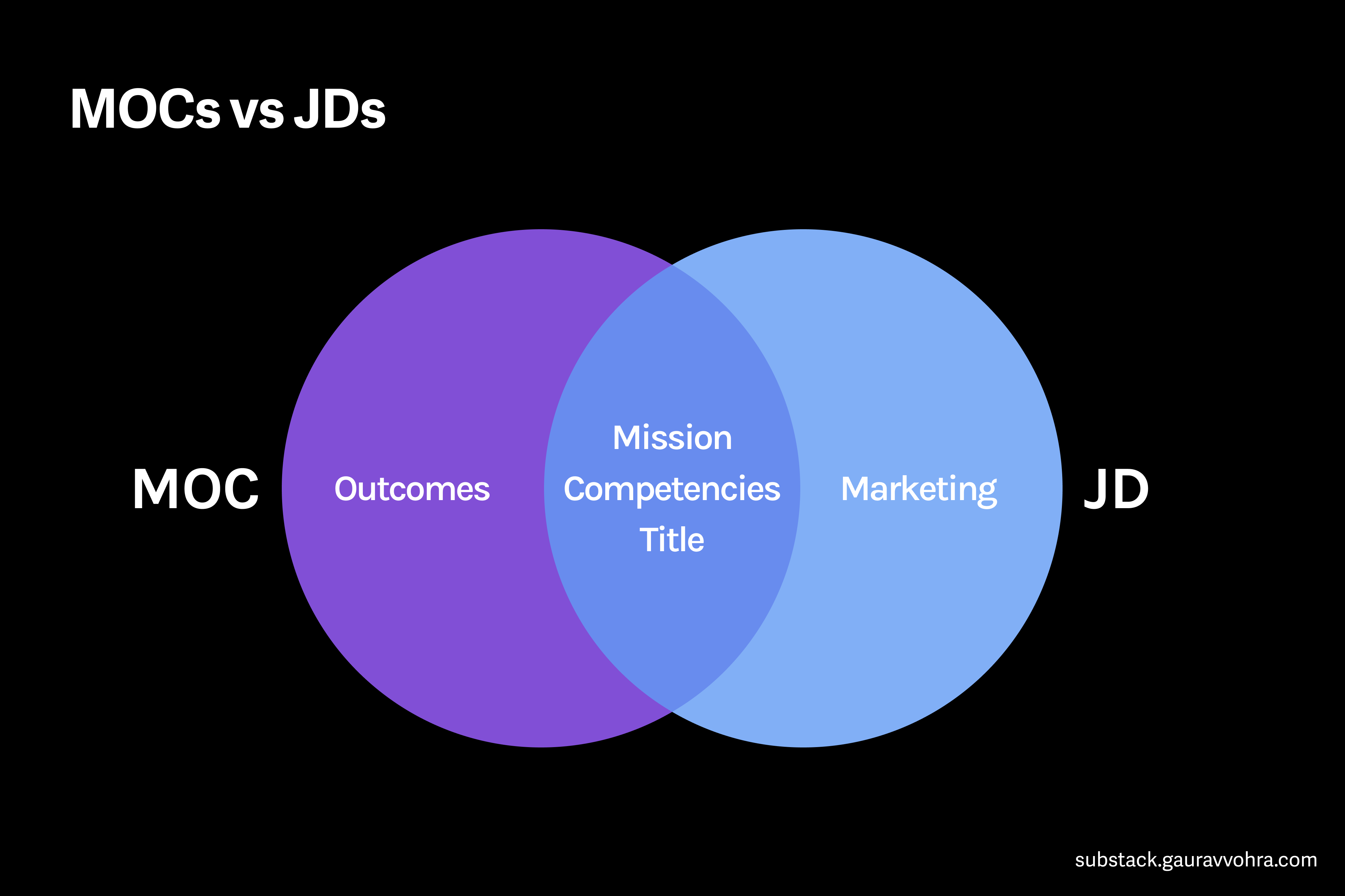
Why aren’t MOCs identical to JDs?
Companies are understandably squeamish about revealing business outcomes in public JDs.
So most JDs are understandably vague on what the person actually needs to do1.
Flow
The correct sequence:
-
Identify important business gap or opportunity
-
Figure out if someone on the team can handle it
-
If no, write a MOC that scopes out a role’s title, mission, outcomes, competencies
-
Use the MOC to create a JD
-
Hire the person
-
Give them their MOC during the hiring process or on day one2
Don’t build your entire team “people first”.
Start with what you need to get done.
I think this is a key reason that “people first” hiring is so persistent. Many hiring managers kick off roles by reading and copying similar JDs from other companies. These hiring managers tend to miss that these JDs don’t define actual business outcomes. In turn, they forget to include outcomes, and so the cycle persists.
The litmus test for your MOC is whether you feel good giving it to your new hire to inform their onboarding plan and hold them accountable.