
Back to school week over here. Three kids. New teachers, new schedules, a calendar that went from summer-empty to FULL in about four days. The lunchbox Notion board is back in rotation (IYKYK).
And I love it. Back to school is my New Year’s. Always has been. The anticipation, the fresh start, the new goals, the hope that THIS is the year we do things better. I get more resolution energy in a September than in any January (January me is mostly tired and cold).
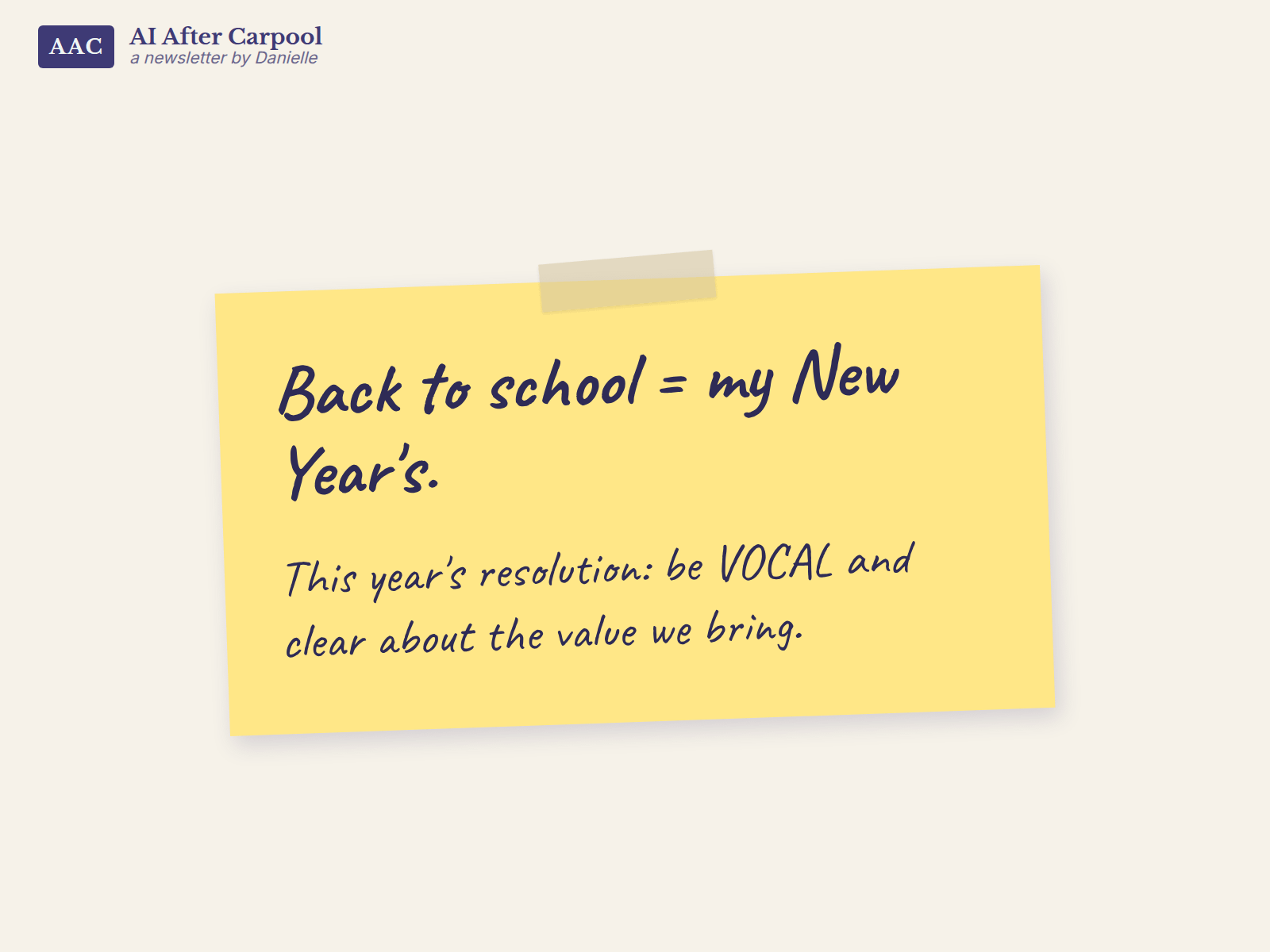
So I made one. This year’s resolution: be vocal and clear about the value we bring. At work. With clients. Out loud.
Which brings me to the playbook.
The Playbook My Boss Gave Me
I got lucky. I was on a tech leadership team for years, and I had a boss who handed me a playbook that made me seen.
It looked like homework at first. It was annoying to be honest. Every Friday, my team sent me and my boss a short list of what they got done that week. Every month, I sent his boss a deck with everything we’d done, then set up a call to walk through what was going well and what wasn’t. I didn’t love it (understatement). It felt like extra work. So much time editing the deck, prepping for the call.
But that homework is the reason my work got talked about in rooms I wasn’t in. Biggest unlock of my career. And I didn’t even choose it, someone made me do it. Best homework I ever got.
People call this “managing up,” which sounds fancier than it is. Managing up just means making sure the people above you know what you’re doing. That’s it. Your boss. Your boss’s boss. The client who pays you. They’re all “up.”
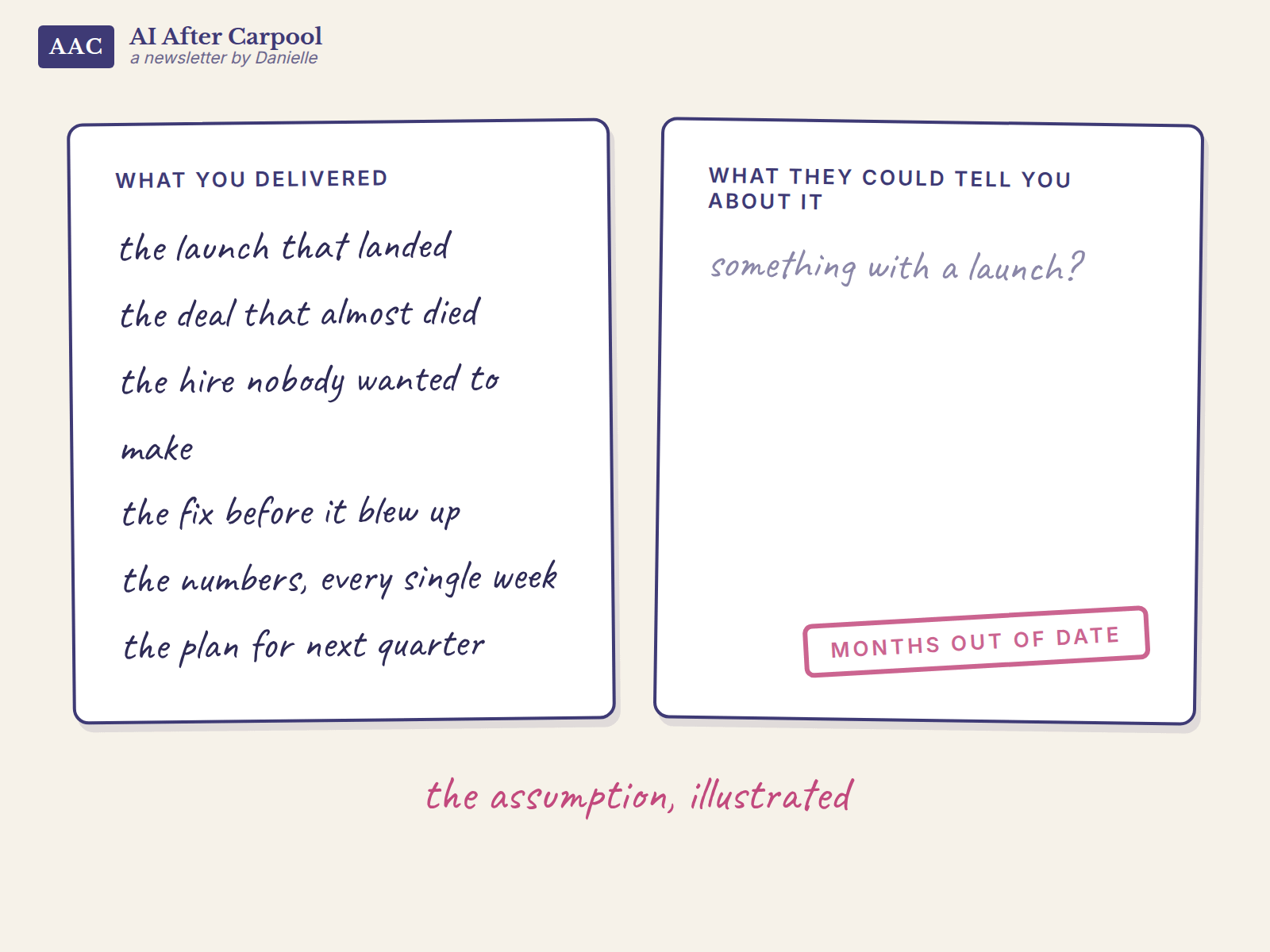
Most people never get taught this. So they just assume: I did the work, so people know.
They don’t. Your boss doesn’t. Your boss’s boss doesn’t. The other teams don’t. Your clients don’t. NOBODY is keeping track of your work for you. Not because they don’t care, because they’re busy with their own. The version of you in their head is months old. And that old version is the one in the room when they decide who gets promoted, who gets the budget, and which contracts get renewed. All the rooms you’re not in.
So this is me sharing said playbook forward. Consider it a back to school gift.
This is one piece of what I write at AI After Carpool – every week, for ambitious parents building careers, households, and things of their own. Calm, specific, useful. If you want more like this, subscribe at AI After Carpool. Either way, this guide is yours to keep.
What Most People Do Instead
I’ve watched a lot of smart people try to fix. I have done it before too, until I had a boss who showed me another way. The idea was head down, work harder. Be the one who always says yes and stays late. That was especially me when I worked in deal advisory.
And unfortunately, just working harder doesn’t cut it. Reviews happen months after the work, and by then the story of your year was already written, by other people, in rooms you weren’t in. And showing off reads as showing off, you know it when you see it and so does everyone else. And you kinda hate that person who shows off. So most people pick heads-down, feel weird about the other thing, and stay unseen. No bueno. (That was me on the other thing, by the way. It felt like bragging to me for YEARS.)
My old boss had a third way: a rhythm. A few short notes, sent to the right people at the right time, on REPEAT.
That’s the playbook. And AI now does most of the writing part, which turns each move into a 15 minute thing instead of a Sunday project.
The Five Moves
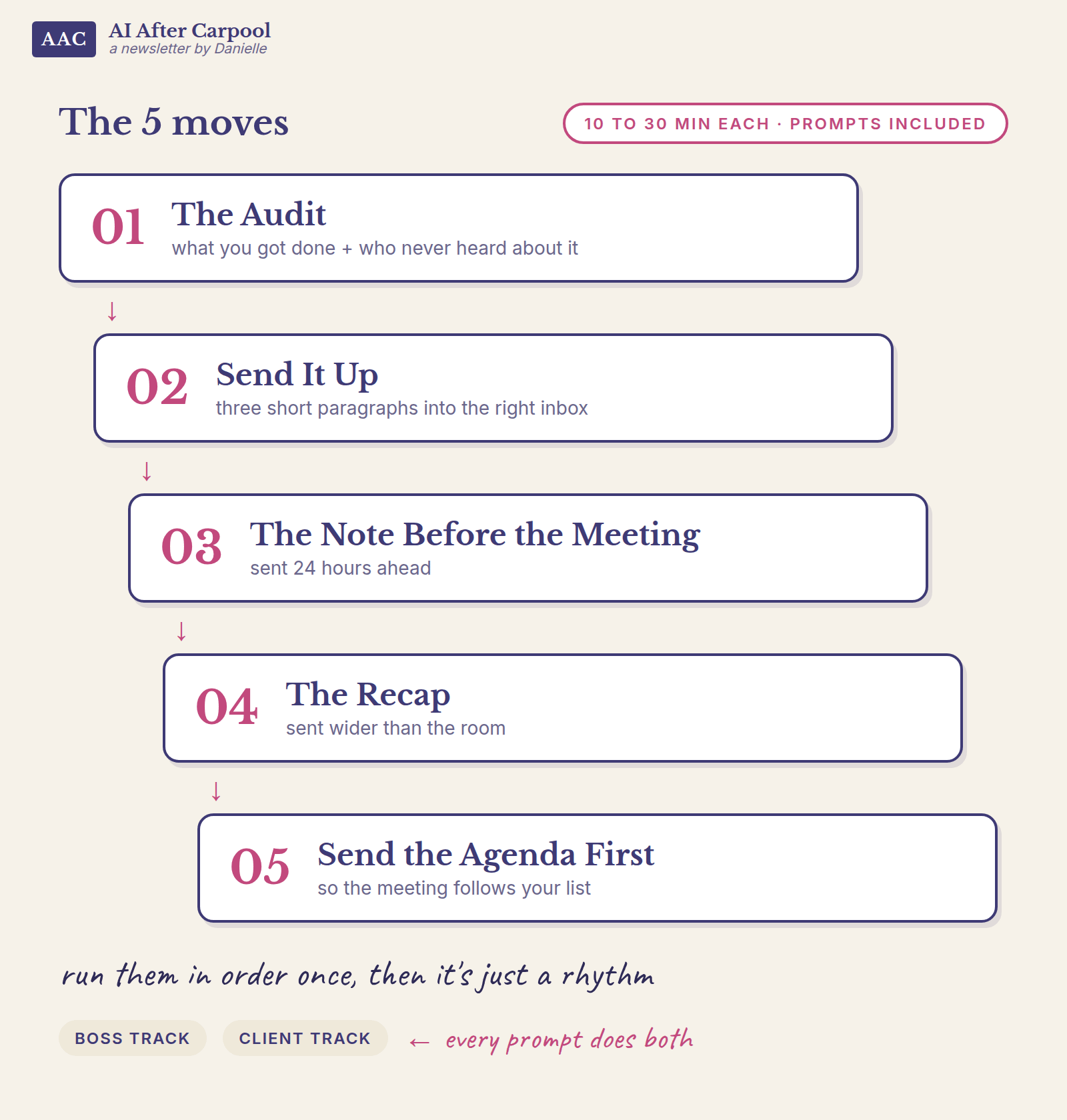
Five moves, not a course. Because we don’t have time for a course right now. Each one is one thing you send, 10 to 30 minutes, with a prompt you paste straight into ChatGPT, Claude, Copilot or Gemini.
No new tools. Do them in order the first time, because each move uses the one before it. And it keeps remembering what worked each time, it keeps building on itself.
Every prompt comes in TWO versions. One for when you have a boss. One for when your “boss” is a client, because you went out on your own, or you’re juggling a few things instead of one job, and the person you answer to changes by the day (that’s me right now – still applies – I see you portfolio career folks wondering how do i do this?)
Listen, the client version is new for me. I had the playbook when I had a boss. Then I went out on my own, and the rhythm didn’t stick.
Nobody is making me send the Friday update anymore, so guess what, I stopped (guilty). My clients see me on our calls, and the work between the calls, where most of the value lives? Invisible by default. So I built this guide as much for me as for you, and I’m starting the client track now. TBD how it comes out.
Let’s go.
Move 01: The Audit
Goal: Figure out what you actually got done, and who never heard about it.
Time: 15 minutes.
You can’t fix this on vibes. The audit goes first because every other move uses what it finds. Okay so: five questions. And question 5 is the one that stings.
Open ChatGPT, Claude, Copilot or Gemini. Paste this in:
I’m a [senior leader / fractional or independent operator] doing a quarterly audit of what I delivered and who knows about it. I’m going to answer 5 questions and I want you to push back if my answers are vague, generic, or missing the call I made. After my answers, summarize my top 3 accomplishments for the quarter in 1 sentence each, focused on the call I made and what changed because of it, not just what got done.

1. What are the 3 biggest things I or my team got done this quarter? Names, numbers, outcomes.
2. For each one, what was the call I made that other people would have gotten wrong?
3. What did each of those things make possible that wasn’t possible before?
4. Who already knows about each of these? List names and titles.
5. Who should know but currently doesn’t? [Boss version: your boss’s boss, peers, senior leaders who care about this work, the other teams your work touches. / Client version: the client’s CEO, the person who decides whether to renew, people who send you referrals.] List names and titles.
Pick three. If you can’t pick three, the audit just told you something useful. Helpful, slightly rude.
What I wish I’d done sooner: When I was on the leadership team, every Friday my team sent me and my boss a list of what they’d accomplished. The audit is the solo version of that habit. The gap between question 4 and question 5 is your to-do list.
Move 02: Send It Up
Goal: Put three short paragraphs about your best work into the right inbox.
Time: 15 minutes.
Boss track: this goes to your boss’s boss. Client track: this goes to your client’s CEO, or whoever decides to keep working with you (guilty of skipping this one myself, see above). Because clients assume too. They see you on the calls. They do NOT see the work between them.
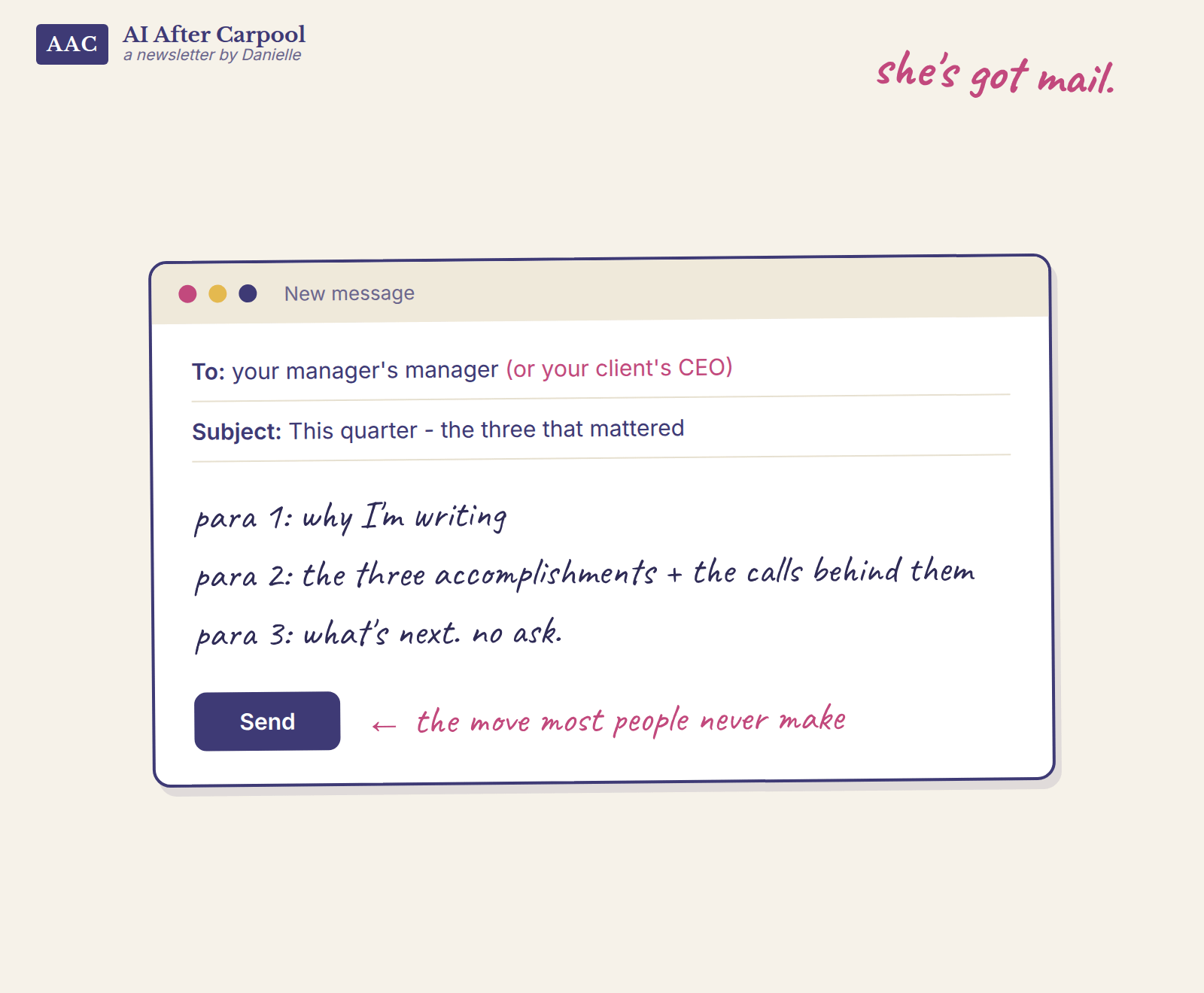
I want to send a [Version A: short warm email / Version B: tight substantive email] to [my boss’s boss / my client’s CEO or the person who decides whether to renew] about what I or my team got done this quarter. Tone: [A: friendly and informational, not asking for anything / B: calm and confident, focused on the calls I made and what changed because of them].

The 3 accomplishments: [paste your audit summary]. Recipient: [name and role]. Recent context: [recent meeting, project, or “none”].

Draft 3 paragraphs. Para 1: [A: warm context, why I’m writing / B: 1 sentence on what the quarter was about]. Para 2: the 3 accomplishments framed around the calls made and what changed, not a list of tasks. Para 3: what’s next, no ask. Sign off natural and confident, not soft.
Read said email out loud before sending. If it sounds like a press release, rewrite the lines that sound like showing off until they sound like you talking.
What I wish I’d done sooner: Send it. The number of people I’ve watched draft a perfectly good email like this and never hit send is the reason this guide exists. (The number of people being me).
Move 03: The Note Before the Meeting
Goal: Shape one meeting before it happens.
Time: 15 to 20 minutes, sent 24 hours ahead.
Pick one meeting in the next 7 days that actually matters. Not a standup. EVER.
Boss track: a meeting you run, or one you don’t run but care about (send the note to whoever runs it, and copy your boss or the right leader).
Client track: your next client call, monthly review, or a pitch. If you already send these, props to you, skip ahead.
I’m sending a short note 24 hours before a meeting. Help me draft it.

Scenario: [A: I run the meeting / B: I don’t run it but want something covered / C: it’s a client call I’m leading].

Context:
- Meeting topic: [what it’s about]
- Who’s in the room: [names and titles]
- What I need: [a decision on X / agreement on Y / a recommendation agreed on Z]
- Anything sent ahead: [deck, memo, analysis, or “none”]

Draft a 4-6 sentence note that: says the goal in one clear sentence, points to anything sent ahead and what to focus on, says where I think we should land if it’s a recommendation, and closes with what I need from them in the meeting. Calm, direct, confident. Not soft, not chest-beating.
What I wish I’d done sooner: Stopped waiting for permission to shape meetings I didn’t run. That move felt “pushy” to me for YEARS, until I realized everyone else was doing it. It isn’t rude, it’s the job.
Move 04: The Recap
Goal: Send one recap after a meeting that mattered.
Time: 10 to 15 minutes, same day. Or next morning if it was a late one, because sleep.
The easiest move in the whole set, and the one other teams will know you by. You were there. You know what got decided. And whoever writes the recap writes the version of the meeting everyone remembers.
Don’t start from a blank page. Three options: paste the transcript from an AI note-taker (Otter, Fireflies, Granola, Fathom, Teams or Zoom transcription), talk it through with a microphone or Wispr Flow (this is my FAVORITE tool), or just your memory, talked out. It is so cool what a transcript remembers that you don’t.
I’m drafting a recap to send after a meeting. Help me shape this.

Situation: [A: I ran the meeting or presented / B: I’m the person from another team who owns what happens next / C: it was a client working session and I own the follow-through].

Meeting context (transcript, notes, or talked-through): [paste or dictate]

Pick the right shape:
- If decisions got made: lead with the decisions, then who owns what, then the dates.
- If it was a big-picture discussion: lead with where we landed, then decisions, then the risks I flagged.
- If the goal was getting everyone on the same page: lead with what we discussed, where we landed, what’s next.

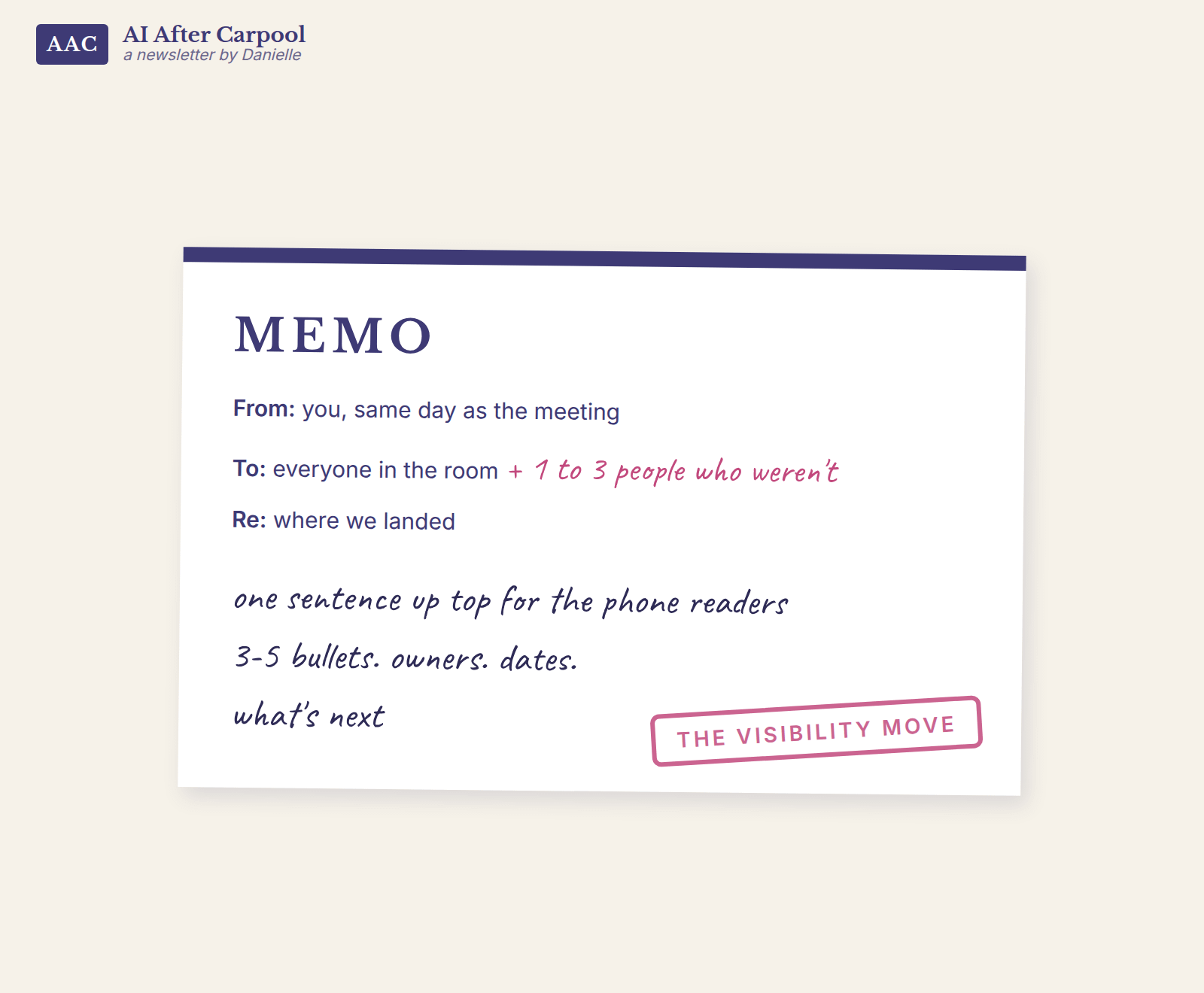
Format: one-sentence summary at the top so a busy person reading on their phone gets it in 5 seconds. Then 3-5 bullets. Close with what’s next and anything still open. Calm and neutral, not chest-beating, not corporate-speak. Push back if anything sounds vague.
Now the part that matters most: send it to everyone in the meeting PLUS 1 to 3 people who weren’t there but should know. Boss track, that’s how other teams find out what you’re driving. Client track, that’s how the client’s CEO sees the work between the calls, so when it’s time to renew, nobody has to wonder what you did all year. Three to seven people max.
Skip recaps for status meetings, recurring 1:1s, and anything where the to-dos don’t involve other people. Nobody needs that email. (Some weeks nobody needs ANY email, honestly. Pick the meetings that mattered.)
What I wish I’d done sooner: If you skip the recap, somebody else writes the version of the meeting that gets remembered, and it won’t be yours.
Move 05: Send the Agenda First
Goal: Send a short agenda before your next 1:1 or client check-in.
Time: 10 minutes the day before. Then every week.
Most 1:1s get taken over by whatever’s loudest that day. Also client check-ins. Same problem. The fix: you send a short list 12 to 24 hours before, so the meeting follows your list instead of the noise. And watching a meeting follow YOUR list? HOW FUN.
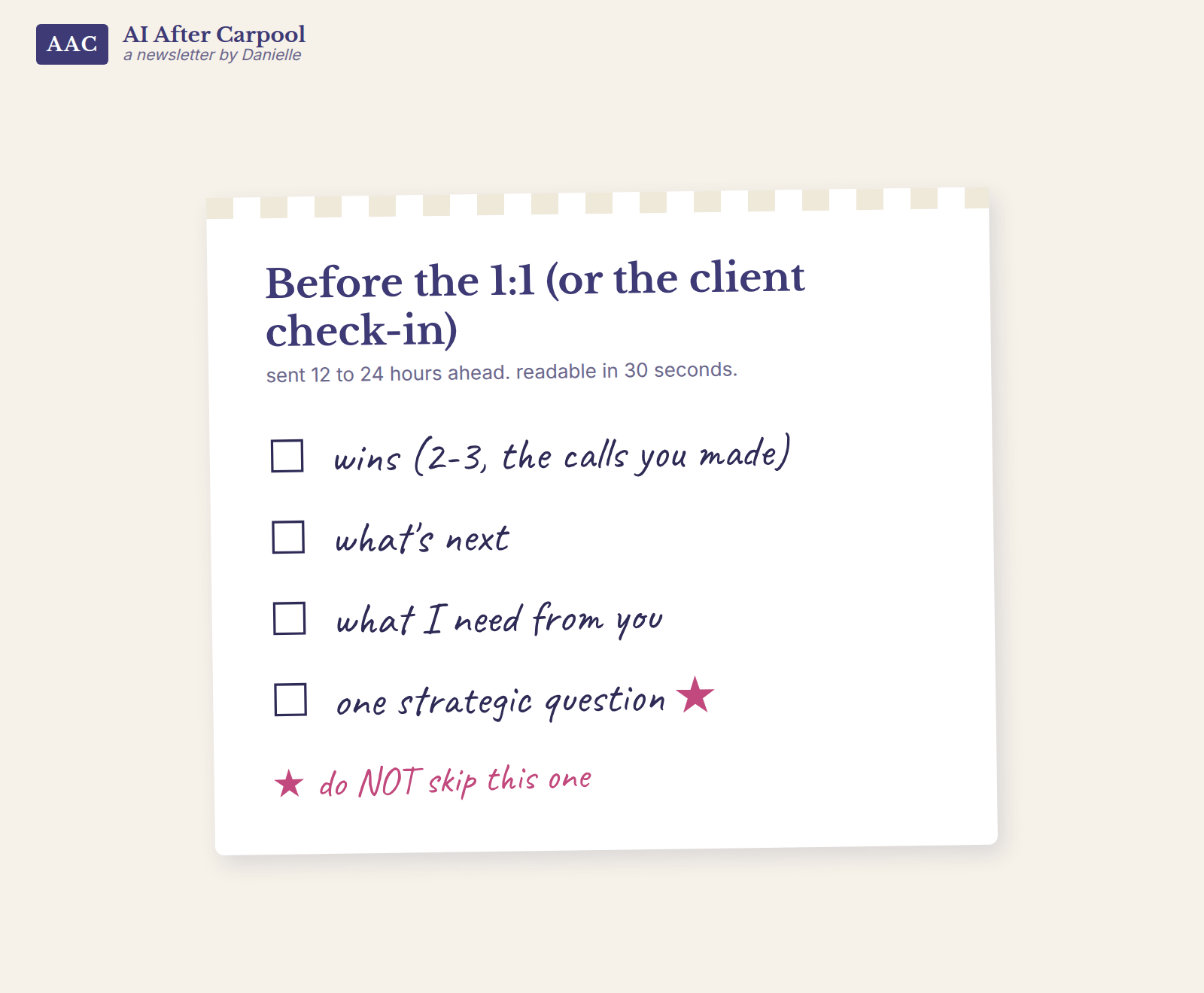
I’m drafting a short agenda to send [my boss / my client] 12-24 hours before our [1:1 / check-in].

What I want to cover (talked through or pasted): [dictate or paste]

Draft an agenda with four sections:
1. Wins from this week (2-3, the calls I made and what changed because of them)
2. What I’m working on next (where I might need input)
3. What I need from you (specific asks, skip if none)
4. One strategic question (bigger than this week’s work)

Readable in 30 seconds. Bullets, not paragraphs. Calm and confident, not chest-beating, not soft. Push back if anything sounds vague.
What I wish I’d done sooner: Never skip the strategic question. Wins-and-problems makes you look like a manager. A strategic question makes you look like someone who belongs in the next bigger room. Same with a client: a list of updates makes you look like a vendor, a strategic question makes you look like a partner.
You Have the Playbook Now
The audit at the start of the quarter. The email up. The note before the meeting. The recap after. The agenda the day before. Do it once in order. And then it mostly runs itself, in the cracks of a normal week.
You did real work this year. Hard calls, things that didn’t blow up because you were the one running them. Point is, the work was never the problem. The telling was. And telling is a system you can run, and now it’s YOURS.
You don’t have to become someone you’re not. You don’t have to be louder, more political, or more “personal brand.” You just have to send the email.
Save this. Share it with someone who did great work this year and needs the right people to see it. You probably know exactly who that is.
Go run the playbook.
I’ll see you after carpool.
Danielle
Thanks for reading AI After Carpool! This post is public so feel free to share it.