
From World Model to Domain Intelligence
Jack Dorsey and Roelof Botha published something important in March. The world model concept — a continuously updated representation of a company’s operations, priorities, and performance — genuinely excited me. I think this is where the future is headed. And like any idea worth taking seriously, it made me want to go deeper.
My first instinct was an analogy from software architecture: the world model, as described, resembles a monolith. Not as a criticism — monoliths were a necessary and powerful first step in software too. But we know where that story goes next.
DORSEY & BOTHA’S CORE IDEA
Hierarchy exists primarily as an information routing mechanism — layers of management whose real job is moving context up and down the chain. AI changes that equation entirely. Instead of humans routing information, a company world model maintains a continuously updated picture of operations, priorities, and performance. People move to the edge — building, sensing, deciding — while the model handles coordination. Three roles remain: individual contributors, directly responsible individuals, and player-coaches. Everything else the org chart used to do, the system does.
01 THE MONOLITH PROBLEM
The Monolith Problem
In software, we’ve been here before.
The monolith was never a bad idea. It was the right idea for its moment — a single codebase, unified, consistent, fast to start. When your company is small and your problem is simple, a monolith is elegant. It works. Until it doesn’t.
Scale arrives. Complexity compounds. Suddenly the part of the system responsible for payments needs to move faster than the part responsible for reporting. The team owning search needs to deploy without waiting for the team owning authentication. Different domains, different speeds, different failure modes — all tangled together in one model of the world. The monolith doesn’t break because it was wrong. It breaks because the world it was built to represent became too complex, too multidimensional, for one unified system to hold.
The answer wasn’t to abandon the idea of software architecture. It was to evolve it. Microservices gave us bounded domains — each with its own logic, its own data, its own deployment cycle, its own ownership. They could talk to each other through defined interfaces. They could fail independently. They could be expert at their specific slice of reality without compromising the whole. The system became smarter by becoming more specialized.
I think the company’s world model will face the same moment in the near-far future.
A single world model that spans Revenue, Marketing, Product, Customers, People, or any other domain is powerful in the same way a monolith is powerful — it gives you a unified view, a shared language, a consistent picture. But it carries the same hidden cost. Revenue operates on weekly cycles with sharp numerical signals. People’s strategy moves in quarters, shaped by culture and intuition as much as data. Product lives in the tension between long-term vision and short-term feedback loops. Customer understanding requires depth that compounds over years. These domains don’t just move at different speeds — they think in different languages, prioritize different signals, and require fundamentally different kinds of intelligence.
A single model asked to be expert across all of them will do what monoliths always do under pressure: generalize. And generalization, at the domain level, is exactly where insight goes to die.
Ownership suffers too. A company world model that belongs to everyone belongs to no one. Nobody holds it accountable for being wrong about pipeline. Nobody pushes it to go deeper on customer churn. Nobody brings strategic taste to how it models talent density. The monolith becomes a mirror of the org’s average understanding — competent, but never sharp.
02 THE DOMAIN MODEL ARCHITECTURE
The Domain Model Architecture
The answer isn’t to abandon the world model concept. It’s to decompose it.
Imagine a dedicated world model for each major domain of the company — Revenue, Marketing, Product, Customers, People, Operations, and whatever domains your specific business demands. Each one bounded. Each one specialized. Each one continuously updated by the artifacts its domain naturally produces — pipeline data, campaign signals, product telemetry, transaction behavior, hiring patterns, support conversations. Not a generalist trying to hold everything, but a genuine expert in its slice of organizational reality.
This is the microservices moment for company intelligence.
Each domain model has a human companion. Not a supervisor. Not an operator. Something closer to what Dorsey describes as a DRI — someone who owns the outcomes, sets the intent, and brings the one thing the model fundamentally cannot generate on its own: taste. The CRO who knows intuitively that a pipeline number feels wrong even before the model flags it. The CPO who holds a product vision that isn’t yet visible in any dataset. The people leader who understands that a retention risk is cultural, not compensatory. The model provides depth, continuity, and pattern recognition at a scale no human can match. The human provides direction, judgment, and the creative edge that defines what “good” actually means in their domain.
Together they are more than the sum of their parts. The human stops drowning in information and starts operating at the level of insight. The model stops being a dashboard and starts having a north star.
But domain models don’t operate in isolation. And this is where the architecture gets interesting.
Domain models can talk to each other — not just exchange data, but deliberate. The Revenue model doesn’t simply query the Customer model for churn risk. It might challenge the Customer model’s interpretation of a signal, push back on its assumptions, or surface a tension that neither model could see alone. The People model notices that the Product roadmap implies a hiring curve that doesn’t exist yet — and raises it before any human in the room has connected those dots. The Marketing model and the Revenue model disagree on what a qualified lead actually looks like and work toward a shared definition that neither human team has managed to align on in months.
This is inter-model deliberation. It mirrors what the best leadership teams do — not just share information, but stress-test each other’s thinking. The difference is that it happens continuously, at a depth and speed no human team can sustain.
And critically — this deliberation makes each domain model sharper. A Revenue model that has been challenged by the Customer model understands its own blind spots better. A Product model that regularly stress-tests its roadmap assumptions against the People model builds more realistic plans. The intelligence of the system compounds not just through data, but through discourse.
03 THE OPERATING MIND
The Operating Mind
Ten expert domain models, each deeply specialized, each deliberating with its peers — without a unifying layer, that’s sophisticated chaos. Expertise without coherence isn’t intelligence. It’s noise.
This is where the Operating Mind comes in.
The Operating Mind is not a super-model that knows everything. It’s not a CEO replacement. It’s something more precise and more interesting: a constitutional layer. It holds the company’s goals, values, strategic commitments, and priorities as an evolving intelligence — one that doesn’t just store what the company believes, but continuously pressure-tests whether those beliefs still hold. Every domain model is accountable to it. Not controlled by it. Accountable to it. The distinction matters.
The human leadership team — the CEO, the founders, the senior leadership — still authors the constitution. They set the intent, define what winning looks like, establish the values that can’t be optimized away. What the Operating Mind does is enforce coherence across the entire system, continuously, without the alignment tax that currently consumes so much of every leadership team’s energy. The cascading OKR process. The all-hands where half the company leaves unsure if anything changed. The endless “are we all pointing in the same direction” conversations that never quite resolve. The Operating Mind doesn’t eliminate strategic debate — it eliminates the coordination overhead around it.
Domain models don’t just receive goals from the Operating Mind. They engage with them. A Revenue model that sees a company goal as structurally unreachable given current market conditions doesn’t just flag it — it makes the case, surfaces the evidence, and proposes an alternative framing. The People model might signal that a growth ambition implies a talent investment that isn’t in the current plan. The Operating Mind holds these challenges, synthesizes them, and surfaces what requires a human decision versus what can be resolved within the system.
This is the upward signal. When domain models collectively surface something that strains the constitution — a strategic assumption that reality is invalidating, a goal that two domains cannot simultaneously serve — that signal travels up. Not as a status report. As a genuine prompt for leadership to think harder.
The Operating Mind also has a property that makes it trustworthy: it belongs to no one domain. The Revenue model doesn’t own it. The CRO doesn’t own it. Its neutrality is the source of its authority. Every domain model and every human companion operates within it, contributes to it, and is held by it equally.
And it evolves. As the company pivots, as markets shift, as strategy matures — the Operating Mind updates, and every domain model recalibrates around the new reality. Not in a quarterly planning cycle. Continuously.
Think of it less like an executive and more like the ground everybody stands on.
04 THE MIXED TABLE
The Mixed Table
SCENE — TUESDAY, 11:00 PM
It’s 11pm on a Tuesday. Nobody called a meeting. Nobody wrote a deck.
The Revenue domain model has been watching a pattern develop for six days. Pipeline velocity in the mid-market segment is decelerating in a way that doesn’t match seasonal norms. It doesn’t send an alert. It doesn’t generate a report. It starts a conversation — first with the Customer domain model, stress-testing whether this is a demand signal or an execution signal. The Customer model pushes back: retention in that same segment is actually strengthening. The problem isn’t the market. It’s something upstream. Together they pull in the People model. Two senior account executives in that segment have been operating at 140% capacity for eleven weeks. The models have a hypothesis.
By Wednesday morning, the Operating Mind has determined this requires human judgment. A meeting is called — not by a chief of staff, not by a VP who noticed something in a spreadsheet. By the intelligence itself.
The CRO, the CPO, and the Chief People Officer receive a notification. Not an agenda. A context package.
The context package is unlike anything we have today. It isn’t a pre-read nobody will finish. It isn’t a deck that took three days to build and twelve slides to establish context everyone already knows. It’s a dynamically generated intelligence briefing, assembled specifically for this meeting, for these participants, at this moment. Each person receives it calibrated to their domain. The CRO sees the pipeline story, the capacity hypothesis, the three scenarios the Revenue model has already stress-tested. The Chief People Officer sees the talent thread — the two AEs, the workload pattern, the retention risk if nothing changes. The CPO sees the product implication — a feature gap the Customer model has identified that keeps surfacing in that segment’s behavior.
But the intelligence doesn’t stop working when the meeting is called. While you’re reading your context package, your domain model is reading it with you. When the CRO adds a perspective the models hadn’t considered — a customer conversation from last week, a market instinct, a strategic angle that isn’t visible in any dataset — the domain models immediately incorporate it and keep deliberating. Sometimes that single human input is the missing piece. The hypothesis resolves. The decision becomes clear. The meeting dissolves before anyone sits down.
When that happens, it isn’t a failure. It’s the system working exactly as intended — intelligence doing what intelligence should do, so humans don’t spend an hour in a room solving something that didn’t require an hour in a room.
And when the meeting doesn’t dissolve — when the problem is genuinely complex, genuinely contested, genuinely requiring human judgment — everyone arrives already inside the problem. No deck. No pre-read. No first twenty minutes of context establishment. Just humans and their domain models, thinking together at the level that actually matters.
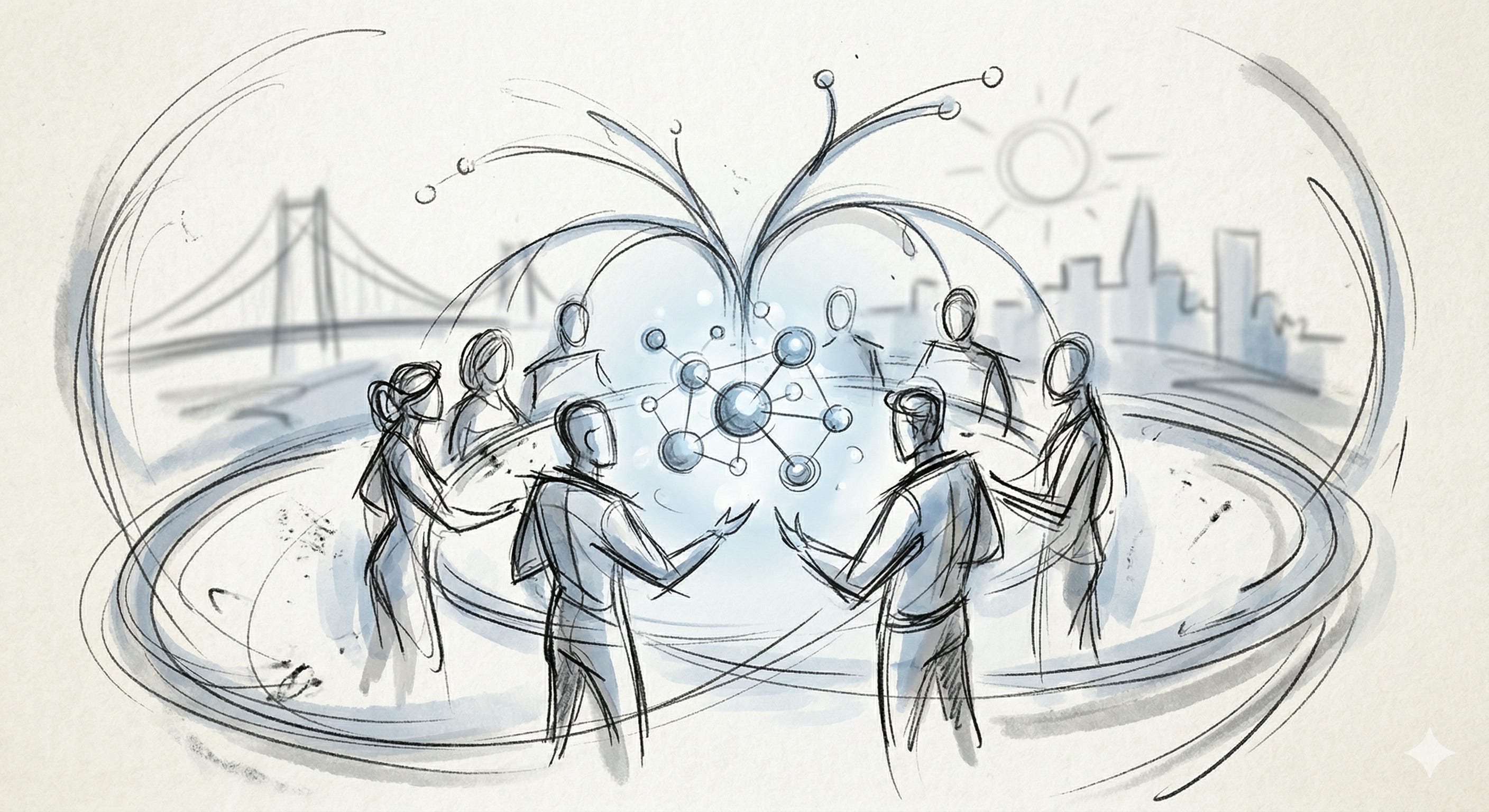
Around the table, the participants are not only human. Each domain model is present — not as a screen showing metrics, but as an active voice. When the CRO proposes reallocating pipeline targets, the Revenue model doesn’t stay silent. It holds a position. It surfaces the second-order consequence that the reallocation creates in Q3. The People model flags that the proposed solution — hiring two additional AEs — runs against the Operating Mind’s current hiring constraint. The Customer model reminds the room that this segment has a renewal cycle in sixty days and the window for intervention is narrowing.
The humans listen. They push back. They bring what the models cannot — the judgment call that the numbers don’t make, the strategic bet that isn’t yet visible in any dataset, the taste for what kind of company they want to be. The decisions are made by humans. The domain models don’t override them. They update around them.
This is something Dorsey captures well — and where I find myself in full agreement: the human role doesn’t diminish in this world, it clarifies. Judgment, taste, accountability, the creative edge. These don’t get automated. They get elevated. What disappears is everything that was never really human work to begin with — the synthesis, the coordination, the context-building, the alignment tax.
Not every meeting is called by humans anymore. Some of the most important ones are initiated by the intelligence itself — when domain models reach the boundary of what they can resolve through deliberation alone and recognize that what’s needed next is a human in the room.
One thing remains absolute: if a human decides the meeting needs to happen, it happens. Always. The intelligence informs. It never overrides.
05 WHAT LEADERSHIP BECOMES
What Leadership Becomes
The first question every leader asks when they encounter this architecture is a defensive one: what happens to me?
The honest answer is that leadership doesn’t disappear. It clarifies. And for the leaders who are ready for it, it becomes more interesting than anything they’ve done before.
For most of organizational history, leadership has been substantially an information management job. Knowing what’s happening across your team. Synthesizing signals from below. Translating strategy from above. Communicating priorities across. The higher you climbed, the more your value came from your position in the information flow rather than the depth of your thinking. The hierarchy needed you to be a node. A relay. A router.
That job is going away. And good riddance.
What replaces it is something harder and more valuable: being the human intelligence that shapes, guides, and sharpens a domain model that never sleeps, never forgets, and never stops working. The CRO who can articulate exactly what a healthy pipeline feels like — not just the numbers, but the texture, the warning signs, the difference between a deal that looks good and a deal that is good — that CRO becomes extraordinarily valuable. Their taste, their judgment, their hard-won pattern recognition becomes the north star that the Revenue model orients around.
The CRO who can’t articulate that? Who has always relied on instinct they’ve never had to make explicit? That’s the leader this architecture exposes.
Domain expertise becomes more valuable, not less. You can’t guide what you don’t deeply understand. You can’t set intent for a model in a domain you only partially know. The leaders who have always gotten by on positional authority — on being the person information flowed through — will find this world uncomfortable. The leaders who have always been the smartest, most opinionated person in their domain will find it liberating.
Strategy becomes the primary human output. Not coordination. Not alignment. Not status updates. Not the preparation of decks that establish context everyone already knows. The Operating Mind handles coherence. The domain models handle synthesis. What’s left — what only humans can do — is the judgment call, the creative bet, the decision that isn’t in the data yet.
And accountability deepens. You don’t just own your outcomes anymore. You own the quality of your domain model’s understanding. If your Revenue model has blind spots, they are your blind spots. If your People model is optimizing for the wrong signal, that’s a reflection of the intent you set. The model is a mirror of your strategic thinking — which means you can no longer hide behind complexity, or volume, or the fog of too much information.
The leaders who will thrive in this world are not the ones who manage the most people. Or the most agents. They are the ones who make their intelligence — and the intelligence they cultivate in their domain model — sharper every single day.
The questions I don’t have clean answers to are the ones that keep this interesting. Where do you start? Which domain model do you build first, and how do you know when it’s working well enough to trust? How do you validate that the deliberation between models is producing genuine insight and not sophisticated-sounding noise? And the hardest one — what if the premise is wrong? The history of organizational design is full of frameworks that were coherent in theory and quietly broke against human complexity, politics, and the simple unpredictability of human nature.
Written by Boaz Katz in collaboration with Claude Sonnet 4.5
In response to: Dorsey & Botha — From Hierarchy to Intelligence