
It’s Not Too Late to Start Using AI as a Product Manager — James Kemp
Every few weeks, a new AI tool launches.
Every few days, someone posts about their AI-powered workflow on X or LinkedIn.
And if you’re anything like me, there’s this nagging feeling that you should be doing more. Using these tools better. Learning faster.
I use Claude Desktop with AutoMem for the majority of my work as a Product Manager at WooCommerce now. I’ve got integrations with Linear for issue management, GitHub for triage context, Enterpret’s Wisdom for user feedback synthesis. I can execute faster and more effectively than I could previously, when I was manually opening dozens of browser tabs to analyse feedback patterns.
And I still feel like there’s more I could be doing.
If that resonates with you, good. That means you’re paying attention.
But here’s what I want you to understand: that feeling shows you’re aware, not behind. Awareness is the first step to actually using these tools in a way that transforms how you work.
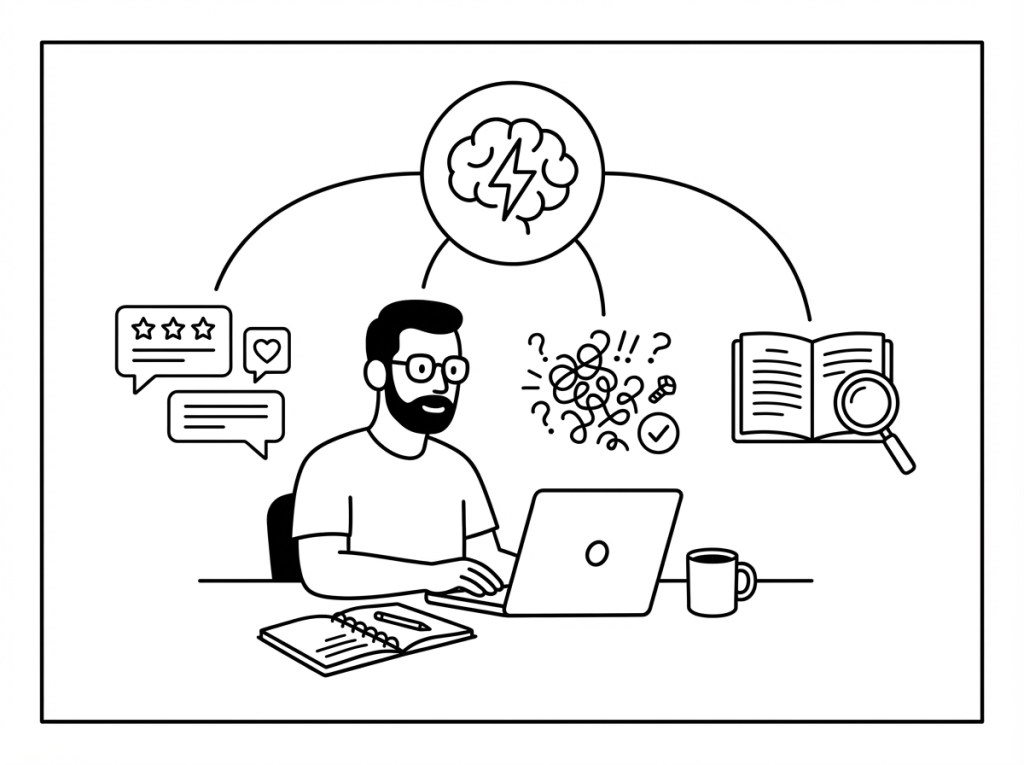
The Pace Is Relentless (And That’s Actually Fine)
Let’s be honest about what’s happening right now.
The AI tools we use as product managers are evolving at a pace we’ve never experienced before. Claude Code, Claude Desktop, Claude Cowork are fundamentally different ways of working.
Back when I ran Iconic, my WooCommerce plugin company (which I sold in 2021), analysing user feedback meant opening dozens of browser tabs. GitHub issues, Reddit threads, support tickets, forum posts. I’d spend entire afternoons copying feedback into spreadsheets, trying to identify patterns that would shape our plugin roadmap. It was necessary work, but exhausting. And I always wondered what patterns I was missing in the noise.
Today, that same analysis takes 30 minutes for an initial pass. I have full context across user feedback from Enterpret’s Wisdom, Linear issues, GitHub repos, and my own knowledge base in a single conversation. I can draft product updates, triage issues, synthesise research, and make faster decisions because the tool has access to everything I need.
The job is fundamentally different now.
And here’s the thing that nobody wants to say out loud: even those of us using these tools every day don’t have it figured out. We’re all learning. We’re all discovering new capabilities. We’re all occasionally wondering if we’re using them “right.”
The people making progress didn’t start with more knowledge. They just started.
Why You Need to Start Now (Even If You Feel Late)
I’m not going to tell you that you’re fine staying where you are.
You’re not.
If you’re a product manager in 2026 and you’re not experimenting with AI tools, you’re choosing to work slower and less effectively than you need to. That’s just the reality.
But here’s the reassuring part: starting today is not late. These tools are still new. Most product managers are still figuring this out. The ones who seem like they have it all sorted are probably just better at posting on X than you are.
I actually started with Claude Code because I wanted the technical depth and command-line power. Then Cowork launched a few months ago and I realised the UI and integrations were better suited for the actual day-to-day work I do as a PM. Easier access to Linear, GitHub, Slack. A cleaner interface for the kind of rapid context-switching product work requires. I switched. I adapted. I’m still adapting.
That’s the mindset shift that matters.
You don’t need to master every tool. You don’t need to have the perfect workflow on day one. You just need to start somewhere and let the limitations you hit guide you forward.
Where to Actually Start
If you’re reading this thinking “okay, fine, I’ll try it,” here’s what I’d suggest.
Start with Claude Cowork.
Not because it’s the most powerful tool. But because it’s the easiest entry point for product managers. The UI is intuitive. You can add integrations with tools like Linear, GitHub, and feedback tools through MCPs. Some come built in, others you can add yourself using documentation from the tool providers. I added Enterpret’s Wisdom MCP myself. You can start using it for real work on day one without needing to learn command-line tools or configure anything complex.
Use it for something small first. Triage five GitHub issues. Draft a product update. Analyse feedback from your last feature launch. If you work on WooCommerce or WordPress, search for patterns in user feedback about a specific feature. Pick something you’d normally do anyway and see what happens when you do it with AI assistance.
You’ll probably hit limitations. That’s good. Those limitations tell you where to go next.
For me, I eventually found that Cowork doesn’t automatically read the CLAUDE.md file or custom skills I’ve set up in my selected folder the way Code does. I have to explicitly tell it to use them. That’s a limitation. Maybe I create a skill in Claude Desktop to automate that process. Maybe I just get used to the extra step. I’m still figuring that out.
Maybe you’ll realise you need deeper code interaction and explore Claude Code. Maybe you’ll discover you need better context management and invest time in setting up a memory system properly. Maybe you’ll find there’s a specific workflow that matters to you and you build a custom skill.
But you can’t know any of that until you start.
The Uncomfortable Truth About “Good Enough”
Here’s what I’m still figuring out.
I use these tools daily. They’ve genuinely changed how I work at WooCommerce. I can triage faster, write better, synthesise user feedback more effectively. I’ve gone from spending afternoons on spreadsheets to getting initial insights in 30 minutes.
And I still feel like I’m not using them to their full potential.
There are features I haven’t explored. Integrations I haven’t set up properly. Workflows I know could be better. Sometimes I’ll see someone else’s setup and think, “I should be doing that.”
That used to bother me. Now I think it’s actually the right mindset.
Because the alternative is thinking you’ve got it all figured out. And the moment you think that, you stop learning. You stop experimenting. You stop discovering new ways to work better.
The goal isn’t to achieve some perfect AI-powered workflow and then coast. The goal is to be someone who continuously adapts their tools and processes to the work that matters.
If you feel behind right now, you’re not. You’re just at the starting line.
And the good news is that the starting line is still in the same place for everyone, because these tools are evolving so fast that nobody’s really “ahead” in any permanent way.
Start with Cowork. Do real work with it. Hit limitations. Adapt. Repeat.
That’s it. That’s the whole strategy.
And if you do that, a year from now you’ll look back and realise you’re not just using AI tools. You’ve fundamentally changed how you work as a product manager.